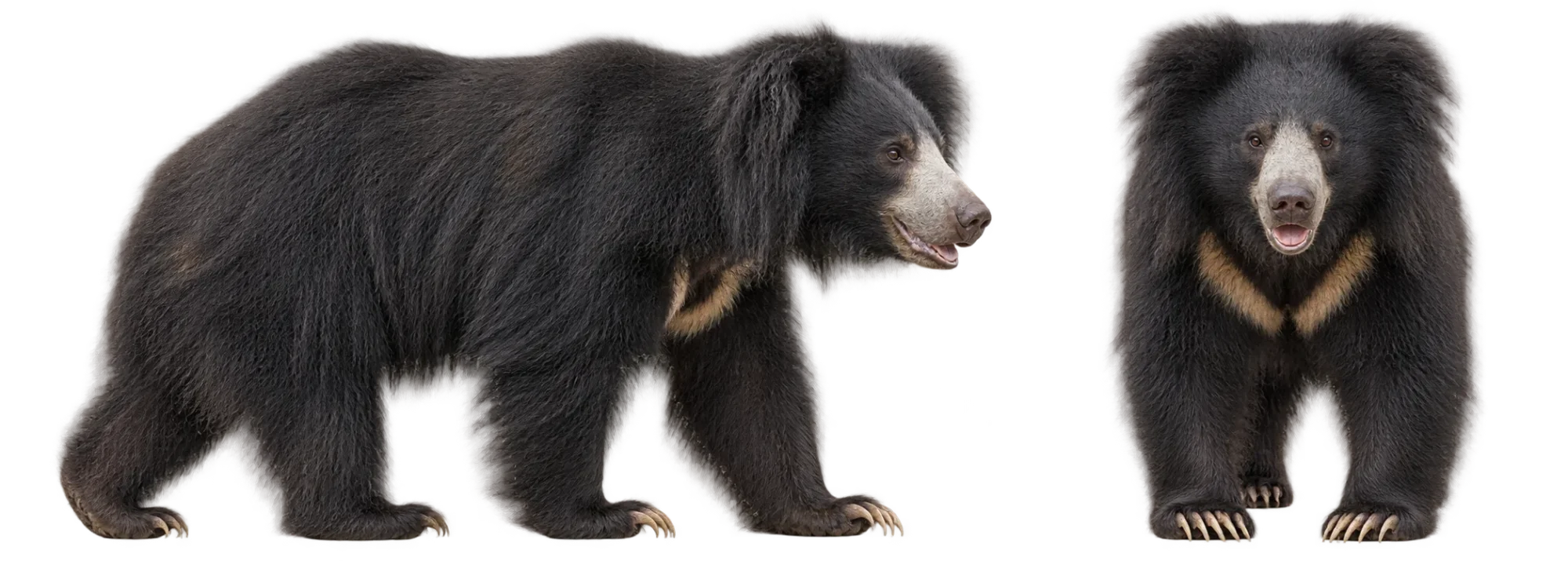
A sloth bear’s reproductive cycle is shaped by delayed implantation, protected denning, and an unusually long period in which cubs remain closely dependent on their mother. In much of India, mating and birth follow a recognizable seasonal pattern, while populations in Sri Lanka show less rigid seasonality.
Breeding Timing Changes Across the Sloth Bear’s Range
For Melursus ursinus in India, mating is concentrated mainly in the hot months, commonly from about May through July. Births then occur several months later, most often from autumn into early winter. Field observations and zoo records do not produce one exact calendar for every population, and reported birth periods can extend from roughly September into January.
Sri Lankan sloth bears show a different pattern. Breeding there appears to be much less seasonal, with mating possible across a broader portion of the year. This geographic difference matters when interpreting a single published “breeding season” for the species: it describes part of the sloth bear population rather than an absolute schedule followed everywhere.
Delayed Implantation Separates Mating From Embryonic Development
Sloth bears have a total gestation period commonly reported at roughly six to seven months, but the embryo is not developing continuously throughout that entire interval. After fertilization, implantation can be delayed before active embryonic development proceeds.
This reproductive mechanism explains why the time between mating and birth is much longer than the period of active embryo growth alone. Smithsonian reproductive information describes embryonic development as lasting about two months even though the full interval associated with pregnancy may span roughly four to seven months.
A reported gestation value for a sloth bear can include the period before implantation. It should not be interpreted as six or seven months of uninterrupted fetal development.
Delayed implantation also occurs in several other bears, including species that hibernate. Sloth bears are useful biologically because they show this reproductive strategy without depending on winter hibernation.
Birth Begins With an Intensive Denning Period
Females give birth in protected sites such as caves, cavities, or excavated dens. Studies of maternal dens in India show that the den is more than a temporary birth site: it provides the setting for the cubs’ first vulnerable weeks while the mother greatly reduces her normal outside activity.
Observations at the Bannerghatta Bear Rescue Centre documented two mothers that remained with newborn cubs for weeks before leaving to feed or drink. One first left after 22 days and another after 28 days. Such observations come from a managed setting and should not be treated as a fixed schedule for every wild female, but they show how concentrated early maternal care can be.
Wild cubs may remain associated with a maternal den for considerably longer before routinely accompanying their mother. Reports commonly place initial emergence at around two to three months, although development and den use vary among individuals and populations.
Cubs Shift From Den Life to Riding on Their Mother
Sloth bear cubs are born poorly developed and initially depend completely on their mother. Their eyes open during the first few weeks, and locomotion develops soon afterward. The most distinctive stage begins after they become mobile enough to leave the den.
Young sloth bears routinely climb onto their mother’s back and hold onto her long fur while she travels. Among living bears, regular maternal back-carrying is a distinctive feature of the sloth bear. Cubs can continue riding for many months, often until roughly six to nine months of age.
Back-riding allows young cubs to move with an adult that may travel over difficult ground while foraging. It also keeps the cubs close to the mother when danger appears. Field accounts have linked the behavior with protection from large predators, including tigers and leopards.
Leaving the den does not mean independence. Cubs continue accompanying their mother long after they can walk and feed outside. Field and institutional accounts generally place separation at around 1.5 to 3 years, with approximately two years being a useful description of the extended dependency period.
Extended Maternal Care Limits How Often Females Produce Litters
The long mother–cub association affects the pace of reproduction. A female caring for dependent young is generally unavailable for another immediate breeding cycle, so litters are often separated by about two to three years.
This relationship is also visible in field observations. Research from southern India found cubs remaining closely associated with mothers for at least a year and separating gradually afterward. More recent den monitoring in eastern Karnataka recorded family groups with cubs ranging from only a few months old to about two years old.
Litter size is small. One or two cubs are most common, while three-cub litters occur less often. Camera-based work in eastern Karnataka identified 37 family groups: 15 had one cub, 19 had two, and three families had three cubs, giving an observed average of 1.68 cubs per family.
This slow replacement pattern comes from the combination of small litters and prolonged maternal investment rather than from gestation length alone. A female may spend far longer raising surviving young than carrying the pregnancy that produced them.
 American black bearUrsus americanus
 Polar bearUrsus maritimus
 Giant pandaAiluropoda melanoleuca
 Brown bearUrsus arctos