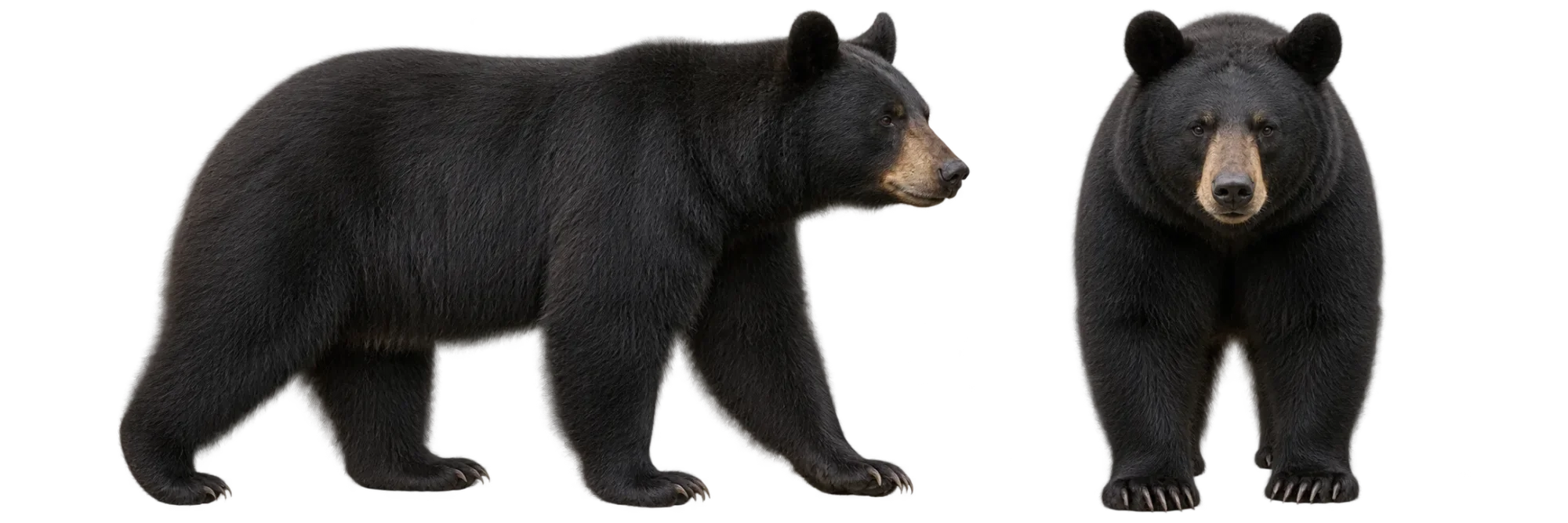
American black bear reproduction is tied closely to the annual denning cycle. Ursus americanus mates during summer, yet fetal development does not proceed continuously from mating to birth. Delayed implantation shifts most development into late fall and early winter, followed by the birth of very small cubs inside the den.
Summer Mating and Delayed Implantation
Breeding usually occurs from late spring through summer, with much of the mating activity concentrated in June and July. After fertilization, the early embryo reaches a blastocyst stage but remains unattached to the uterine wall for several months.
Implantation normally occurs in late fall. Active fetal development then takes place during the relatively short period before the female gives birth in winter. This reproductive pattern is known as delayed implantation.
Why Gestation Length Can Be Misleading
A total gestation figure of roughly 200–220 days includes the delayed period between mating and implantation. Most fetal growth occurs during only the final part of that calendar interval, generally around the last two months before birth.
This timing allows mating to occur when bears are active in summer while placing the most energy-demanding stage of pregnancy much closer to denning and winter birth.
Cubs Are Born During the Winter Denning Period
Births are concentrated in January and February across much of the species’ range. A litter commonly contains two or three cubs, although both smaller and larger litters occur.
Newborn black bears are extremely small compared with their mothers. Typical birth weights are only a few hundred grams. The cubs are poorly developed at birth, with closed eyes and very limited mobility, and depend completely on maternal warmth and milk.
The female supports both herself and her litter largely from body reserves accumulated before denning. Studies of nursing black bears have found that early lactation occurs while the mother is fasting, and her milk is unusually rich in fat. Cubs can therefore grow rapidly inside the den even though the mother is not feeding normally.
The connection between autumn condition and winter reproduction is especially important in this species. Females entering the den in better nutritional condition generally have a better chance of producing and supporting cubs.
Food Supply Changes the Timing and Output of Reproduction
Female black bears do not begin reproducing at exactly the same age in every population. Many produce their first litter at about three to five years old, while first reproduction can occur later where food is less abundant or growing seasons are shorter.
Body condition affects more than the timing of a first litter. Research across black bear populations has linked better nutrition with larger litters, shorter intervals between successful litters, and better survival of young. Years with abundant hard mast such as acorns can therefore influence reproduction beyond the immediate feeding season.
Age also matters. Young females producing their first litter often have fewer cubs than older females. Because food supply, maternal age, climate, and local habitat differ across the black bear’s broad range, a single litter-size or maturity value should not be treated as universal for every population.
Maternal Care Extends Into the Cub’s Second Year
Cubs leave the winter den with their mother in spring and continue to nurse while gradually adding solid foods. Weaning commonly occurs later during their first year, but weaning does not mark immediate independence.
The family normally remains together through the following summer and fall. The young then den with their mother again during the next winter. Separation generally occurs when the yearlings are about 16–18 months old, often near the beginning of the next breeding season.
This long period of maternal care helps explain why successful females commonly produce litters at about two-year intervals. A female raising cubs through their second spring is usually unavailable for another normal breeding cycle during the previous summer.
The interval can change when a litter is lost. If cubs die or disappear early enough, a female may return to reproductive condition and breed again sooner, allowing consecutive-year litters in some cases.
 Giant pandaAiluropoda melanoleuca
 Brown bearUrsus arctos
 Sloth bearMelursus ursinus
 Polar bearUrsus maritimus