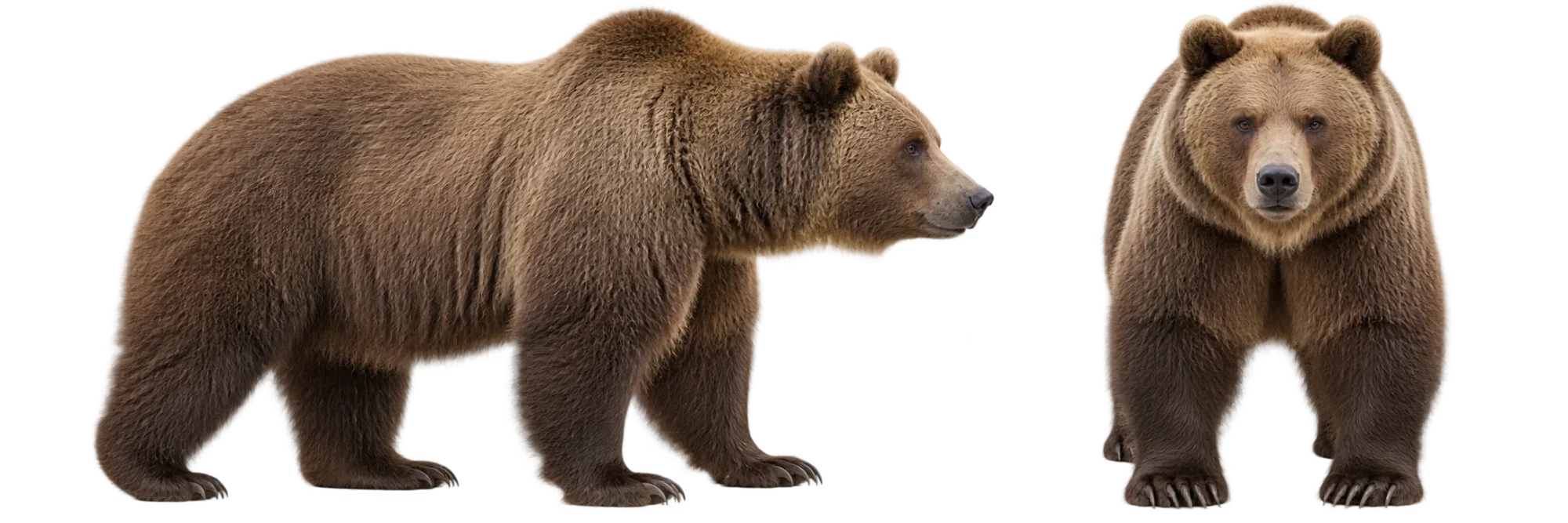
Brown bear reproduction is timed around the winter den. Mating occurs in late spring and early summer, but the embryo remains at an early developmental stage for months before implanting in late autumn. Most fetal growth then takes place over a much shorter period, with cubs born while the mother is denned and living from stored energy.
Delayed Implantation Separates Mating From Active Pregnancy
Brown bears (Ursus arctos) generally mate from May into July. Fertilization can occur during this period, but the embryo does not immediately begin continuous development. It reaches the blastocyst stage and remains unattached in the uterus during a period of delayed implantation, also called embryonic diapause.
Implantation usually occurs near the beginning of winter. A study of free-ranging brown bears estimated a mean implantation date around December 1 and an active gestation period of about 56 days, with births centered in late January. This distinction matters because a value measured from mating to birth includes months when active fetal development has not yet begun.
Birth occurs inside the winter den rather than soon after mating. Recent work using activity data from female grizzly bears, the North American form of Ursus arctos, estimated births from late December through late February across four studied populations. The exact timing varies among females and regions rather than falling on one fixed date.
Cubs Begin Development Inside the Winter Den
Brown bear cubs are extremely small relative to their mothers at birth. Newborns are commonly around several hundred grams and are poorly developed, depending completely on maternal warmth and milk. Litters most often contain one to three cubs, with twins common in many well-studied populations. Litters of four occur but are less usual.
The first weeks of growth take place while the mother remains in the den. She is not replenishing her energy through normal feeding during this period, so fetal development and early lactation ultimately draw on reserves accumulated before denning. The newborns grow rapidly on energy-rich milk before the family leaves the den in spring.
Den emergence is an important developmental transition. Cubs that were tiny at birth must begin moving through a much more demanding environment while still relying heavily on their mother. A 2026 study of four North American grizzly bear populations found that females whose litters were later observed alive had, on average, more time between birth and den exit than females whose litters were not subsequently observed with them. The finding points to the developmental value of time spent growing in the den, although birth timing is only one part of cub survival.
Extended Maternal Care Slows the Reproductive Cycle
Leaving the den does not mark independence. Young brown bears remain with their mother through a long period of growth and learning. In many populations, family groups remain together for roughly two years, while studies have documented both shorter and longer periods.
Research on Scandinavian brown bears illustrates how variable this stage can be. In a 29-year dataset covering 217 litters, maternal care commonly lasted either 1.5 or 2.5 years. The factors associated with the longer period differed between northern and southern study areas, showing that maternal-care duration cannot be reduced to a single species-wide schedule.
This long association also affects how often a female can produce another litter. A mother caring for dependent young normally does not begin another successful reproductive cycle during that period. As a result, intervals of roughly three years between litters are common in studied populations, although shorter and longer intervals occur.
For example, females in the Greater Yellowstone Ecosystem have been reported with an average interbirth interval of about 2.8 years. Broader North American grizzly bear data place averages from roughly 2.8 to 3.4 years in different ecosystems. These are population measurements rather than universal constants for every brown bear.
Age and Local Conditions Change Reproductive Output
Female brown bears often begin reproducing at around five to seven years of age, but first reproduction varies geographically. Some populations show earlier starts, while females living under other ecological conditions may begin later. The same variation appears in litter spacing and the length of maternal care.
First-time mothers may also differ from experienced females. Long-term research in Sweden found that primiparous females produced smaller litters on average and had a higher probability of losing cubs than females that had reproduced before. Females in the southern study area also began reproducing earlier than those in the north.
These differences help explain why one maturity age or one litter interval should not be treated as an exact biological timetable for the entire species. Brown bears occupy environments with very different growing seasons, food availability and denning periods. Female body condition and local ecological conditions can alter when reproduction begins and how frequently young can be raised.
Reproductive life can extend for many years after first maturity. Females in some well-monitored populations continue producing young into their twenties, although reproductive performance declines at advanced ages. In North American grizzly bear populations, reproductive senescence has been reported around the mid- to late twenties in long-lived females.
 Sloth bearMelursus ursinus
 American black bearUrsus americanus
 Giant pandaAiluropoda melanoleuca
 Polar bearUrsus maritimus