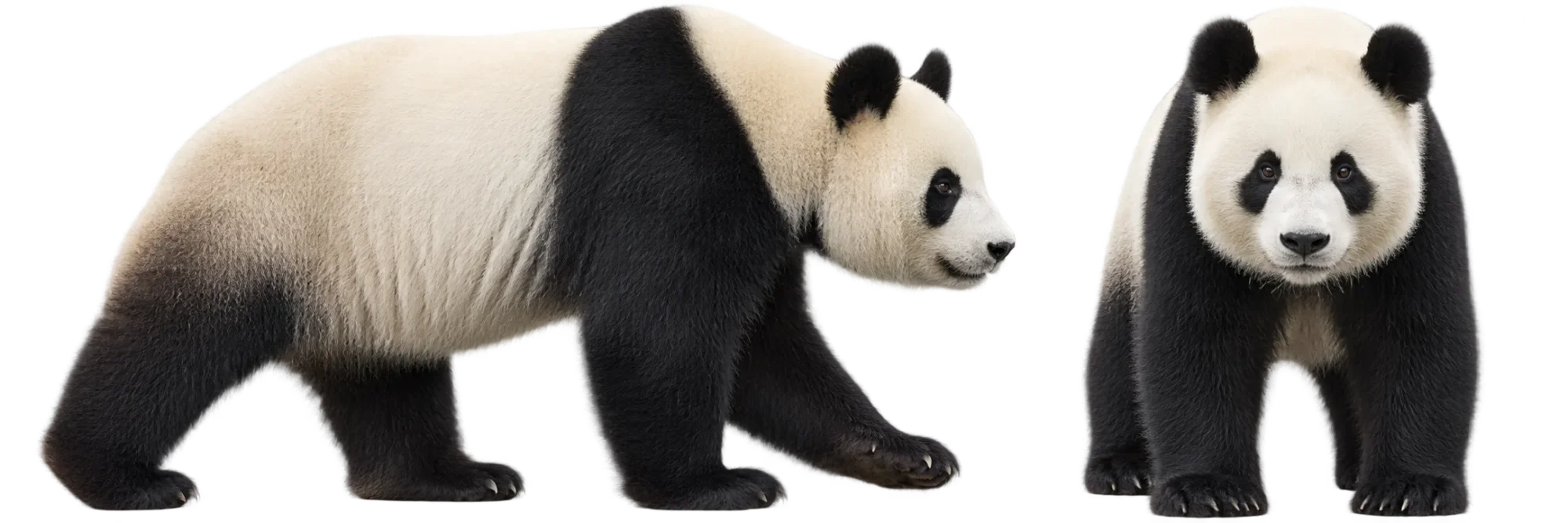
A giant panda’s reproductive life is shaped by a brief annual chance to conceive, an unusually variable interval between mating and birth, and a newborn that requires intensive maternal care. The result is a life-history pattern in which producing a cub and successfully raising one are very different stages of the same reproductive cycle.
One Annual Estrus Creates a Narrow Breeding Window
Female giant pandas generally ovulate only once each year. Breeding activity is concentrated in spring, commonly from March through May, but the period when conception can actually occur is much shorter. A female may be fertile for only about 24 to 72 hours.
This short window helps explain why reproductive timing matters so much in both wild and managed populations. Scent marking, vocalizations and changes in activity help males and females locate one another as ovulation approaches. The broader breeding season may last for weeks, yet successful mating has to coincide with a small part of it.
Raising a cub also occupies far more than the mating season. A wild mother may remain associated with her offspring well into the following year. As a result, successful births cannot simply occur every spring. Under favorable conditions, a female may raise a cub roughly every other year rather than producing surviving young annually.
Delayed Implantation Makes Pregnancy Timing Variable
The interval between mating and birth in giant pandas is commonly around three to six months, but this does not represent continuous fetal growth for the entire period. After fertilization, development can pause before the embryo implants in the uterus. This process is known as delayed implantation, or embryonic diapause.
Because the length of the pre-implantation period varies, two females that mate at similar times can give birth on quite different dates. Once implantation has occurred, the period of active fetal development is much shorter. Estimates from managed pandas place this later developmental phase at roughly 50 days.
Pregnancy Is Difficult to Confirm Early
Hormonal and behavioral changes do not reliably separate a true pregnancy from a pseudopregnancy in giant pandas. A female may build a nest, sleep more, reduce food intake and show similar progesterone patterns without carrying a developing fetus. Detecting a fetus by ultrasound provides much stronger evidence, but fetal development becomes visible relatively late.
This biology is why a quoted panda “gestation length” is better treated as the interval from mating to birth rather than as a measure of continuous fetal development.
Newborn Survival Depends on Near-Constant Maternal Care
A newborn giant panda usually weighs only about 85 to 140 grams. Relative to an adult female weighing many tens of kilograms, the cub is close to one-thousandth of its mother’s mass. It is born blind, with very little fur, limited mobility and poor control of its own body temperature.
During the first weeks, the mother keeps the cub pressed against her body for warmth and protection. Newborn cubs also depend on maternal licking to stimulate urination and defecation. Observations of wild pandas have found mothers keeping very young cubs on their bodies for much of the early denning period.
Early Maternal Investment Can Be Intense
Field observations have recorded mothers remaining in the den and fasting for extended periods after giving birth. As the cub develops better temperature control and becomes less fragile, the mother can spend progressively longer periods away from it.
Twins add another difficulty. Giant pandas can produce two cubs, and twin births occur regularly in managed breeding populations. A mother may be unable to provide the same continuous care to both newborns, however, and in natural conditions usually only one cub survives. Breeding centers can sometimes raise twins by alternating access to the mother and providing additional care, so survival patterns under human care should not be treated as the natural outcome of a twin birth.
Calls Help Maintain Contact
Vocal communication begins when the cub is still almost completely helpless. Research published in 2024 found that newborn giant pandas produce broadband calls extending into ultrasonic frequencies during their first two weeks. Experimental work published in 2025 also found that lactating females respond more strongly to cub-call playback than nonlactating females.
For a newborn that cannot follow its mother, see clearly or regulate its temperature well, these calls provide a way to signal its condition and draw maternal attention.
The Transition From Milk to Independence Takes Many Months
Giant panda cub development extends well beyond the vulnerable newborn stage. The eyes generally open at about six to eight weeks, while purposeful movement develops later. By around three months, a cub is becoming mobile and can explore outside the tight physical contact that dominated its first weeks.
First Weeks
Full Dependence
The cub relies on its mother for warmth, milk, sanitation and protection while its sensory and motor abilities remain limited.
6–8 Weeks
Eyes Opening
Vision begins to develop, although the cub is still far from independent.
Around 3 Months
Greater Mobility
Walking and exploration become more practical, marking a major change from the largely stationary newborn period.
First Year
Dietary Shift
Cubs investigate bamboo months before it becomes their main food. Milk remains important during much of this transition, with nutritional weaning occurring around the end of the first year.
18–24 Months
Growing Independence
Many cubs become behaviorally independent during this period, although mother–offspring association in the wild can sometimes last longer.
Stopping regular nursing does not immediately end the mother–cub relationship. A young panda must already be eating enough solid food, moving confidently and spending more time away from its mother before separation becomes practical. This distinction between nutritional weaning and social independence explains why different sources can give different ages for “weaning” without necessarily describing conflicting biology.
After independence, several more years pass before reproduction begins. Giant pandas generally reach breeding maturity between about four and seven years of age, leaving a long developmental interval between the tiny, dependent newborn and an adult capable of entering the annual breeding cycle.
 Sloth bearMelursus ursinus
 Brown bearUrsus arctos
 Polar bearUrsus maritimus
 American black bearUrsus americanus