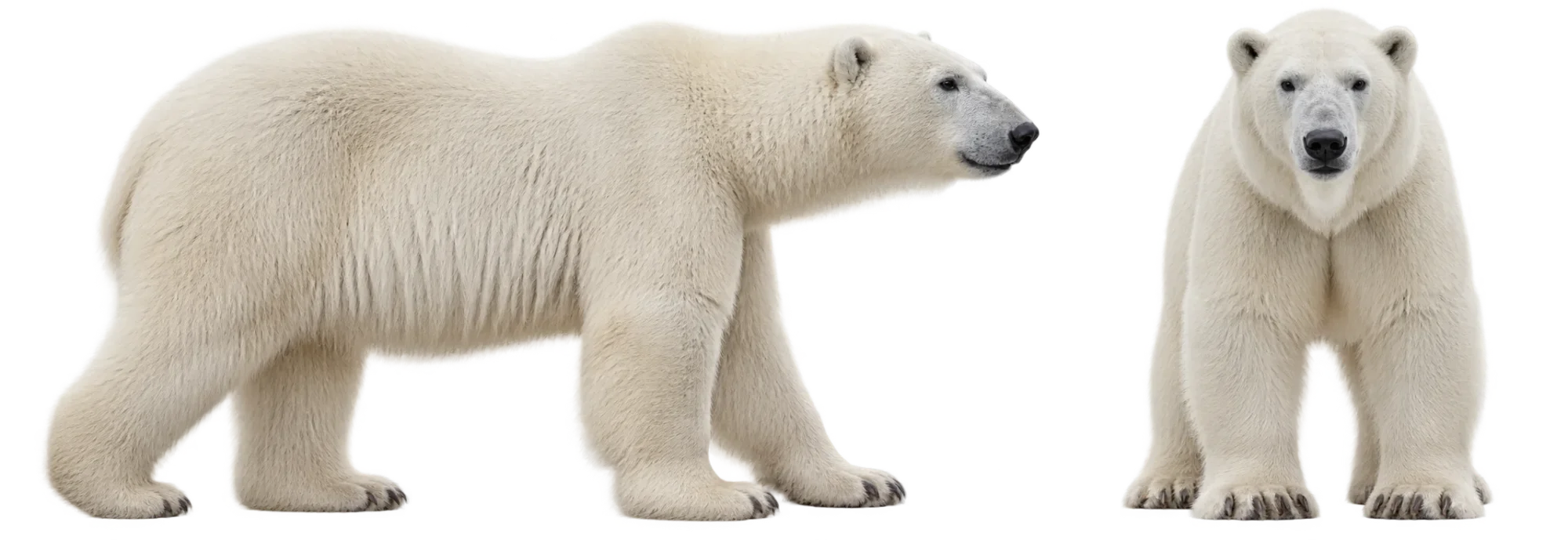
A polar bear can mate in spring while active fetal development waits until autumn. This delay shifts the most energy-demanding part of reproduction toward the maternity-den season, when a female gives birth, nurses rapidly growing cubs, and may spend months without feeding.
Delayed Implantation Sets the Reproductive Calendar
Polar bears usually mate from spring into early summer. Mating can trigger ovulation, but the fertilized egg does not immediately attach to the uterus and begin sustained development. Instead, the blastocyst remains in a delayed state until autumn.
Implantation normally occurs around September or October. Once that happens, active gestation is much shorter than the full interval between mating and birth. Fetal development lasts only about two months, with most cubs born from late November through early January.
How to interpret gestation
The mating-to-birth interval and active gestation are different measurements in polar bears. A value covering the whole reproductive interval includes several months of delayed implantation, while the period of active fetal growth after implantation is much shorter.
This timing also links reproduction to the female’s physical condition. A female must enter the later stages of the cycle with enough stored energy to support pregnancy, denning, and milk production.
The Maternity Den Carries Much of Early Cub Development
Pregnant females are unusual among polar bears because they spend an extended winter period inside maternity dens. Males, juveniles, and females that are not pregnant generally remain active rather than following the same denning schedule.
Females commonly enter dens in October or November. Birth follows during the winter, but the cubs are still far too small to leave. They remain protected inside the den while feeding on their mother’s milk and gaining mass rapidly.
The mother supports this growth largely from energy stored before denning. She does not leave the den to hunt while nursing newborn cubs, and the broader fasting period associated with pregnancy and denning can last many months.
Families usually emerge during March or April, but emergence is not always followed by an immediate departure. Mothers and cubs may remain close to the den for several days while the young become stronger and adjust to conditions outside. Research on Beaufort and Chukchi Sea bears has linked a longer post-emergence stay with better early litter survival, although the relationship is still being studied.
Cub Dependency Extends the Breeding Cycle
A polar bear litter normally contains one to three cubs, with twins the most common outcome. Producing the litter is only the beginning of the female’s reproductive investment. Cubs continue to depend on her for food, protection, movement, and the gradual development of hunting skills.
The exact age of independence varies among observations and populations. Family groups are commonly described as remaining together for about two to two and a half years, while longer periods are also reported. This prolonged care prevents a female with dependent cubs from producing a new litter every year.
For a female that successfully raises cubs through the normal dependency period, the interval between litters is commonly at least about three years. That spacing, combined with small litters, gives polar bears a slow reproductive rate even though an adult female may reproduce repeatedly over a long life.
Female reproductive timing also needs to be separated from simple sexual maturity. First reproduction varies among populations, generally beginning between about four and seven years of age, with many females producing a litter by around age six.
Males can become sexually mature by about six years, yet maturity does not guarantee immediate breeding success. Competition with larger adults means many males do not contribute regularly to reproduction until roughly eight to ten years of age.
Cub Survival Reflects Maternal Condition and Timing
There is no single cub-survival percentage that describes polar bears everywhere. Survival can differ among subpopulations, years, litter stages, and environmental conditions, so a rate measured in one study should not automatically be treated as a species-wide value.
The mother’s condition is closely tied to early investment. Long-term work in Alaska’s Southern Beaufort Sea found that litter mass varied with maternal mass as well as maternal age, litter size, and the date on which bears were measured. A female entering reproduction with larger energy reserves has more stored resources available for the period when newborn cubs depend entirely on her.
The weeks surrounding den emergence also matter. A 2024 study of denning females in the Southern Beaufort and Chukchi seas found that mothers later observed with surviving cubs had generally remained near their dens longer after emerging than females later seen without cubs. The sample was limited, so the result is best treated as evidence that the transition from den life to spring travel is an important developmental stage rather than as a fixed survival rule for every polar bear population.
 Giant pandaAiluropoda melanoleuca
 Sloth bearMelursus ursinus
 American black bearUrsus americanus
 Brown bearUrsus arctos