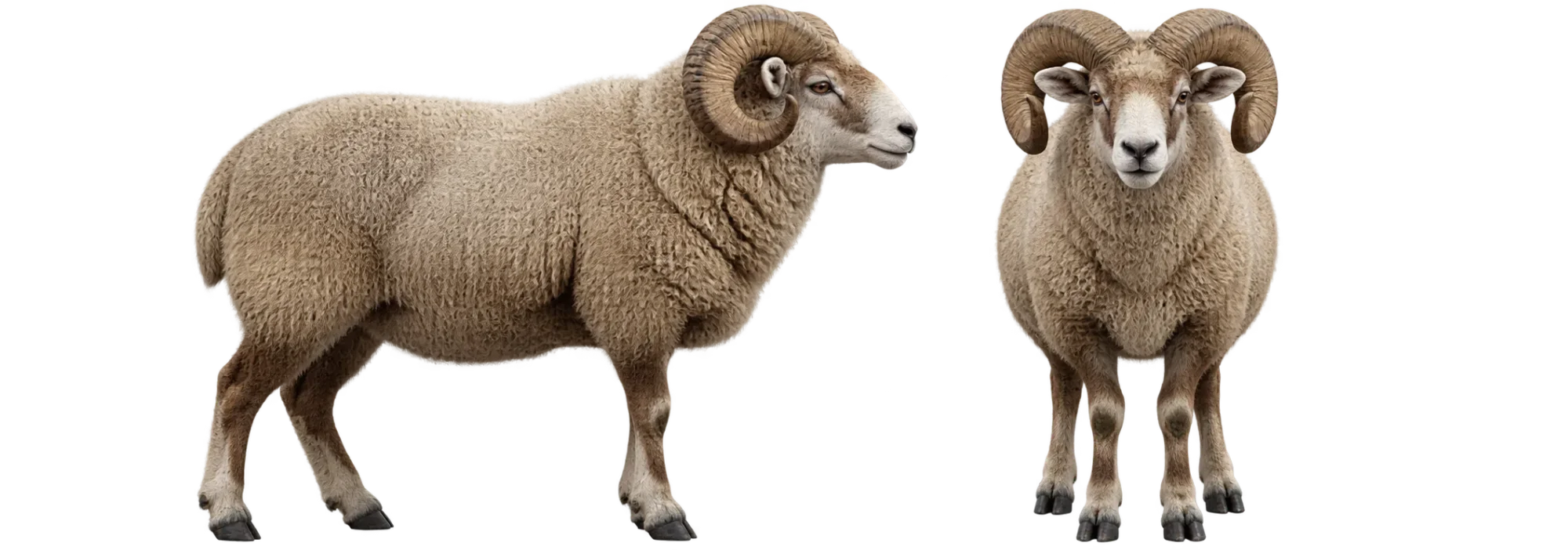
Domestic sheep have been shaped by thousands of years of breeding, so reproductive timing, litter size, growth and age at first breeding can vary widely among breeds. Their life history still carries the seasonal pattern of wild sheep, but domestication and selective breeding have widened the range of reproductive strategies seen within Ovis aries.
Domestic Sheep and Mouflon Need Separate Biological Context
Ovis aries is the domestic sheep. Modern mammal taxonomy treats it as the domestic form of the wild sheep lineage represented by Ovis gmelini, the Asiatic mouflon. Genetic studies place Asiatic mouflon populations close to the ancestry from which domestic sheep emerged.
The word mouflon can cause confusion because it has been applied to more than one population and appears under different taxonomic treatments. European mouflon populations, especially those associated with Mediterranean islands, also have a complicated history involving early human movement of sheep and later genetic exchange. For life-history data, a wild mouflon record should therefore not be assumed to describe a domestic sheep, and a value from a managed sheep breed should not automatically be transferred to a wild mouflon population.
Longevity, reproductive timing, body mass, litter size and developmental records can depend on whether the animal is a domestic breed, a feral population or a wild mouflon. The taxonomic relationship is close, but the biological context of the measurement still matters.
Breed History Shapes Reproduction and Development
There is no single domestic-sheep reproductive schedule that represents every breed. Human selection has produced sheep adapted to different climates and production systems, and that history is reflected in fertility, growth and reproductive seasonality.
Litter size shows some of the clearest variation. Many ewes give birth to one or two lambs, while highly prolific breeds can average larger litters. Genetic differences affecting ovulation rate contribute to this range, along with ewe age, nutrition, body condition and management. Studies comparing sheep populations have found average litter sizes ranging from around one lamb to three or more in some breeds.
Age at puberty also varies. A lamb does not become reproductively mature after reaching a universal age threshold. Growth rate, body condition, genotype, nutrition and the season in which a young ewe approaches maturity can all alter the timing. In strongly seasonal breeds, an animal may reach adequate body development yet not enter its first normal breeding period until the appropriate photoperiodic conditions occur.
This breed-level variation is especially important when interpreting species-level values. A reported maturity age or litter size may accurately describe the animals in a study without defining a fixed biological value for every domestic sheep.
Day Length Organizes the Reproductive Year
Most domestic sheep retain seasonal reproduction inherited from their wild ancestors. In strongly seasonal breeds, reproductive activity rises as day length decreases. Changes in photoperiod alter hormonal signaling, helping synchronize mating with a later lambing period that historically placed newborns into favorable seasonal conditions.
Gestation lasts about five months, so autumn mating in temperate regions commonly produces lambs in late winter or spring. The exact calendar shifts with latitude, breed and husbandry. Some breeds show much weaker seasonality and can reproduce across a larger part of the year.
Domestication has not erased this annual rhythm. Instead, sheep breeds occupy a range from strongly seasonal reproduction to relatively extended breeding seasons. Nutrition, social cues and management can modify reproductive activity, but photoperiod remains a major biological signal in many populations.
Rams and ewes also express seasonality differently. Rams may remain capable of producing sperm outside the main mating season, while changes in reproductive activity and sexual behavior still occur through the year. Ewes generally show the more obvious cycle, with periods of repeated estrous cycles followed by seasonal reproductive inactivity in breeds that retain a strong short-day response.
Birth Begins a Fast Ewe–Lamb Bonding Period
Sheep produce relatively well-developed young. Soon after birth, a healthy lamb begins a sequence of standing, searching for the udder and suckling. The ewe simultaneously licks and grooms the newborn, gives characteristic low-pitched calls and allows access to the udder.
These first interactions establish the ewe–lamb relationship. Ewes learn identifying cues from their offspring soon after parturition, and the quality of maternal behavior can affect lamb survival. Close contact is particularly important when a ewe has twins or a larger litter because each lamb must establish access to its mother and milk.
The bond continues well beyond the first feeding. Lambs remain dependent on milk during early development while gradually adding solid food. Under natural social conditions, the reduction in nursing and close maternal contact is progressive. Managed weaning can occur much earlier and more abruptly, so a recorded weaning age may describe a husbandry decision rather than a fixed developmental point for the species.
Maternal condition also influences this period. Nutrition during pregnancy can affect ewe body condition and milk production, while litter size changes how maternal resources are divided among offspring. A single lamb and twins therefore do not necessarily follow identical early growth trajectories even when born to ewes of the same breed.
 Domestic cattleBos taurus
 Domestic goatCapra hircus
 Water buffaloBubalus bubalis
 American bisonBison bison