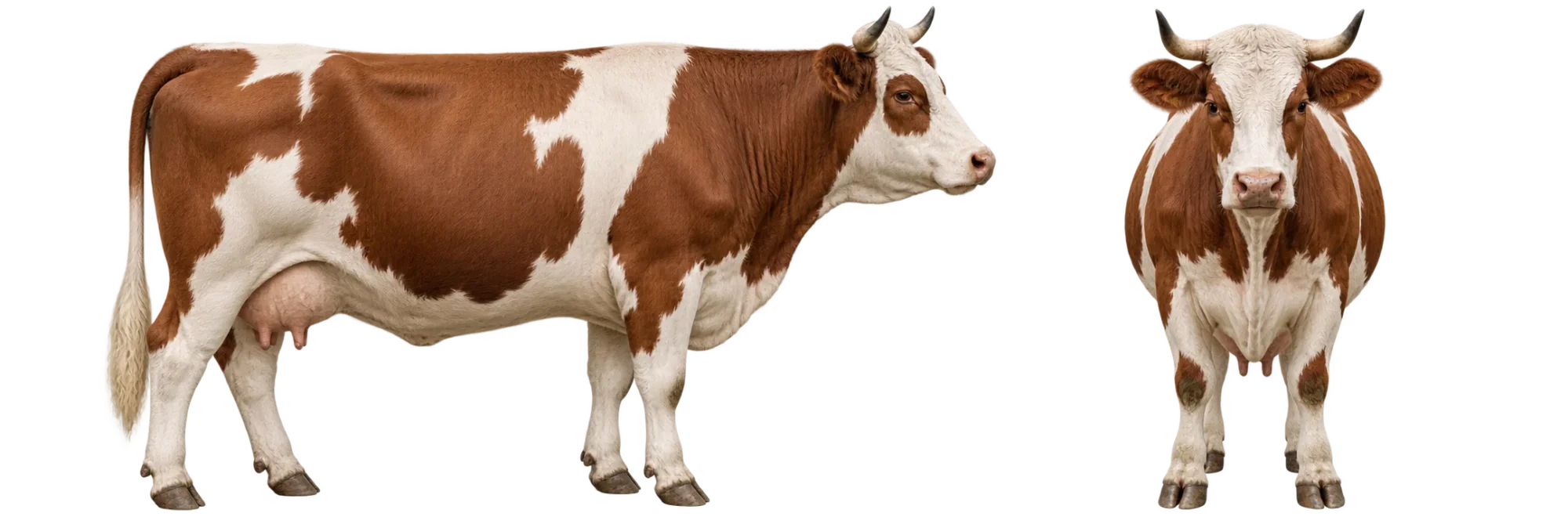
Domestic cattle have one of the most variable life histories among familiar large mammals. Breed, ancestry, nutrition and human management can shift the timing of puberty, pregnancy, weaning and herd exit, so a single age or duration rarely describes every population well.
Pregnancy Length Varies Across Cattle Lineages
Cattle usually carry one calf per pregnancy. Twins occur, but the species is biologically adapted mainly to singleton births. This reproductive pattern combines a long pregnancy with a calf that is already well developed at birth.
The often-cited cattle gestation of about 283 days is useful as a reference rather than a universal value. Breed studies show a noticeable range. Angus and Holstein cattle may average close to 281–282 days, while Brahman and some other indicine-influenced cattle tend to have longer pregnancies, often approaching 290 days or more.
This difference matters when comparing cattle records. Domestic cattle may be treated broadly as Bos taurus in some taxonomic systems, while taurine and indicine cattle are separated in others. Modern herds also contain many crosses. A gestation figure from one breed group should therefore not automatically be applied to every domestic cow.
Calf sex, genetics and the individual pregnancy can add further variation. Gestation length is better treated as a biological range shaped by ancestry and the particular dam and calf rather than an exact countdown shared by all cattle.
Puberty Follows Growth as Well as Age
A heifer does not become reproductively mature simply because she reaches a fixed birthday. Puberty depends on development of the reproductive system together with body growth, nutritional status and genetics.
Many taurine beef heifers can reach puberty around 12–14 months under suitable growth conditions. Breed averages can fall outside that range. Jersey cattle, for example, tend to mature earlier than many larger beef breeds, while Brahman and other cattle with strong Bos indicus ancestry commonly mature later.
Heifers of the same chronological age may be at different reproductive stages. Body development and energy intake affect the hormonal changes that allow regular ovarian cycles to begin.
First ovulation is also not identical to full reproductive readiness. A young female may ovulate before she has established regular cycles or reached the body development normally associated with successful breeding. This is why cattle studies often consider weight relative to mature body size alongside age.
Male development follows its own schedule. Well-grown taurine bulls may reach puberty during their first year, while puberty can occur later in indicine genotypes. Nutrition during early development can alter the timing because reproductive maturation depends partly on whether the growing animal has enough energy available for both body growth and reproduction.
Calves Begin Life Physically Advanced
Newborn cattle are precocial. A healthy calf is capable of standing and moving soon after birth rather than passing through a long helpless stage. This early mobility fits the life history of grazing bovids, but it does not mean that the calf is nutritionally independent.
Milk remains central during early growth. In conventional beef systems, calves are often weaned at roughly 6–8 months of age, although actual weaning can occur earlier or later. Dairy management can separate calves from their dams much sooner, so age at physical separation should not be confused with the biological end of early milk-dependent development.
Growth during the months after birth also influences later reproductive timing. Heifers that grow more slowly can enter puberty later, while faster early development may bring reproductive maturation forward. The relationship is not simply “heavier means mature”: breed, body composition and endocrine development all contribute.
Herd Life Is Usually Shorter Than Biological Lifespan
Longevity figures for domestic cattle require careful interpretation because most cattle do not live until biological old age. Managed herds remove animals for many reasons, so the age at which a cow leaves a herd can be far earlier than the age she could potentially reach.
Domestic cattle can live for around two decades, and individuals may exceed 20 years. That figure describes potential lifespan far better than it describes the normal age structure of commercial cattle populations.
Dairy research therefore often separates total lifespan from productive life. Productive life usually begins at first calving and ends when the cow leaves the milking herd. Health, fertility, milk production and herd replacement decisions can all shorten this period. A cow leaving a herd at five or six years old has not reached the biological lifespan limit of cattle.
Beef cattle create a different comparison problem. Some females can remain breeding animals for many years, while cattle raised primarily for meat may leave production at young ages. Combining these animals into one “average cattle lifespan” would mix biological aging with very different management pathways.
This distinction is especially important for domestic cattle because human selection and herd management affect nearly every stage of the life cycle. Pregnancy remains long and usually produces a single well-developed calf, but the ages of puberty, first breeding, weaning and final herd exit can differ greatly among breeds and production systems.
 Domestic sheep, or MouflonOvis aries
 Domestic goatCapra hircus
 American bisonBison bison
 Water buffaloBubalus bubalis