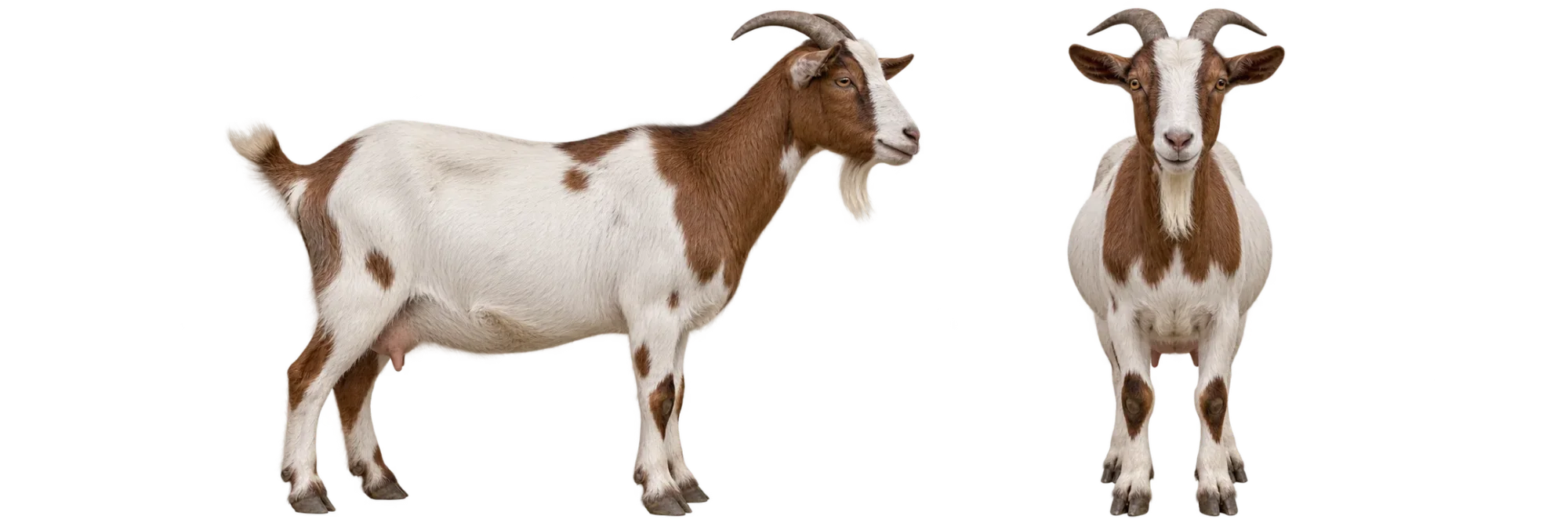
The domestic goat, Capra hircus, does not follow one fixed reproductive and developmental timetable. Breed, latitude, season of birth, nutrition, body growth and husbandry can all shift when reproduction begins, how often births occur and when young are separated from milk. Some traits, especially pregnancy length, remain much more stable.
Domestic Goat Life History Varies Across Breeds and Herds
The Mammal Diversity Database recognizes Capra hircus as the domestic goat and describes it as the domesticated form derived from Capra aegagrus. Thousands of years of human breeding have since produced goats adapted to very different climates and production systems.
That history matters when interpreting life-history data. A value measured in one dairy breed kept at a temperate latitude may poorly represent a locally adapted goat living in the tropics. Reproductive traits can also change within the same breed when nutrition, birth season or breeding management changes.
Why Goat Trait Values Often Differ
Domestic goat records describe a species with extensive breed and management variation. Differences between reliable datasets do not automatically indicate an error; they may describe different populations, sexes, seasons or husbandry conditions.
Seasonal Breeding Changes With Latitude and Breed
Goats are generally described as short-day seasonal breeders. In strongly seasonal populations, reproductive activity rises as day length decreases. This pattern is clearest in temperate regions and helps concentrate births into a favorable part of the year.
The pattern becomes less rigid across breeds and locations. Breeding seasons tend to be longer at lower latitudes, while some breeds show much stronger seasonality than others. As a result, statements that domestic goats either reproduce throughout the year or reproduce only during one season are both too broad for the species as a whole.
During an active reproductive period, the estrous cycle averages about 21 days. Reproductive timing can also respond to social cues. Introducing a sexually active buck after females have been separated from males can stimulate ovarian activity, a response commonly called the buck effect.
This sensitivity to light and social conditions makes the breeding calendar partly biological and partly environmental. The same female genotype can therefore enter reproductive activity at different times under different seasonal conditions.
Puberty Depends on Body Growth and Season of Birth
Female goats commonly reach puberty during the first year of life, and veterinary references often place the usual range around 6–9 months. Age alone, however, does not describe reproductive development well.
Body growth matters. In managed herds, females are often considered physically ready for breeding only after reaching roughly 60–65% of mature body weight. Sexual maturity and suitable breeding size are therefore separate milestones.
Season can shift puberty as well. Research on seasonally breeding goats has shown that young females born at different times of year may encounter their first favorable breeding season at different ages. A kid reaching adequate body development while day length is becoming favorable may begin cycling earlier than one reaching the same developmental stage during seasonal reproductive inactivity.
Male exposure can alter this timing further. Experimental work has shown that sexually active bucks can induce ovulatory activity in young females under conditions in which puberty would otherwise be delayed. Puberty age in domestic goats is therefore better treated as a variable developmental outcome than as a species-wide birthday.
Pregnancy Length Stays Within a Relatively Narrow Range
Gestation is less variable than the timing of puberty or the breeding season. Domestic goat pregnancy generally lasts 145–155 days, with about 150 days commonly used as the central value.
Even within that range, gestation can shift with breed, parity, environmental conditions and the total weight of the developing litter. A single exact number should therefore be read as a representative value rather than a deadline applying to every pregnancy.
The number of kids also varies substantially. First-kidding females often produce one or two kids, while multiple births can become more common in later parities. Twins are common in many populations, and triplets or larger litters occur in some breeds and older does.
Litter size has a genetic component, but it is also associated with parity and other biological and environmental conditions. This is one reason litter-size values from individual breeds should not automatically be treated as averages for all domestic goats.
Weaning Age Reflects Husbandry as Well as Development
Weaning data require a different kind of interpretation because domestic goats are often separated from milk according to a management schedule. A recorded weaning age may describe a farming decision rather than the point at which a kid would independently stop nursing.
Managed dairy and meat systems use different schedules, and even research on dairy goats has compared weaning at several ages. A study of Alpine kids weaned at 6, 8 or 10 weeks found more behavioral signs of difficulty with the transition in the earliest-weaned group, while later-weaned kids generally adjusted more smoothly to solid feed.
Young goats also undergo gradual digestive development as solid food becomes more important and the rumen develops. Milk dependence, solid-feed intake and social separation do not change at one biological instant. For this reason, a database value for weaning should be interpreted according to how the original study or husbandry system defined weaning.
Longevity Records Need Management Context
Maximum longevity is especially easy to misread in a domesticated species. AnAge reports a verified captive longevity record of 20.8 years for Capra hircus. It also notes a report of a goat reaching 22 years, but that record is not verified.
Neither figure represents the age a typical goat is expected to reach. Maximum longevity records describe exceptional observed individuals. Domestic goats may leave a managed population much earlier because of production decisions, reproductive problems, dental wear, lameness or other health issues.
Longevity datasets for domestic goats therefore mix biology with human management in a way that records for many wild mammals do not. A verified maximum age can show that the species is capable of surviving for more than two decades under suitable conditions, while providing little information by itself about the usual lifespan of goats in a particular herd or production system.
 American bisonBison bison
 Domestic sheep, or MouflonOvis aries
 Domestic cattleBos taurus
 Water buffaloBubalus bubalis