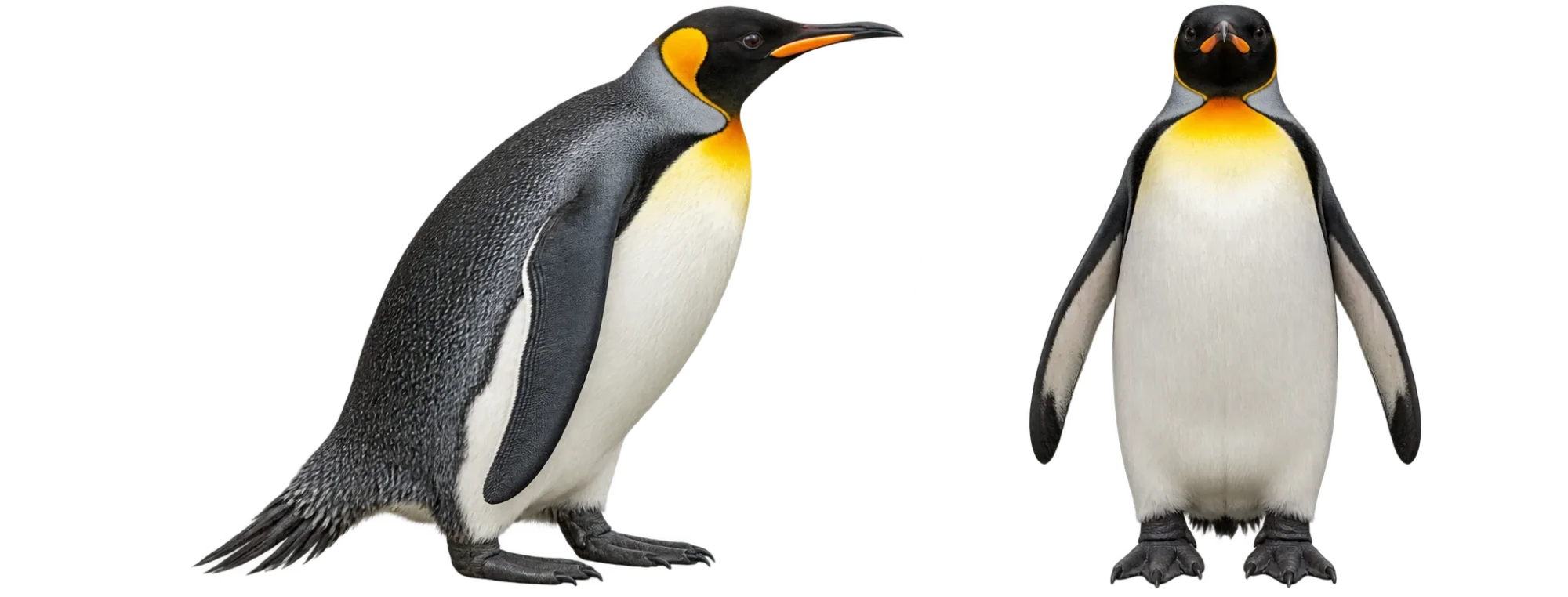
King penguins (Aptenodytes patagonicus) fit reproduction into a cycle that runs longer than a calendar year. A single egg is followed by alternating incubation shifts, months of chick growth and an austral winter in which feeding becomes sparse. The timing of each stage affects whether a chick survives and when the adults can attempt to breed again.
One Egg Starts a Breeding Cycle That Can Last Beyond a Year
King penguins lay one egg rather than a multi-egg clutch. There is no constructed nest. The adult balances the egg on its feet beneath a fold of abdominal skin, and the parents alternate incubation while the other bird returns to sea to feed.
Incubation lasts about 54 days. The male normally takes the first long shift after laying, followed by repeated exchanges between the pair. These changeovers matter because an incubating bird is fasting on land and depends on stored body reserves until its partner returns.
After hatching, the chick remains closely brooded for roughly its first month. Parental care then changes. Both adults can make foraging trips while the growing chick remains in the colony, where young birds gather in dense crèches.
A complete successful cycle can take roughly 12 to 14 months. Because chick rearing extends into the following breeding season, successful reproduction cannot simply repeat on the same date every year.
Winter Splits Chick Development Into Two Different Growth Periods
King penguin chicks grow rapidly during their first summer, but that pattern changes when austral winter arrives. Parents make much longer journeys or return less often, and chick feeding can fall to very low levels for an extended period.
The chicks cope by drawing on energy accumulated before winter. Body mass can fall while growth slows, so the condition reached before this seasonal food shortage has a direct connection with overwinter survival. Research on early- and late-hatched chicks has found that later chicks have less time to build reserves before winter and can face poorer survival prospects.
Feeding increases again after winter. The chick resumes development, replaces its thick brown juvenile plumage and eventually leaves the colony for the sea. From hatching to fledging, development lasts around 11 months, making the chick-rearing period unusually long for a bird.
The Outcome of One Attempt Changes the Timing of the Next
Breeding success has a carryover effect in king penguins. Adults that raise a chick through the full cycle remain occupied well into the next reproductive period. They must also restore body reserves and complete their own annual moult before another breeding attempt can proceed normally.
This creates a strong link between breeding date and reproductive history. Long-term work at the Crozet Islands has shown that birds completing a successful cycle may return too late for another equally well-timed attempt. Birds whose earlier attempt ends sooner can re-enter the breeding schedule at a different point.
The result is not a simple pattern of one successful chick per pair every year. Individual schedules can move forward or backward depending on when breeding began, how long parental care continued and whether the previous egg or chick survived.
Decades of individual monitoring have shown that king penguin breeding frequency cannot be understood from egg laying alone. The previous breeding outcome helps determine when an adult is physiologically and seasonally ready to try again.
Breeding Dates at Crozet Have Moved Earlier Over Recent Decades
A 2026 study based on 24 years of monitoring and about 17,000 marked king penguins on Possession Island in the Crozet Archipelago found a pronounced shift in breeding timing between 2000 and 2023.
The researchers linked breeding timing with ocean conditions experienced across more than one year. Earlier breeding was associated with better reproductive performance in this monitored population, showing how a cycle that already spans multiple seasons can respond to environmental conditions carried over from earlier periods.
The finding also adds an important distinction to fixed life-history values such as incubation length or age at maturity: the seasonal date on which reproduction begins is flexible. In king penguins, that flexibility can alter how much time chicks have to grow before winter and can affect the timing available for the adults’ next breeding attempt.
 Jackass penguinSpheniscus demersus
 Emperor penguinAptenodytes forsteri
 Little penguinEudyptula minor
 Adelie PenguinPygoscelis adeliae