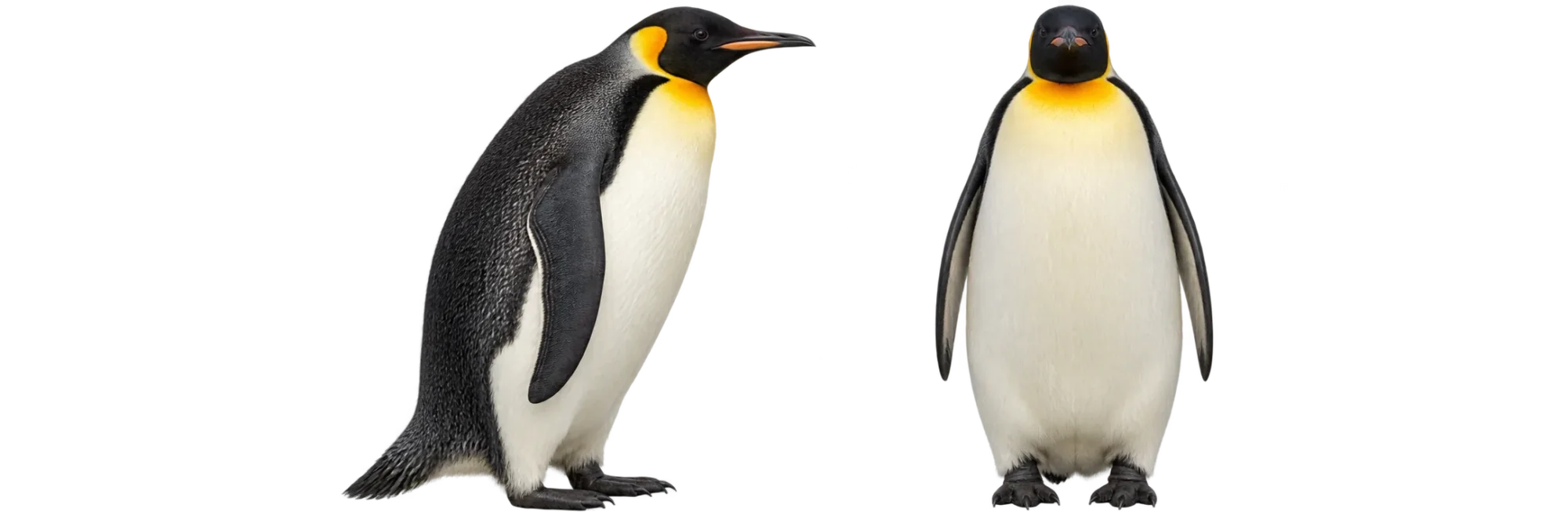
Emperor penguins (Aptenodytes forsteri) place almost their entire breeding season on Antarctic sea ice, starting as the ice forms in autumn and finishing as their chicks become ready for the ocean near the beginning of summer. One egg, months of parental fasting, rapid chick growth and the adults’ own annual moult all have to fit into that narrow seasonal cycle.
A Breeding Year Timed to Antarctic Sea Ice
Most emperor penguin colonies assemble on stable fast ice during March and April. Courtship follows soon after arrival, and each breeding female produces one egg for the season, usually in May or early June.
The timing is unusually early for an Antarctic bird because the chick needs several months to develop before summer changes the ice around the colony. Breeding therefore begins during the approach of winter rather than waiting for warmer conditions.
The Male Carries the Winter Incubation Cost
Emperor penguins do not build nests. After the egg transfer, the male balances the egg on his feet and covers it with a warm fold of skin and feathers called the brood pouch. Direct contact with the ice could quickly chill the egg, so maintaining this position is part of the incubation system rather than simply a way of holding it.
Incubation lasts roughly 65 to 75 days. The male cannot leave the egg to forage during that period. His total fast is even longer because it begins before incubation, while adults are gathering and pairing at the colony. By the time the chick hatches and the female returns, a male may have gone without food for close to four months and lost around 40–50% of his earlier body mass.
Huddling changes the energy cost of this fast. Birds pack together during severe weather and continually shift position within the group, reducing the amount of time any one individual remains exposed at the outer edge. The behaviour helps males preserve the stored body fat that must support both normal metabolism and weeks of incubation.
The return of the female marks an abrupt change in parental roles. She has been feeding at sea and can take over care of the newly hatched chick. The depleted male then travels back to feeding water. Once he returns, both parents take part in provisioning the chick.
Chick Development Has to Keep Pace With the Season
An emperor penguin chick begins life extremely dependent on its parents. Newly hatched chicks have only a thin covering of down and cannot immediately maintain body temperature on their own. For roughly the first several weeks, staying on a parent’s feet beneath the brood pouch remains an important part of survival.
That dependence changes as the chick grows. By around September, older chicks can spend more time away from direct parental brooding and gather together in crèches. A crèche is not an independent juvenile group: the chicks still rely on their parents for food. Its importance is that both adults can now forage at the same time as the chick’s energy needs rise.
Growth during spring is fast. Parents repeatedly move between the colony and feeding areas, delivering food while the chick develops a much larger body and begins replacing its soft natal down. By early summer, the juvenile must have enough waterproof plumage to enter the ocean safely.
The sea ice is part of the breeding timetable. Chicks normally approach independence around December, when summer conditions begin changing the ice around many colonies. If stable breeding ice disappears unusually early, chicks that have not completed enough feather development may be forced toward the water before they are ready.
Young emperors can leave the colony at a body mass below that of adults. Independence therefore does not mean that growth is complete. It means that the juvenile has reached the point where waterproof plumage, stored energy and its developing swimming and foraging abilities allow it to begin life at sea without parental feeding.
Breeding Experience Builds Slowly Across a Long Adult Life
Emperor penguins may reach reproductive capability at around three years of age, but many do not begin breeding until about four to six years old. Delayed entry into the breeding population fits a species in which adults can survive through many annual cycles while producing no more than one chick in a breeding attempt.
Pair Bonds Usually Last for One Breeding Season
Emperor penguins are monogamous within a breeding attempt, yet they show unusually low mate retention between years for penguins. Studies have placed interannual mate fidelity at only about 15%.
The colony provides no fixed nest territory where a previous pair can simply reunite. Birds arrive at different times, move through a crowded breeding group and face a limited period in which to form a pair. A bird that returns without its former partner may pair with another available adult rather than delay breeding. The result is a strong partnership during the current season without a dependable lifelong pair bond.
Moult Creates a Second Major Fasting Period
After chick care ends, adults must restore the reserves used during breeding and prepare to replace their plumage. Penguins undergo a rapid annual moult in which the old feathers are replaced over a period of weeks.
During this stage the plumage cannot provide its normal waterproof barrier, so the birds remain out of the sea and cannot forage. They must enter the moult with enough stored energy to sustain another prolonged fast. Once the new plumage is complete, the adults return to the ocean to feed and rebuild reserves before the next autumn breeding season begins.
 Little penguinEudyptula minor
 Jackass penguinSpheniscus demersus
 Adelie PenguinPygoscelis adeliae
 King penguinAptenodytes patagonicus