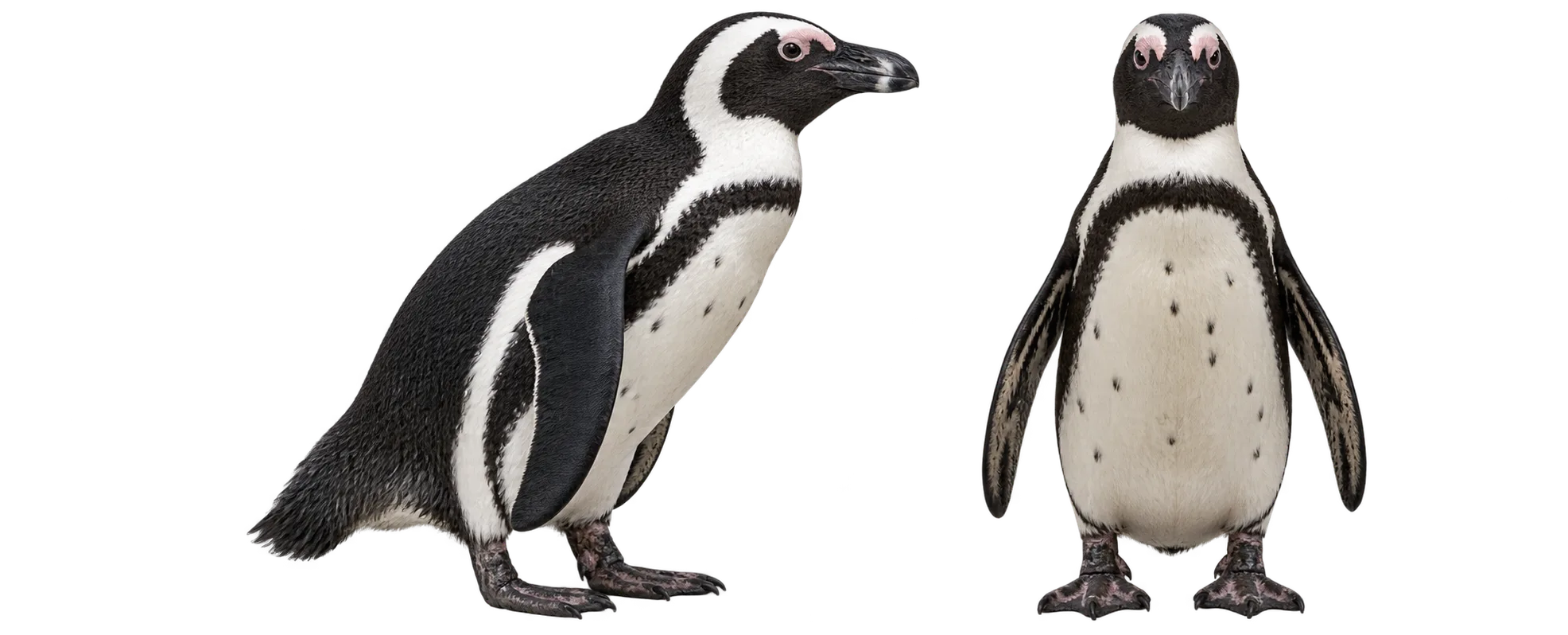
The jackass penguin is the African penguin, Spheniscus demersus, an older common name that refers to its donkey-like braying call. Its breeding calendar can shift markedly between colonies and years, while the annual replacement of its entire plumage places a much firmer limit on the life cycle.
Breeding Can Extend Across Much of the Year
African penguins do not follow one short breeding season across their range. Egg laying can occur throughout the year, with the busiest months differing between colonies. South African colonies generally show different seasonal peaks from colonies farther north in Namibia, and long-term observations at Dassen Island found that the timing of peak breeding could also move from one year to another.
A pair usually lays two eggs. Both parents incubate them, taking turns while the other bird goes to sea to feed. Incubation lasts roughly 38–41 days, and eggs within the same clutch may hatch a few days apart.
The breeding attempt does not always end with the first clutch. African penguins can lay replacement clutches after losing eggs or chicks, and some pairs may breed again after successfully raising young. This flexibility helps explain why a single fixed breeding date gives a poor picture of the species’ reproductive schedule.
Parental Care Changes as the Chick Grows
Newly hatched chicks depend closely on their parents for warmth, protection and food. During the earliest stage, an adult remains with the young while its partner forages. The chicks gain better control of their own body temperature after roughly the first two weeks.
Fledging is followed by another long developmental interval. A banding study in Namibia found that the first immature moult occurred from 12 to 23 months after hatching. Birds fledging at different times of year could therefore reach the next major plumage stage at quite different ages.
The Annual Moult Resets the Adult Plumage
Adult African penguins periodically replace all of their feathers in a concentrated moult. During this period they remain ashore because the shedding plumage no longer provides the waterproof covering needed for normal feeding at sea.
The bird must build sufficient energy reserves before the moult begins. That makes the weeks before coming ashore biologically important: an individual has to carry enough stored energy to replace its plumage while fasting.
Moult is also more tightly synchronized than breeding in some wild colonies. At Dassen Island, most recorded moulting occurred between September and January even though breeding was much more spread through the year. Individual intervals were variable, but the pattern still placed moult close to an annual rhythm.
Age at First Breeding Varies Among Individuals
African penguins may reach reproductive condition before they actually establish themselves as breeding birds. Research on the Robben Island population recorded some individuals starting as early as two years old, while participation increased among older birds and the study treated birds aged five as breeders.
Other physiological work places reproductive maturity around four years in free-ranging African penguins. These observations fit a life-history pattern in which maturity age and first successful breeding are related but can occur at different times. Pair formation, breeding opportunity and local conditions can delay reproduction after a bird is physically capable of it.
Once established at a breeding colony, adults show strong attachment to their breeding area and commonly return to the same colony in later years. That site fidelity links several breeding attempts across the adult life rather than making each nesting season an independent event.
 Emperor penguinAptenodytes forsteri
 Little penguinEudyptula minor
 King penguinAptenodytes patagonicus
 Adelie PenguinPygoscelis adeliae