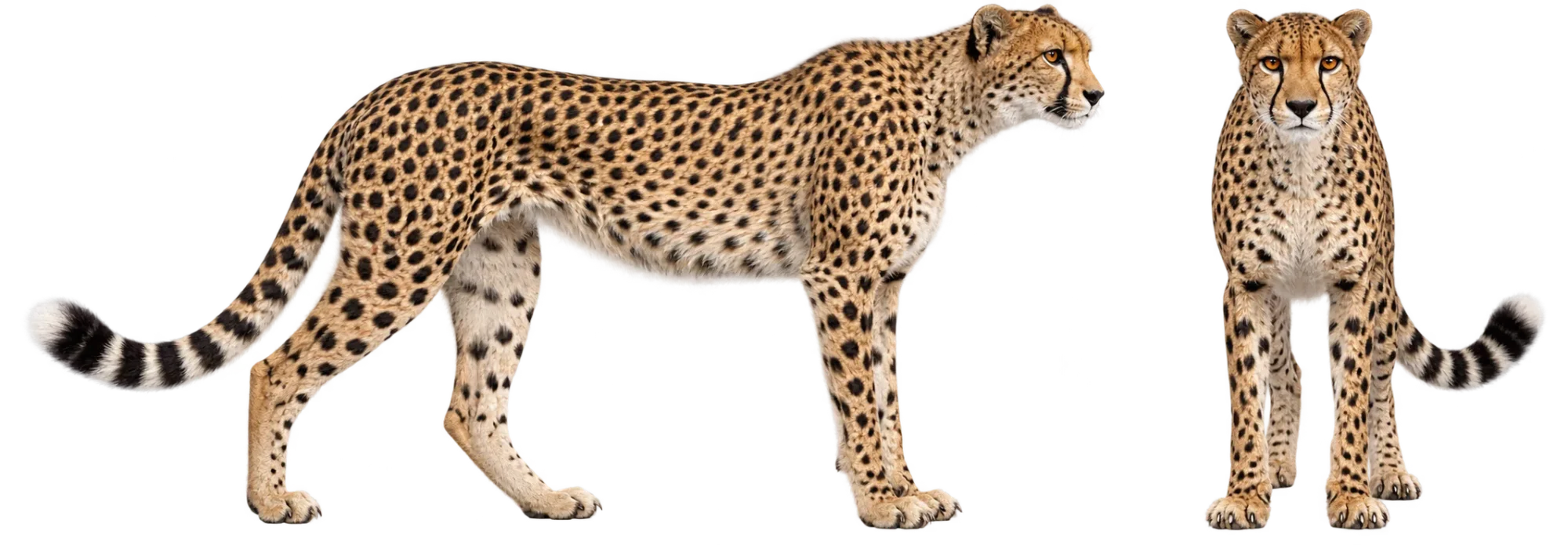
For a cheetah, Acinonyx jubatus, the roughly three-month pregnancy is only the beginning of a much longer reproductive investment. Cubs remain dependent on their mother for well over a year, and survival during the first months can have more influence on reproductive success than the number of cubs originally born.
Pregnancy Is Short Compared With Maternal Care
Cheetah gestation lasts about 90–95 days, with 93 days commonly used as a representative value. Several cubs may be born in one litter, but birth does not quickly lead to independence.
Newborn cubs are poorly developed and depend completely on their mother. During their earliest weeks, she keeps them concealed while leaving periodically to hunt. The cubs become mobile enough to follow her after this early denning period, but they still have a long period of learning ahead.
Milk is gradually replaced by meat during the first several months. Later, the mother provides opportunities for the young to develop hunting skills. By around six months, cubs can take part more actively in encounters with prey, yet they are still far from being self-sufficient hunters.
The mother normally raises the litter without help from an adult male. Young cheetahs commonly remain with her until roughly 15–18 months of age. This long dependency helps explain why reproductive timing cannot be understood from the gestation period alone. Producing another surviving litter requires far more time than carrying a pregnancy.
Early Cub Survival Shapes Reproductive Success
A litter containing several newborns does not necessarily produce several independent young. The first months are one of the most vulnerable parts of the cheetah life cycle.
Long-term observations have recorded very high cub mortality in some wild populations, especially where mothers and young live alongside larger predators. Lions, spotted hyenas and other carnivores can kill cubs, while illness, poor condition and the loss of a mother can create additional risks.
Mortality Rates Need Local Context
Figures approaching 90% have been reported for young cubs in parts of the Serengeti, but this should not be treated as a universal cheetah mortality rate. Survival differs among populations, landscapes, study periods and the age at which researchers measure it.
This difference between litter size and offspring recruitment is important. A female may give birth repeatedly during her life while producing far fewer young that survive to independence. For population growth, surviving juveniles matter more than the number of newborn cubs alone.
Independence Happens in Stages
Leaving the mother does not immediately produce the adult social pattern. When maternal care ends at around a year and a half, littermates may remain together for several more months while their hunting ability and independence continue to develop.
The paths of the sexes then tend to diverge. Young females usually separate and adopt the largely solitary life typical of adult female cheetahs. Brothers often remain together and may form a lasting male coalition. Some males live alone, but sibling coalitions are a familiar part of cheetah social biology.
This makes adolescence more than a simple boundary between juvenile and adult life. It links maternal dependence, learning to hunt, separation from the natal group and the formation of adult social relationships. Sexual maturity may begin around this general period, but reaching physiological maturity and establishing an independent adult life are not identical events.
Female Fertility Changes Before the End of Life
Research on cheetahs in human care has revealed an important difference between longevity and reproductive longevity. Females can live well beyond the ages at which breeding success begins to decline.
Studies of reproductive aging found that females older than about eight years reproduced less often in managed populations. The change was not explained simply by an abrupt loss of ovarian activity. Older females could still produce fertilizable oocytes, while age-related changes in uterine tissue became more common.
That finding matters because an old longevity record cannot be used to estimate how long a female normally remains equally fertile. Maximum lifespan, adult lifespan and reproductive lifespan describe different biological limits.
The age pattern documented in zoological populations should also not be converted into a fixed fertility cutoff for every wild female. Reproductive history, individual condition and environment can alter outcomes. What the research shows clearly is that chronological survival and reproductive capacity do not decline on exactly the same schedule.
 Domestic catFelis catus
 Eurasian lynxLynx lynx
 CougarPuma concolor
 BobcatLynx rufus