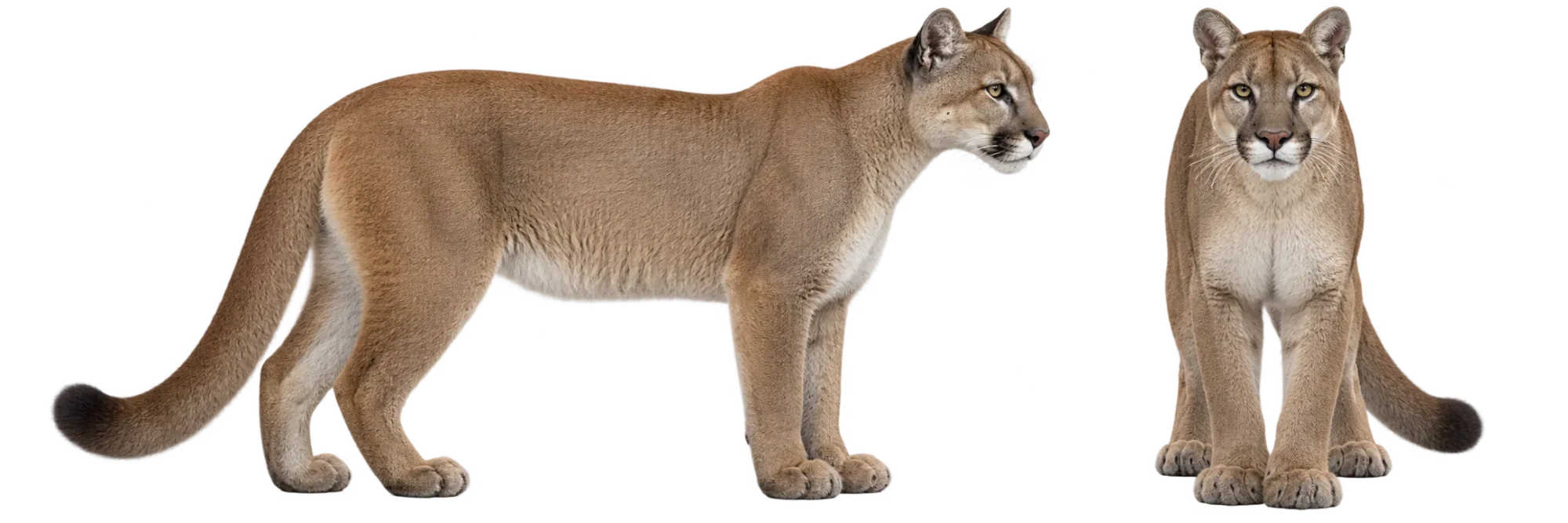
For a cougar, pregnancy is brief compared with the time required to raise a litter. Gestation lasts about three months, while dependent young may remain with their mother for well over a year. That long period of maternal care shapes birth spacing, juvenile development, dispersal, and the timing of the next reproductive attempt.
Breeding Timing and Gestation
Cougars (Puma concolor) can mate during any part of the year. The pattern varies across their wide range, however. Northern populations often show stronger seasonal peaks, while breeding and births may be spread more evenly through the year in warmer regions.
Gestation is usually close to 92 days. A litter may contain one to six kittens, although two or three is common in field reports. The female raises the litter without help from the male.
This creates an important difference between mating opportunity and actual reproductive pace. A female may be physiologically capable of breeding again, but successfully raising dependent kittens occupies much of the period that might otherwise be available for another litter.
Maternal Care Through the Juvenile Stage
Newborn cougar kittens are poorly developed and depend completely on their mother. During their first weeks they remain concealed at a den or nursery site while she leaves periodically to hunt.
Weaning therefore marks only one stage of development. A kitten that no longer depends on milk still benefits from months of protection, access to kills, movement with its mother, and repeated opportunities to practice predatory behavior.
Field research in Utah that followed 49 young cougars from 16 females found that kittens receiving more maternal contact had better survival during their first months. Kittens of experienced mothers also tended to survive better than those of first-time mothers. The findings fit the cougar’s long juvenile period: maternal behavior continues to affect survival after the earliest den stage.
Dispersal and the Start of Independent Life
Leaving the mother does not immediately make a young cougar an established breeding adult. Independence is followed by a dispersal phase in which many juveniles travel away from their natal area and attempt to find space of their own.
Males generally disperse farther than females. Young females are more likely to remain closer to their natal range, while males commonly make longer movements. Studies in western North America have placed typical dispersal near the middle of the second year of life, although individual timing varies considerably.
Reproductive maturity also develops separately from physical independence. Females often begin reproducing at roughly two to three years of age. Males commonly breed later, around three years or beyond, because access to mates also depends on survival, movement, and the ability to occupy or use an established range.
A juvenile can leave its mother before it has secured an adult home range or reproduced. Dispersal, settlement, and first successful breeding may occur months apart.
Rebreeding After Litter Loss
A female that successfully raises kittens normally has a long interval between births because maternal care continues for more than a year. The schedule can change sharply when an entire litter dies.
Recent field observations published in 2026 documented seven female mountain lions in South Dakota and New Mexico that lost litters and later bred again. Recorded intervals between litter loss and rebreeding ranged from four days or less to 94 days, with an average of 46 days among the documented cases.
The short intervals were recorded after litter mortality and should not be treated as the normal birth interval for all cougars. In the same New Mexico research, females whose kittens survived to dispersal age showed much longer intervals before subsequent breeding, ranging from 333 to 631 days in the documented cases.
Loss of dependent young removes the extended maternal period that normally delays another reproductive attempt. This helps explain why estimates such as one litter about every two years describe successful reproductive cycles better than they describe every possible sequence of pregnancies. A female that loses kittens early may return to breeding far sooner.
 LeopardPanthera pardus
 JaguarPanthera onca
 LionPanthera leo
 CheetahAcinonyx jubatus