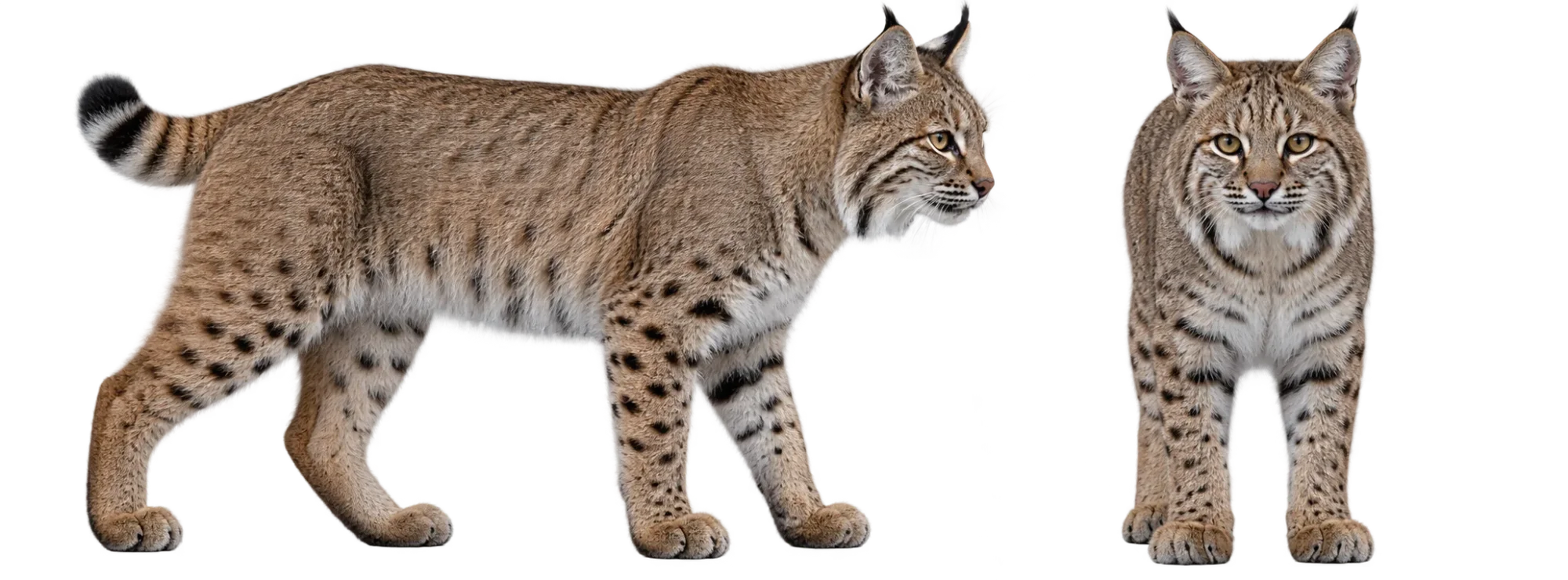
For the bobcat (Lynx rufus), pregnancy lasts only about two months, but raising a litter occupies a much larger part of the year. Kittens remain closely tied to their mother through nursing, early hunting practice and the gradual transition to an independent home range.
Breeding Timing Varies Across the Bobcat’s Range
Bobcat reproduction has a strong seasonal peak across much of North America. Mating is most common in late winter, especially during February and March, followed by many births in April and May. The calendar becomes less rigid in warmer parts of the range, where mating and births can occur over a much broader part of the year.
This geographic variation helps explain why published breeding periods do not always match. Latitude, local climate and other environmental conditions can shift the reproductive season. A date reported for a northern population should not automatically be treated as the breeding schedule for bobcats farther south.
Bobcats are also unusual within the genus Lynx because females are polyestrous. They can enter more than one reproductive cycle rather than being restricted to a single estrus each year. A later second litter is therefore possible, although free-ranging females generally produce one litter in a year.
Gestation is usually reported at roughly 60 to 70 days, with about 62 days often used as the central estimate. This relatively short pregnancy places much of the female’s reproductive investment after birth rather than during gestation.
Kittens Depend on Their Mother Through Their First Hunting Season
Birth takes place in a protected den. Rock crevices, hollow trees, caves, dense vegetation and spaces among boulders can all serve this purpose. The exact structure matters less than shelter and concealment during the period when the kittens have little ability to move or defend themselves.
Litters of two to four kittens are common, although both smaller and larger litters have been recorded. Newborn bobcats are well furred but initially helpless, and their eyes usually open during roughly the first ten days of life.
Nursing continues for about two months. The transition away from milk does not end maternal dependence. The female begins providing animal food, and the kittens later accompany her as they gain the movement and hunting skills needed to survive alone.
By about three to five months of age, young bobcats may be travelling regularly with their mother. This part of development gives them repeated exposure to hunting areas, prey and the movements associated with a solitary predator’s home range. Maternal care therefore extends well beyond the den stage.
Juvenile Dispersal Extends From Fall Into the Following Spring
Young bobcats do not all leave their mother at one precise age. Many begin separating during their first fall or winter, commonly when they are around eight months old or older. In some northern populations, young have remained with their mother into the following spring.
The period between learning to hunt and establishing an independent range can therefore last for months. A juvenile may already be capable of obtaining food before it has permanently left the maternal area.
Dispersal also marks the start of another demanding stage of the life cycle. A young bobcat must locate suitable space while navigating areas that may already be used by established adults. The timing of departure can vary among populations rather than following a single species-wide schedule.
Females Can Reach Reproductive Maturity Earlier Than Males
Female bobcats may become reproductively mature at about 9 to 12 months, and breeding at roughly one year of age is documented. Reaching physiological maturity does not mean that every young female breeds immediately. Reproductive participation can vary with age and local conditions, and older adult females often show higher pregnancy rates than the youngest mature females.
Males generally mature later. Published accounts commonly place male sexual maturity between about 18 months and two years. A male may therefore have been independent for a substantial period before entering the breeding population.
Bobcats can remain reproductively active as adults for many years. Wild individuals exceeding ten years of age are documented, with exceptional records reaching roughly 15 to 16 years. Captive longevity can extend much farther, including records around 32 years. These upper records describe what the species can reach under particular circumstances; they should not be read as the normal life expectancy of a wild bobcat.
 JaguarPanthera onca
 Domestic catFelis catus
 CougarPuma concolor
 LionPanthera leo