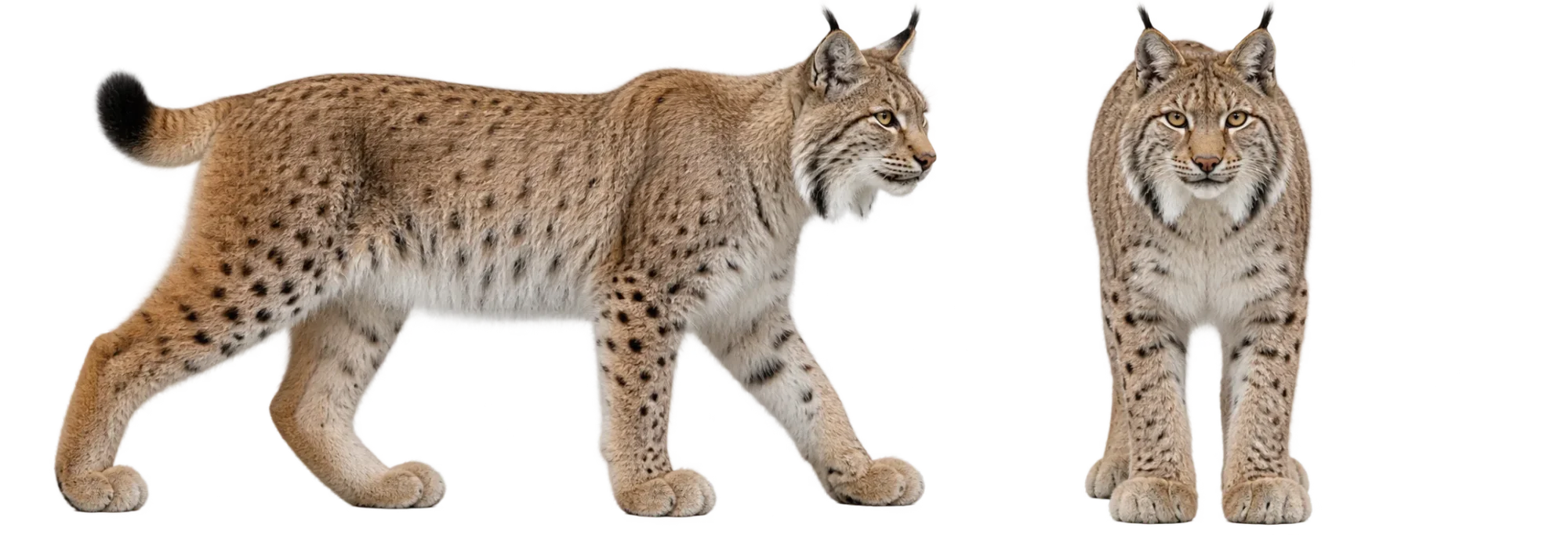
The Eurasian lynx (Lynx lynx) fits most of its reproduction into a narrow annual window. Births are strongly concentrated in late spring, kittens remain dependent on their mother through the following winter, and young females do not immediately reproduce at the same rate as experienced adults. Long-term field studies show that maternal age affects whether a female breeds and how well her offspring survive, even though litter size itself changes relatively little through much of adult life.
Reproduction Is Concentrated Into One Annual Cycle
Eurasian lynx are strongly seasonal breeders. In Scandinavian populations, mating is concentrated mainly in March and April, followed by births in May and June. A study of 175 known birth dates found that births clustered around May 30, with 173 occurring between May 2 and June 30.
This tight timing reflects unusual reproductive physiology for a cat. Female lynx normally have one oestrous period each year. After ovulation, ovarian structures called corpora lutea can remain hormonally active for an unusually long period. Their continued production of progestagens helps suppress additional reproductive cycles during most of the year.
That pattern makes a second mating opportunity uncommon, but apparently not impossible. In the Scandinavian birth-date study, two females produced very late litters, on July 29 and August 15. Researchers found no evidence that either female had first lost an earlier litter. These cases support the possibility of a rare second oestrus rather than a normally extended breeding season.
The result is a life cycle in which reproductive events are highly synchronized. Most kittens begin life at roughly the same point in the seasonal year, giving them several months of growth and maternal care before their first winter.
Female Age Changes the Chance of Successful Reproduction
Sexual maturity does not mean that every young female immediately produces kittens. Eurasian lynx females can enter reproductive life at about two years of age, but field studies have repeatedly found lower breeding rates among these young adults than among females in their prime years.
The clearest large-scale evidence comes from a 2026 Biology Letters study that combined 38 years of observations from 173 known-age females across Europe and western Asia. Breeding probability rose from early adulthood, reached its highest levels during intermediate ages, and then declined among older females.
That pattern adds useful context to a simple maturity-age value. A female may be capable of breeding at two years without having the same reproductive performance she will show later. Continued physical development and experience with hunting, territory use, mating, den selection, and maternal care can all separate basic maturity from peak reproductive performance.
Older age also has an effect. The same long-term study detected a decline in breeding probability late in life, along with lower offspring survival among older mothers. In northern populations, older females also tended to have smaller litters. Reproductive performance therefore follows an age curve rather than remaining constant throughout adulthood.
Litter Size Is More Stable Than Breeding Probability
Wild Eurasian lynx usually give birth to small litters. Field studies commonly record one to four kittens, with two kittens especially common. What is notable is how little this number changes across much of a female’s reproductive life.
Earlier Scandinavian research following radio-collared females found clear variation in the proportion of females that reproduced, but much less variation in litter size once reproduction occurred. The newer multi-population study reached a similar result: litter size remained around two kittens through much of adulthood even while the probability of breeding changed with age.
This distinction matters when interpreting reproductive data. A young female may be less likely to produce a litter in a given year, yet a young female that does breed does not necessarily produce a much smaller litter than an older female.
Maternal investment also continues long after birth. Compared with pregnancy, raising mobile, growing kittens requires months of feeding, protection, and access to prey. For Eurasian lynx, reproductive success is therefore not well represented by litter size alone. Whether kittens survive through the long period of dependence is another major part of the life-history pattern.
Maternal Care Continues Through the First Winter
For the first weeks after giving birth, a female repeatedly returns to a natal area while hunting away from her kittens. Tracking studies describe this as central-place foraging. The pattern is especially clear during roughly the first six to eight weeks, when the kittens are still closely tied to the den or natal site.
As the kittens become more mobile, the family begins moving together over a larger part of the mother’s range. Their dependence lasts far beyond the den stage. Field observations place separation from the mother at roughly eight to eleven months of age, often during March or April of the following year.
This timing links one generation directly to the next breeding season. Kittens born near the end of May can spend summer, autumn, and much of winter learning within their mother’s range before separating as the next mating period approaches.
Survival during this period is variable. A Scandinavian study of breeding females found that about 70% of mothers known to have reproduced in spring were still accompanied by at least one offspring during the following winter. More recent work across Europe also shows that offspring survival varies with maternal age, tending to be highest for females in the middle part of their reproductive lives.
Family separation marks a major transition rather than immediate adulthood. Young lynx then enter a dispersal stage in which they must establish independent movement patterns and eventually secure access to a suitable home range. Reproductive maturity follows soon afterward for some individuals, but successful breeding may take longer.
 LionPanthera leo
 LeopardPanthera pardus
 BobcatLynx rufus
 CheetahAcinonyx jubatus