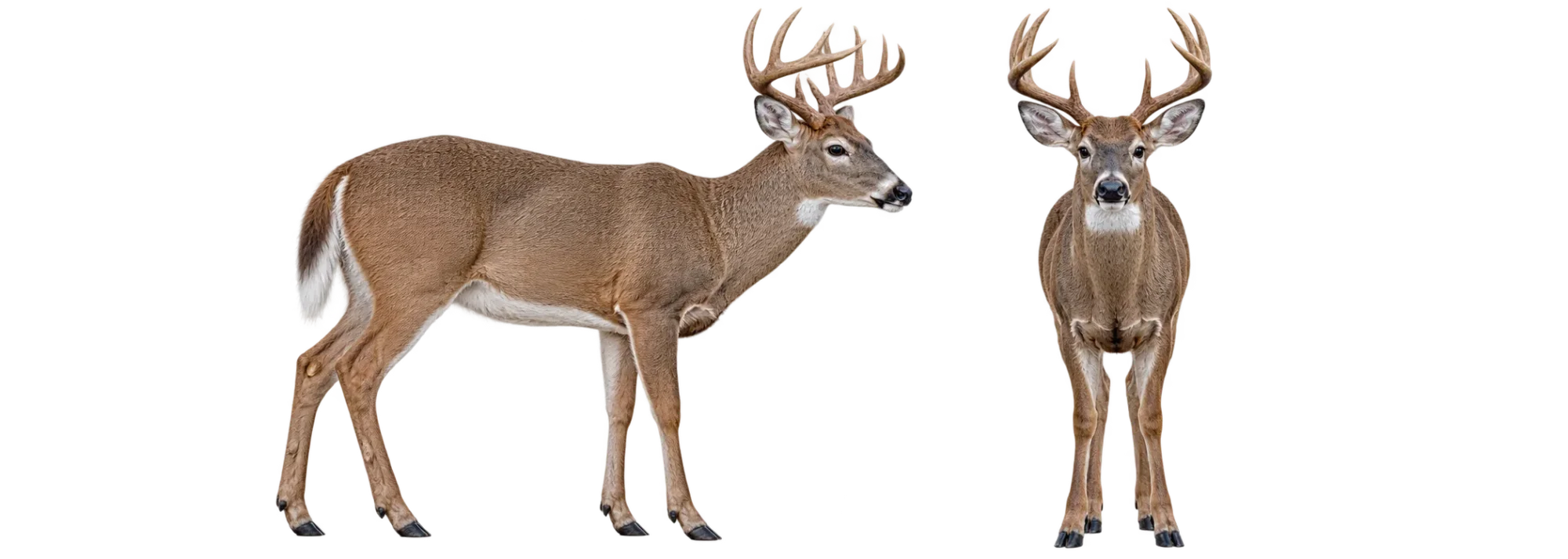
White-tailed deer (Odocoileus virginianus) do not follow one reproductive calendar across their entire range. Their life history changes with latitude, season, nutrition, maternal age and body condition. Those differences are especially clear in the timing of breeding, the number of fawns a female produces, and the pace at which young deer move from hiding newborns to independent juveniles.
Breeding Timing Changes Across the White-Tailed Deer Range
In northern populations, reproduction is strongly seasonal. Shortening day length helps synchronize the rut, so many females conceive within a relatively narrow period in autumn. In much of the northern United States, breeding activity centers around November, placing births in late spring or early summer when conditions are generally better for lactation and early fawn growth.
That familiar autumn-rut pattern becomes less uniform farther south. White-tailed deer occupy such a broad span of latitude that populations can differ markedly in breeding dates. Some southern populations breed weeks or months later than northern deer, while populations closer to the tropics may have a much longer reproductive season.
This geographic variation matters because a date that describes one population should not automatically be applied to the species as a whole. Florida alone has populations with very different breeding schedules, and research from tropical parts of the species’ range shows that reproduction can become far less tightly tied to the northern autumn calendar.
Once conception occurs, gestation generally lasts about six to seven months. Published values commonly fall around 187–213 days. The relatively stable pregnancy period means that differences in conception dates carry forward into differences in fawning dates.
Females that do not conceive during an estrous period can cycle again. Estrous intervals are usually measured in weeks rather than months, giving a doe another opportunity to become pregnant during the same reproductive season.
Maternal Age and Condition Shape Reproductive Output
A female white-tailed deer can become reproductively capable while still young, but reaching puberty does not guarantee pregnancy. Young females are particularly sensitive to nutrition and body condition. In productive environments, some female fawns can conceive during their first autumn. Where forage or body condition is poorer, first reproduction may occur later.
This creates an important distinction between age at sexual maturity and the age at which reproduction regularly succeeds. A young doe must allocate resources to her own growth as well as reproduction, while an adult female has already completed much more of her structural growth.
Maternal age also affects litter size. First-time and very young mothers are more likely to carry a single fawn. Mature females commonly produce twins when nutritional conditions are favorable, and triplets occur in some populations. Larger litters are possible but are unusual and should not be treated as the normal reproductive pattern.
Field data from Midwestern white-tailed deer illustrate how strongly age can influence reproduction. Pregnancy rates and average fetal counts were lower among fawn-aged females than among adults, and young females tended to conceive later in the breeding season. These patterns reflect the connection between age, body size, stored energy and the cost of continuing to grow while reproducing.
Food availability can shift reproductive performance even within the same population. A doe entering the breeding season in good condition has more resources available for conception, pregnancy and subsequent lactation. Poor nutritional conditions can reduce pregnancy rates, alter litter size and limit early fawn growth. For this reason, reproductive measurements from one herd or one year are not fixed species-wide constants.
The First Weeks of Fawn Life Depend on Concealment
A newborn white-tailed deer enters a short but distinctive developmental stage in which remaining hidden is more useful than following its mother continuously. Fawns can stand soon after birth, yet they are not immediately able to travel with an adult doe or escape danger at adult speed.
During the first weeks, a fawn spends long periods bedded alone in vegetation or other cover. The mother moves away to feed and returns periodically to nurse. When twins are present, the doe may keep them in separate bedding locations rather than placing both young together.
This separation is normal maternal behavior. It reduces the amount of time an adult deer is standing close to a concealed newborn and allows the doe to meet the nutritional demands of milk production. The fawn’s spotted coat, low profile and tendency to remain motionless all support this early hiding strategy.
The arrangement changes quickly as locomotion improves. By roughly the first month, young deer become much better able to accompany their mothers. They also begin sampling vegetation early in life while continuing to depend on milk.
Weaning is a process rather than a single event. Published life-history accounts commonly place completion of weaning at around 8–10 weeks, although association between a doe and her offspring continues well beyond the nursing period. Young females may remain within maternal social groups longer, while young males typically disperse from their natal associations as they approach or pass their first year.
Early growth is rapid. Newborn mass varies with sex, litter size, maternal condition and population, so one birth-weight figure does not represent every fawn. Growth during the first weeks can be fast enough for body mass to multiply within a short period, supported by milk and then by the gradual addition of plant food.
Reproductive Maturity Arrives Before Adult Growth Is Finished
White-tailed deer can become sexually mature well before they reach their final adult body size. This is especially useful when interpreting maturity data: a yearling capable of reproduction is still a growing animal.
Female body mass commonly approaches a stable adult level earlier than male body mass. Reviews of white-tailed deer growth place female stabilization often around three to four years of age, while males commonly continue adding body mass until roughly four to five years. Local conditions can move those ages earlier or later.
Males provide an especially clear example of the difference between physiological maturity and reproductive participation. A young buck may be capable of breeding, yet older and larger males can limit his mating opportunities through competition during the rut. Reproductive ability therefore does not mean that males of every mature age contribute equally to breeding.
Growth rate itself remains sensitive to conditions experienced earlier in life. Birth mass, maternal nutrition, population density, forage quality and weather can affect how quickly a young deer develops. The result is natural variation among individuals of the same chronological age rather than a single body-size schedule that every white-tailed deer follows.
 Caribou, or ReindeerRangifer tarandus
 MooseAlces alces
 Red deerCervus elaphus