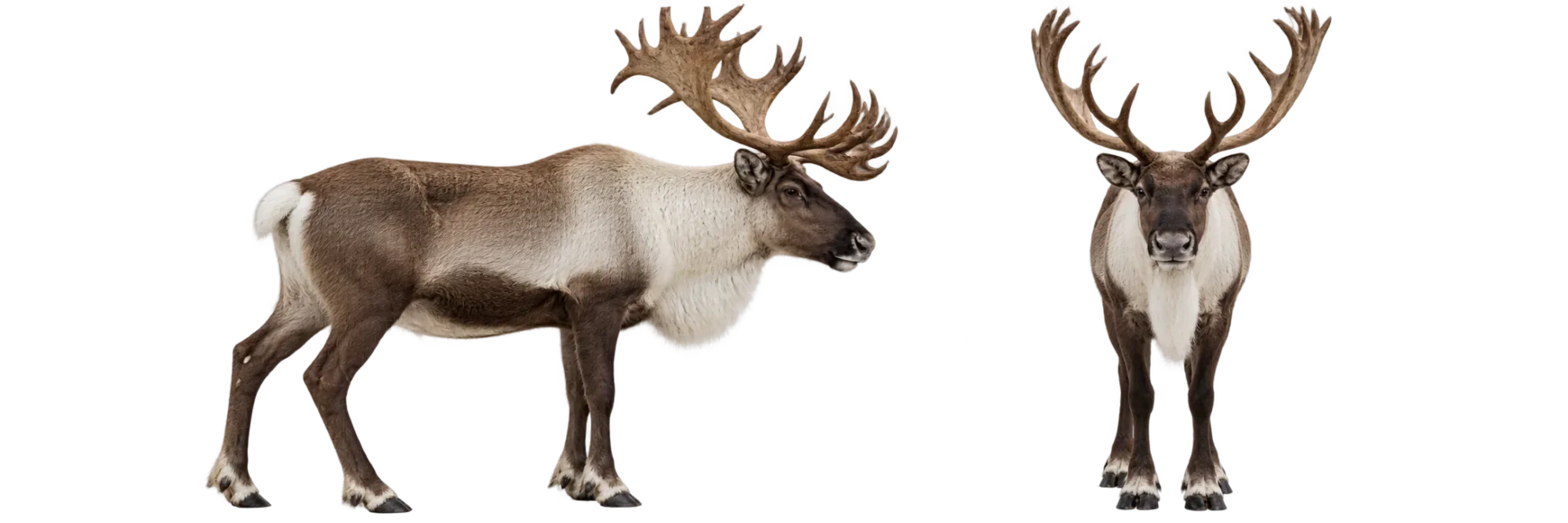
Caribou and reindeer are two common names for Rangifer tarandus. “Caribou” is used mainly in North America, while “reindeer” is the usual name across Eurasia, including both wild and managed populations. Regional forms differ greatly in size, movement and ecology, and several have been proposed as separate species. The Mammal Diversity Database version 2.5, released in July 2026, still retains them within Rangifer tarandus rather than adopting that proposed split.
A Short Rut Sets the Calendar for the Following Summer
Reproduction follows a strongly seasonal schedule. Across many populations, mating takes place in autumn, commonly during September and October. Pregnancy then extends through winter, with gestation generally reported at about 225–235 days. Most calves are born during May or June, although the exact timing shifts with latitude, population and local conditions.
The usual reproductive investment is one calf. Twins occur, but they are uncommon. This makes each pregnancy a large investment for the female, especially because much of fetal development takes place while winter limits the quality and availability of food.
Births within a herd are often tightly synchronized rather than spread across the whole spring. Some populations produce most of their calves within a period of only several days to a few weeks. This concentrates the most vulnerable stage of calf life into a short seasonal window and allows calves to enter the brief northern growing season at roughly the same time.
Calves Must Become Mobile Almost Immediately
A newborn caribou or reindeer calf enters a very different developmental path from a young mammal that can remain hidden in a den or nest. It is born well developed enough to stand, nurse and begin following its mother soon after birth. Mobility develops rapidly because females may continue moving across open ground and because a calf that cannot stay close to its mother is especially exposed during its first days.
Milk supports the calf during its first rapid growth phase, but plant feeding begins early. Dependence on milk then declines as summer forage becomes available. Published weaning estimates differ among populations and sources, which is expected for an animal spread across such a wide range; nursing can decline strongly during summer even when occasional suckling continues later.
This early development is closely matched to northern seasonality. A calf born near the start of plant growth has only a limited summer in which to gain body mass before its first winter. Birth timing, maternal milk production and access to good summer forage therefore affect the same developmental window rather than acting as isolated traits.
Female Body Reserves Link One Season to the Next
Pregnancy continues through the part of the year when northern food supplies are often poorest. Female Rangifer can therefore draw on body reserves accumulated earlier, using stored energy and protein while supporting fetal development during winter. Research on reindeer and caribou describes this reliance on maternal reserves as an important part of their reproductive physiology.
Body condition also helps explain why the same species can show different reproductive rates from one population or year to another. Females in good condition may reproduce at a younger age, while females facing poorer nutrition may delay their first pregnancy or fail to reproduce in a particular year. Alaska data indicate that exceptionally well-conditioned females can breed at about 16 months, although first breeding at roughly 28 months is more typical in many herds.
Maternal mass has also been associated with pregnancy rate, calving date, calf birth mass and early calf survival in studies of reindeer. A heavier female is not simply a larger version of a lighter one; her stored resources can change the reproductive outcome of that season and the starting condition of her calf.
Male Reproduction Is Concentrated Into an Intense Autumn Period
Males follow a different seasonal energy pattern. During the rut, mature bulls compete for access to females and may reduce feeding while spending more time on courtship, movement and competition. Body reserves built before the breeding season help support this short period of high reproductive effort.
Sexual maturity does not guarantee equal breeding success. Young males may be physiologically capable of reproduction before they can compete effectively with older bulls. Reviews of North American caribou report that successful breeding by males commonly occurs later than the first appearance of sexual maturity, with mature body size and social competition affecting access to females.
This difference between female and male schedules is part of the species’ annual rhythm: females carry the energetic cost of pregnancy into winter and lactation into summer, while adult males concentrate much of their reproductive expenditure around the autumn rut.
Female and Male Antlers Run on Different Seasonal Clocks
Both sexes can grow antlers, an unusual pattern among deer. Their antler cycles are not identical. Adult males generally cast their antlers after the autumn rut, while females can retain theirs through winter. Pregnant females may keep them until around the calving period.
For males, the largest antlers coincide with competition during the breeding season. Female antlers have a different seasonal role. Research has linked their winter retention to competition over feeding sites, particularly where food must be reached through snow. The timing is also tied to female reproductive physiology, so antler retention and pregnancy occur during much of the same winter period.
The connection can be seen in the timing of antler casting. Pregnant females commonly retain antlers later than adult males, and reproductive state can influence when females lose them. In Rangifer, antlers are therefore part of the annual reproductive schedule as well as a visible physical trait.
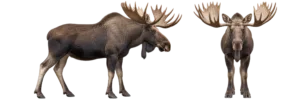 MooseAlces alces
 Red deerCervus elaphus
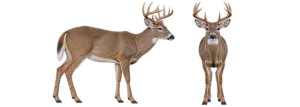 White-tailed deerOdocoileus virginianus