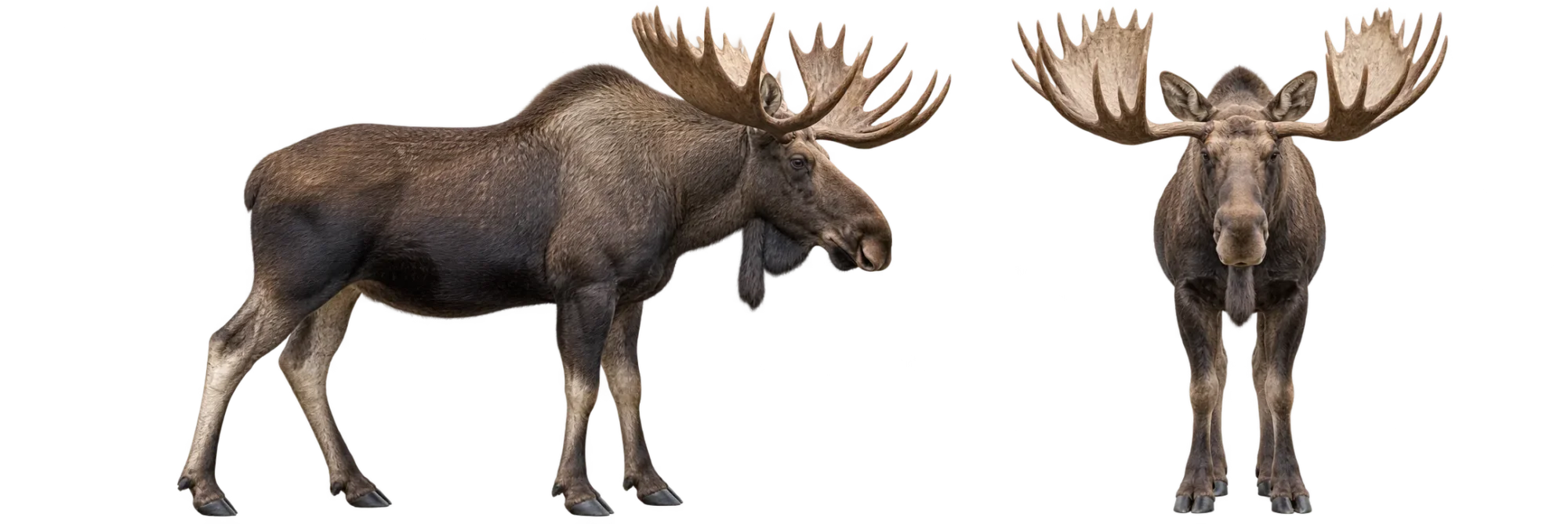
Moose reproduction is timed so that calves arrive as spring plant growth accelerates across much of the species’ northern range. That timing links pregnancy, milk production, calf growth and the female’s next breeding attempt to the amount of energy available during a relatively short growing season.
The Breeding Calendar Compresses Growth Into One Summer
Moose are strongly seasonal breeders. Mating is concentrated in autumn, and North American studies place the main rut around late September and early October. Gestation averages close to 231 days, placing most births in spring.
This schedule gives a newborn calf access to improving forage at the same time its mother is producing milk. Calves are small compared with adults at birth, commonly around 13–16 kg in Alaskan records, but their early growth is extremely fast. During the first several months they combine nursing with an increasing amount of plant food and can multiply their birth mass many times before winter.
The result is an annual maternal cycle with little idle time. A female can be nursing a growing calf while preparing physiologically for another autumn breeding season, then carry the next pregnancy through winter while the previous calf remains nearby.
Body Condition Shapes Female Reproductive Output
Female reproductive timing is unusually sensitive to growth and nutrition. Well-grown females can become reproductively active as yearlings, while females growing under poorer conditions may mature later. Alaska records, for example, place normal first breeding near 28 months but document conception as early as about 16 months.
The same relationship appears in the number of young produced. Moose commonly have one calf, but twins can be frequent where females have access to good forage. Twinning therefore varies far more among populations than a simple species-wide litter value suggests.
Research on Norwegian moose shows why body condition matters beyond conception. In one study of 65 adult females, early-winter pregnancy rates remained at or above 0.8 across the study years, yet the proportion producing calves in spring ranged from 0.40 to 0.83. Loss of body mass during winter explained reproductive outcome better than body mass measured at only the start or end of winter.
A female can conceive successfully and still fail to add a surviving calf to the population. Embryonic loss, late pregnancy conditions, birth losses and calf mortality all occur after conception. For moose, reproductive potential is therefore larger than the number of young that eventually survive to independence.
Age interacts with this energy balance. Young females are still allocating resources to their own growth, so reaching a larger body mass has a particularly strong association with whether they reproduce. Research across Norwegian populations found that the relationship between body mass and ovulation was much stronger in young females than in older adults.
Early Survival Can Differ Sharply Between Populations
Producing a calf is only one part of reproductive success. The weeks and months after birth can remove a large share of a year’s offspring, and the causes vary across the moose range.
Predation by bears and wolves can account for many early calf deaths in some areas. Elsewhere, parasites, maternal nutrition and local habitat conditions may have a larger role. This variation makes a single universal calf-survival percentage a poor description of the species.
A 2017–2020 study in Vermont followed adult females and calves in a population affected by winter ticks. Researchers found reduced productivity and low calf survival associated with the parasite burden and nutritional condition. The pattern was local rather than a fixed feature of moose biology, but it shows how events during one winter can carry into the next reproductive season.
More recent work from New York found another population with a different balance of pressures. Moose monitored during 2015–2018 and 2022–2024 had relatively high annual survival, while infection by giant liver fluke accounted for much of the recorded disease-related mortality. Calf mortality risk also fell as estimated nutritional energy availability increased.
These population differences help explain why pregnancy rate, number of calves born and number of calves surviving should be treated as separate life-history measurements. Each describes a different point between conception and the addition of an independent young animal to the population.
Male Maturity Continues Beyond the First Breeding Age
Bull moose can become physiologically capable of reproduction while still young. North American reproductive work has documented puberty in yearling males, but reaching puberty does not place a young bull on equal terms with a fully grown adult during the rut.
Moose continue developing well beyond their first possible breeding season. Body size, antler development and reproductive physiology change with age, giving mature bulls different breeding opportunities from yearlings. In Alaska, the largest antlers are often produced around 10–12 years of age, although large antlers can appear several years earlier.
Male reproductive condition is also tied to body development. A study of Swedish bulls aged 1.5 to 11.5 years found that measures of normal sperm were positively associated with carcass and testis mass. Age alone therefore does not describe male reproductive condition as well as age considered together with physical development.
The rut itself is brief. A North American review found that most pregnancies in studied populations were initiated within a narrow part of the breeding season. Bulls enter that period after months of antler growth and seasonal reproductive development, then testosterone declines after the rut and antlers are shed during winter.
 Red deerCervus elaphus
 White-tailed deerOdocoileus virginianus
 Caribou, or ReindeerRangifer tarandus