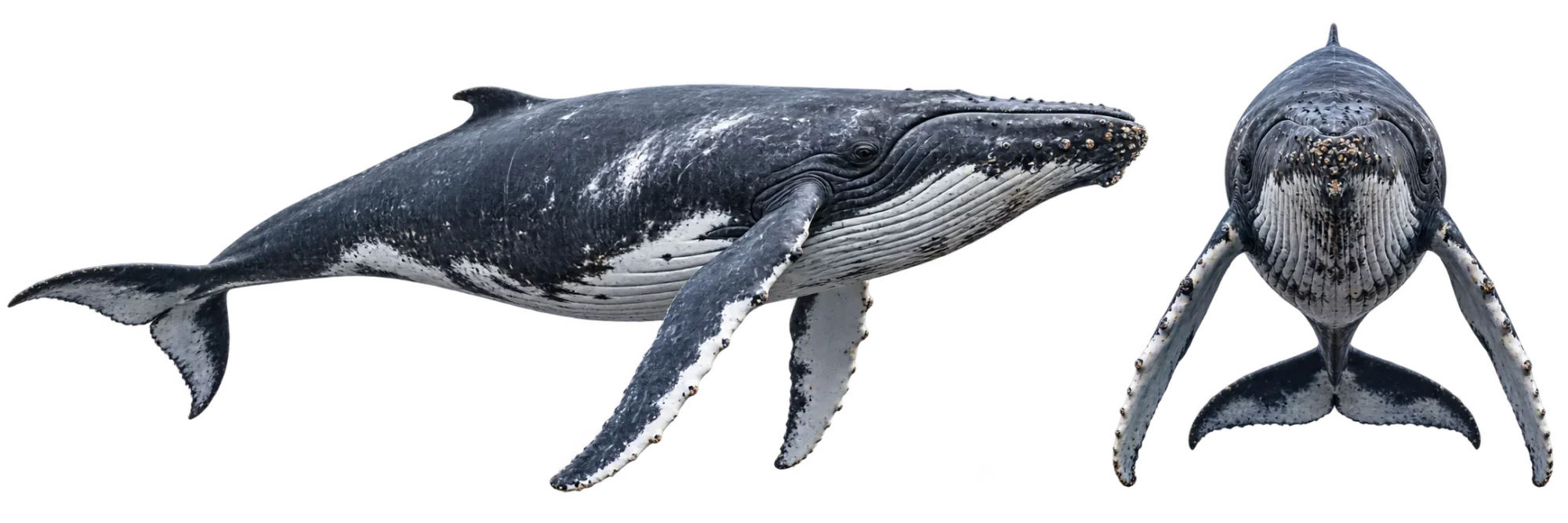
For a humpback whale, reproduction is tied to the yearly movement between productive feeding areas and lower-latitude breeding waters. Females build energy reserves during the feeding season, then draw heavily on those stores during migration, birth and early nursing. This link between feeding success and reproduction shapes much of the life history of Megaptera novaeangliae.
Migration and Reproduction Run on the Same Energy Cycle
Most humpback whale populations separate feeding from breeding across thousands of kilometres. Whales usually spend the productive part of the year feeding in temperate, subpolar or polar waters, then migrate toward warmer breeding areas. During much of the winter breeding period, feeding is limited or absent.
This makes the humpback whale a capital breeder: energy stored earlier in the year can later pay for migration and reproduction. The relationship is especially demanding for females. A pregnant whale may leave a feeding ground carrying both the developing fetus and the reserves needed for a long migration. After birth, those reserves also support milk production.
The familiar reproductive figures fit inside this larger cycle. Pregnancy lasts about 11 to 12 months, so conception during one breeding season can be followed by birth around the next. A female normally produces one calf. The timing keeps late pregnancy, birth and early calf development aligned with the annual migration pattern.
Feeding success carries forward
A female’s condition at the end of the feeding season can affect how much stored energy is available for migration, pregnancy and nursing. Reproduction therefore depends on more than the time spent on the breeding ground.
The First Year Concentrates an Exceptional Amount of Growth
Humpback calves grow quickly because they must develop while accompanying a mother that is already moving through an ocean-scale annual cycle. Nursing begins immediately after birth, and the mother-calf pair remains the most stable social relationship in the species during this period.
Research using drone measurements in Hawaiʻi and Southeast Alaska has made the energetic scale of this early growth easier to measure. In one North Pacific study, lactating females in Hawaiʻi lost body volume while fasting as their calves rapidly increased in size. Larger females and females in better body condition tended to produce larger, faster-growing calves.
A 2025 growth analysis also estimated that postnatal growth demands far more energy than prenatal growth. Much of the calf’s lifetime structural growth is compressed into its first year, placing a heavy cost on lactation rather than spreading that cost evenly across development.
Weaning is better understood as a transition than as a single date. Calves can begin reducing their dependence on milk around the middle of the first year, while nursing and close association with the mother may continue for close to a year. By the time independence develops, the calf has already completed a large part of its early physical growth.
Calving Intervals Reflect the Cost of Rebuilding Reserves
Humpback females commonly have a calf every two to three years, although annual calving has been documented. The interval is not simply a fixed biological timer. Pregnancy and especially lactation remove energy that later has to be replaced through feeding.
This can be seen after mothers return to feeding areas. Drone-based measurements in Southeast Alaska found that lactating females restored body condition more slowly than females in other reproductive states. They were feeding again, but part of the incoming energy was still being transferred to a growing calf.
A female that finishes one reproductive cycle with ample reserves may be able to reproduce again sooner than a female that needs more time to recover. Age, body size, prey conditions and individual history can therefore contribute to variation between females and between years. An observed two- or three-year interval is the outcome of this energy balance rather than a rule followed by every adult female.
Sexual maturity also does not mark the end of growth or guarantee immediate reproduction. Humpbacks can become reproductively mature within the first decade of life, while body growth and accumulated reproductive experience continue beyond that point.
A Calf’s First Migration Helps Shape Where It Returns Later
The months spent beside the mother provide more than nutrition and protection. A calf follows her through part or all of a migration circuit, linking breeding waters with the feeding destinations she already uses.
Long-term photo-identification and genetic work show strong maternally directed fidelity to feeding areas. Young whales are more likely to return to places they experienced with their mothers. Studies in the Gulf of Maine found that whales first seen as calves at particular feeding sites later returned to those same areas more often than whales without that early association.
This maternal influence can remain visible at the population level. Mitochondrial DNA patterns differ among some feeding regions more strongly than markers inherited from both parents, a pattern consistent with generations of calves learning and returning to maternally used destinations.
The mother-calf bond usually ends after the first year rather than developing into a permanent family group. Even so, experience gained during that short period can continue to influence where an independent whale feeds and migrates years after direct maternal care has ended.
 Blue whaleBalaenoptera musculus
 Fin whaleBalaenoptera physalus
 Common minke whaleBalaenoptera acutorostrata