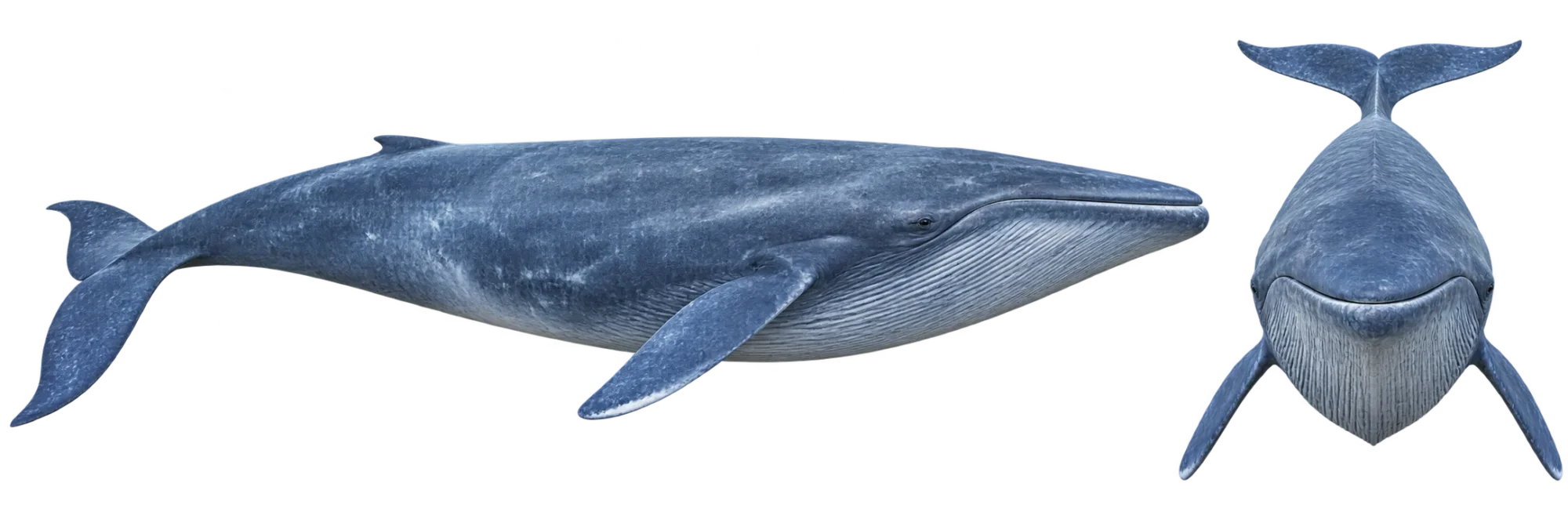
Blue whale development is concentrated into two very different periods: exceptionally fast growth before and soon after birth, followed by years of slower growth before regular reproduction begins. For Balaenoptera musculus, the scale of the animal makes the first year especially striking, but the pace of reproduction across adulthood is comparatively slow.
A 10–12 Month Pregnancy Produces a Multi-Tonne Calf
A blue whale pregnancy lasts only about a year, yet the calf reaches roughly 6–8 m in length and several tonnes in mass before birth. That requires a rate of prenatal growth far beyond what body size alone might suggest.
Research on blue whale fetal development indicates that this acceleration does not begin at the earliest embryonic stage. A growth model built from historical fetal measurements found that the most rapid increase takes place during the fetal period, after major early developmental changes are already underway.
This distinction matters because a newborn blue whale is not simply a proportionally enlarged embryo. During gestation, its skeleton, head, respiratory passages and other structures develop into the specialized form needed by a swimming marine mammal while its total body length rises rapidly toward several metres.
The exact length and mass reported for newborns vary among populations and historical datasets. Values around 7 m are common, but birth size should be treated as a biological range rather than a single fixed measurement.
A Calf Can More Than Double Its Birth Length Before Weaning
The fastest visible growth comes during the nursing months. Blue whale calves feed on energy-rich milk and may gain up to about 90 kg in a day during periods of rapid growth.
Nursing usually lasts roughly 6–8 months. By the end of that period, a calf may be around 16 m long. The change is large enough that a recently weaned blue whale is already longer than the adults of many other whale species.
This early growth is supported almost entirely by the mother. Baleen whale milk contains much more fat than ordinary cow’s milk, allowing a large amount of energy to be transferred without requiring the calf to consume the huge volume of liquid that a more dilute milk would demand.
Weaning also fits into the annual movement of many blue whale populations. Births are associated mainly with the winter reproductive season, while weaning is thought to occur on the way to productive feeding areas or after the whales reach them. The calf therefore moves from milk dependence toward independent feeding during the same part of the year when dense prey becomes more available.
Not every blue whale population follows an identical migration schedule, so this seasonal pattern should not be read as a fixed route followed by every individual.
The Cost of Raising a Calf Extends Beyond Pregnancy
For a female blue whale, producing a calf is not finished at birth. Lactation places an even larger energetic demand on the mother as she supplies enough milk to support months of rapid calf growth.
Body-condition research in eastern North Pacific blue whales found that females accompanied by dependent calves were more likely to be in poor body condition than calves or other photographed whales. The pattern matches the high energy cost expected during lactation.
This helps explain why blue whales normally do not produce a calf every year. The commonly estimated 2–3 year interval between calves allows time for a female to complete pregnancy and nursing and to rebuild the body reserves used during reproduction.
Feeding success can therefore affect reproduction beyond the current season. A female entering a reproductive period with reduced energy stores may be less able to support pregnancy and lactation. In populations that migrate between concentrated feeding areas and winter reproductive areas, energy acquired during productive feeding periods can influence events many months later.
Some eastern North Pacific blue whales feed during much more of the year than the older model of a strict summer-feeding and winter-fasting cycle suggests. The details vary geographically, but the biological link between prey intake, maternal condition and successful reproduction remains important.
Sexual Maturity Varies by Population and Method
Blue whale maturity is often given as a broad age range because researchers cannot follow most individuals continuously from birth. NOAA currently places sexual maturity at roughly 5–15 years, reflecting the uncertainty and variation in available records.
More focused work can produce narrower estimates. Studies of eastern North Pacific females have placed sexual maturity near 8–9 years, with first birth around 9–10 years. Hormone measurements preserved in the earplug of one male blue whale also suggested sexual maturity at about 10 years.
These figures should not be merged into one universal age. Blue whales occur as different populations and subspecies, and historical maturity estimates have been based on several methods, including reproductive organs, body length, earplug layers and hormone profiles.
Sexual and Physical Maturity
Reproductive maturity does not mean that growth has ended. A blue whale can become capable of reproduction while skeletal and body growth continue. Length at maturity also differs among populations, partly because Antarctic blue whales reach larger adult sizes than some other forms.
Earplug Layers Provide a Record of Age Across Decades
Blue whales are estimated to live for many decades, with commonly cited average lifespan estimates around 80–90 years. These values are estimates rather than ages obtained by tracking known individuals from birth.
One of the main aging tools is the whale’s waxy earplug. Layers accumulate through life and can be counted after the animal dies. In blue whales, the same material can preserve chemical information, allowing researchers to reconstruct parts of an individual’s developmental history as well as estimate age.
A study of a male blue whale that died at an estimated age of about 12 years used successive earplug layers to trace testosterone over the animal’s lifetime. The hormonal pattern placed sexual maturation near age 10, showing how an aging structure can also record a biological transition.
Earplug counts are useful, but a maximum-longevity figure derived from them should not be treated as the normal lifespan of every blue whale. Age estimates depend on the condition of the sample and interpretation of its growth layers. Long lifespan, age at sexual maturity and maximum recorded age therefore describe different parts of the species’ life history and should remain separate.
 Fin whaleBalaenoptera physalus
 Humpback whaleMegaptera novaeangliae
 Common minke whaleBalaenoptera acutorostrata