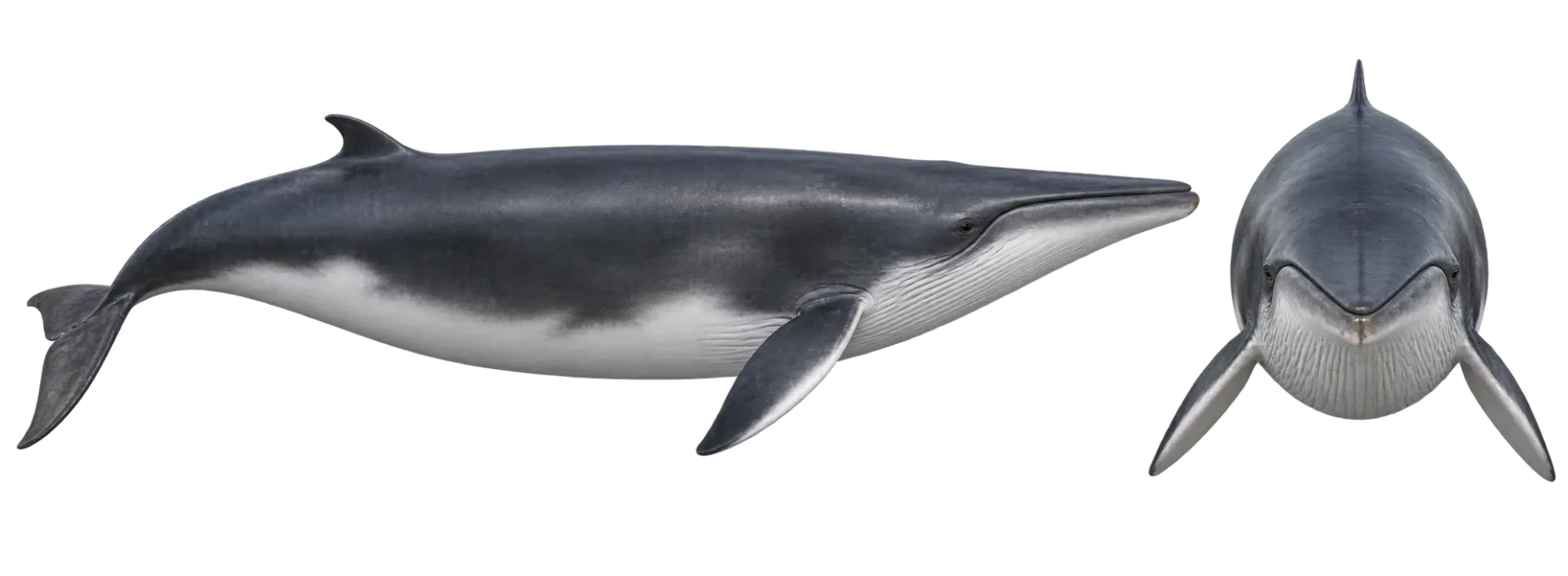
Common minke whales (Balaenoptera acutorostrata) can move through pregnancy, nursing, and another reproductive opportunity on a much tighter schedule than many larger baleen whales. That fast cycle is supported by intense seasonal feeding, rapid early growth, and relatively early reproductive maturity, but the timing is not identical across all populations included within the species.
How Common Minke Whales Can Calve in Consecutive Years
Pregnancy lasts about 10 to 11 months and normally produces a single calf. Nursing is comparatively brief for a large whale: calves generally remain dependent on milk for roughly four to six months.
This schedule leaves little room for the long non-reproductive interval seen in many other baleen whales. North Atlantic and other northern common minke whale populations are therefore often described as capable of near-annual or annual reproduction.
Annual calving should not be read as a rule that every mature female produces a calf each year. Pregnancy success, calf survival, body condition, seasonal timing and population differences all affect the interval observed between calves.
Summer Feeding Supports Both Reproduction and Rapid Growth
The reproductive schedule is closely tied to how common minke whales use energy. Research on whales feeding around Iceland found that mature and pregnant animals added blubber through the feeding season. Those stored reserves can later support migration, fetal development, milk production and normal body maintenance.
Immature whales showed a different pattern. Instead of accumulating seasonal blubber in the same way as reproductive adults, more of their available energy appears to be directed toward body growth. Reaching reproductive size quickly has a clear life-history benefit in a species that begins breeding relatively early for a baleen whale.
Female body condition has also been linked with fetal growth in common minke whales. Pregnancy therefore draws on energy acquired well before birth, especially during productive feeding periods.
The calf continues this fast-growth phase after birth. Milk dependence lasts only part of the first year, so a young whale must add body size rapidly before becoming nutritionally independent. This compressed early development fits the broader pattern of a species that moves from birth to reproductive maturity faster than many much larger whales.
Why Sexual Maturity Is Reported as an Age Range
Common minke whales are usually reported to reach reproductive maturity within roughly the first decade of life, with many estimates clustering around six to eight years. The exact age is less certain than a single profile value can suggest.
One reason is that aging a minke whale is technically difficult. Researchers have used growth layers in structures such as the tympanic bulla, but studies of North Atlantic animals have shown that counts from these layers can underestimate age. In one evaluation, the method produced an estimated bias of about 37% under the assumptions used in the analysis.
This matters when interpreting maturity, adult growth and longevity together. A whale classified as a certain chronological age by one aging method may not receive the same estimate from another method. Reported maturity ages should therefore be treated as population-level estimates rather than an exact biological birthday shared by every animal.
Sexual maturity marks the ability to reproduce. It does not mean that skeletal or body growth has completely stopped. Common minke whales may continue growing after they first become reproductively active.
Dwarf Minke Whales Show Why One Reproductive Schedule Does Not Fit the Entire Species
The common minke whale includes geographically separated forms and populations with different migration and breeding patterns. The dwarf minke whale of the Southern Hemisphere is particularly useful for showing how much variation can sit beneath the species name.
A 2026 study using long-term photo-identification records from eastern Australia inferred one-, two-, and three-year calving intervals among identified dwarf minke females. Consecutive-year calves occurred, proving that a short interval is biologically possible, but two- and three-year intervals were also recorded.
The same work found that information on individual females was often incomplete across years, so a missing calf could not always be interpreted as a true reproductive pause. Calf loss, missed sightings and conception timing can all change the interval visible in field records.
This variation is important when life-history values from North Atlantic or North Pacific common minke whales are used for the species as a whole. Gestation length, nursing period and early maturity form a broadly similar biological pattern, while the exact spacing of births can depend on the population being studied.
 Blue whaleBalaenoptera musculus
 Humpback whaleMegaptera novaeangliae
 Fin whaleBalaenoptera physalus