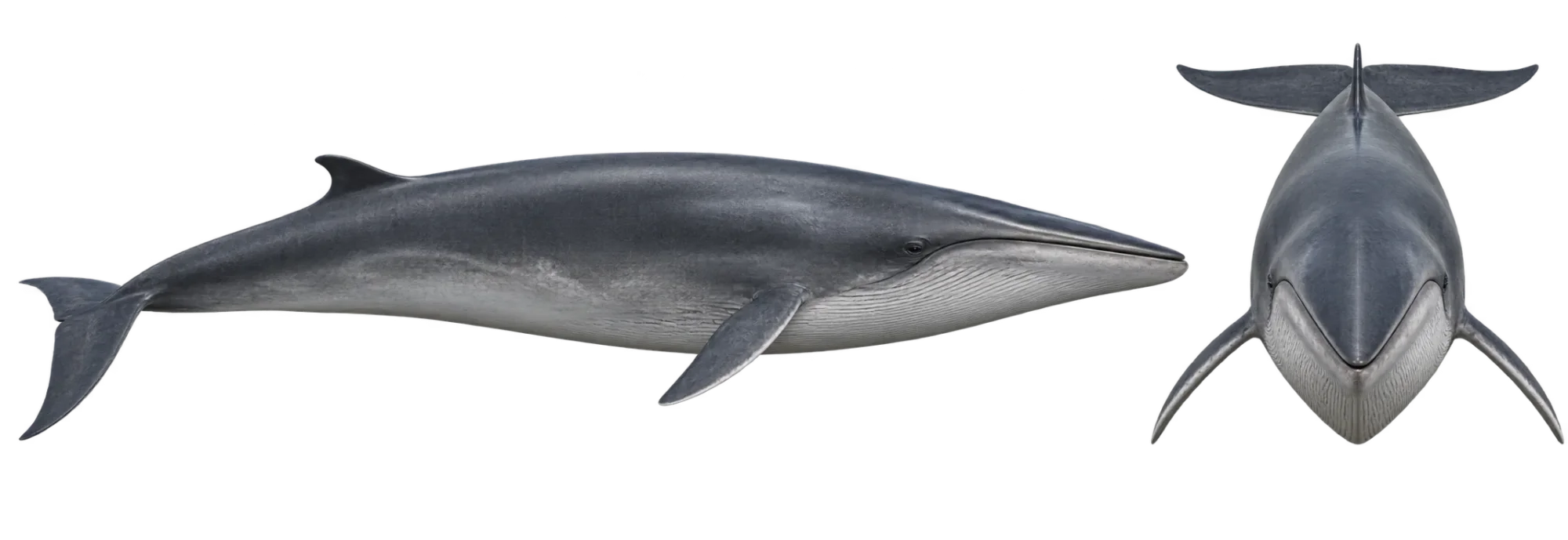
A fin whale can enter its reproductive years while it is still far from full physical maturity. In Balaenoptera physalus, breeding age usually arrives during the first decade or early teens, yet growth and skeletal maturation continue for many more years. That separation shapes a life history in which reproduction can span much of an exceptionally long adult life.
Reproductive Maturity Arrives Before Full Body Maturity
Sexual maturity and physical maturity describe different stages in a fin whale’s development. Published estimates commonly place male sexual maturity at roughly 6–10 years and female maturity at about 7–12 years. Full physical maturity is usually placed near 25 years of age.
The exact age cannot be reduced to one universal number. Historical studies have produced different maturity estimates among ocean regions, sexes, and sampling periods. North Atlantic estimates, for example, do not perfectly match values derived from North Pacific or Southern Hemisphere animals.
This variation matters because a reproductively mature whale should not automatically be treated as a fully grown whale. A female that has already begun breeding may continue changing in length and body proportions for years afterward.
Reproduction Runs on a Multi-Year Maternal Cycle
A fin whale pregnancy lasts about 11–12 months and normally produces one calf. The calf then depends on its mother through a nursing period commonly estimated at about six to seven months. These stages occupy much of the reproductive cycle, so births are not normally annual events for an individual female.
Intervals of roughly two to three years between calves are commonly reported. The spacing is an estimate rather than a fixed biological schedule. Individual history, population conditions, pregnancy success, calf survival and the quality of feeding periods can all affect when another calf is produced.
Breeding Is Seasonal, but Geography Varies
Conception and birth are strongly associated with the winter season in many fin whale populations. Older descriptions often present this as a regular movement from high-latitude feeding areas to warmer breeding waters. Field research has shown a less uniform pattern.
Some fin whales remain within regions such as the Mediterranean or Gulf of California for much or all of the year, and winter presence has also been documented at higher latitudes. Research on resident Gulf of California fin whales has still found a seasonal reproductive hormone pattern. Seasonal breeding, therefore, does not require every population to make the same long-distance migration.
The exact location of mating and calving remains poorly defined for several populations. Winter timing is better established than a single species-wide map of where reproduction takes place.
Calves Compress Major Growth Into the First Months
A newborn fin whale is already about six metres long, yet the nursing period supports another large burst of growth. By weaning at roughly six to seven months, reported calf lengths are commonly around 11–12 metres.
That is close to a doubling of body length within only part of the first year. Length alone does not describe the full energetic cost to the mother, but it shows why lactation occupies such an important part of the reproductive schedule.
Weaning also marks a major change in how the young whale obtains energy. The calf moves from maternal milk toward independent feeding on dense patches of small fish and crustaceans. In migratory populations, this transition commonly occurs as the mother and calf reach or approach productive seasonal feeding areas.
Weaning should not be treated as the same event as adult independence in every behavioral sense. It primarily marks the end of milk dependence. Association with the mother can continue beyond the point at which the calf begins feeding for itself.
Body Proportions Continue Changing as Fin Whales Grow
Growth in a fin whale is not a simple process of every body part enlarging at the same rate. Modern drone measurements are beginning to show how body proportions shift across different size classes without requiring physical handling of the whale.
A 2025 photogrammetry study measured ten body dimensions in 82 fin whales along the Catalan coast. The measurements showed negative allometric growth: several body dimensions changed more slowly than total body length rather than remaining in a fixed proportion.
The head region, for example, became proportionally smaller as animals approached about 14 metres, remained more stable through the next size range, and then showed another proportional change in larger whales. The study also detected different growth trajectories between males and females around the 15–17 metre range. Adult females generally attain greater total length, while male and female bodies do not reach that endpoint through identical proportional growth.
These drone measurements came from fin whales observed along the northwestern Mediterranean coast. They provide direct evidence that body shape changes with development, but the exact size relationships should not be converted into a universal growth chart for every fin whale population.
Earplugs Give an Independent Check on Long Fin Whale Lifespans
Age estimates for fin whales have traditionally relied heavily on laminated material in the ear canal. A fin whale forms a waxy earplug over its lifetime, and visible growth layers can be counted in much the same way that annual structures are used to age some other long-lived animals.
A 2024 study tested earplug ages against the well-dated rise in environmental radiocarbon created during twentieth-century atmospheric nuclear testing. Earplugs from three adult fin whales produced age histories consistent with the known radiocarbon timeline. The whales were roughly 65–85 years old, and the layer-based age estimates were within about 6% of the radiocarbon-based ages.
This gives much stronger support to the use of earplug layers for reconstructing decades of fin whale life than an untested layer count alone. It also helps place earlier research on growth and maturity on firmer biological footing.
Published upper lifespan estimates still vary. A value near 90 years is often used in species accounts, while some longevity records report an estimated wild maximum of 114 years. These figures describe different kinds of evidence and should not be presented as an expected lifespan for every animal.
A maximum longevity record is an estimate of the oldest known or inferred individual, not the age most fin whales routinely reach. For a species capable of living for many decades, that distinction is especially important when comparing longevity with maturity age, reproductive output or generation length.
 Humpback whaleMegaptera novaeangliae
 Blue whaleBalaenoptera musculus
 Common minke whaleBalaenoptera acutorostrata