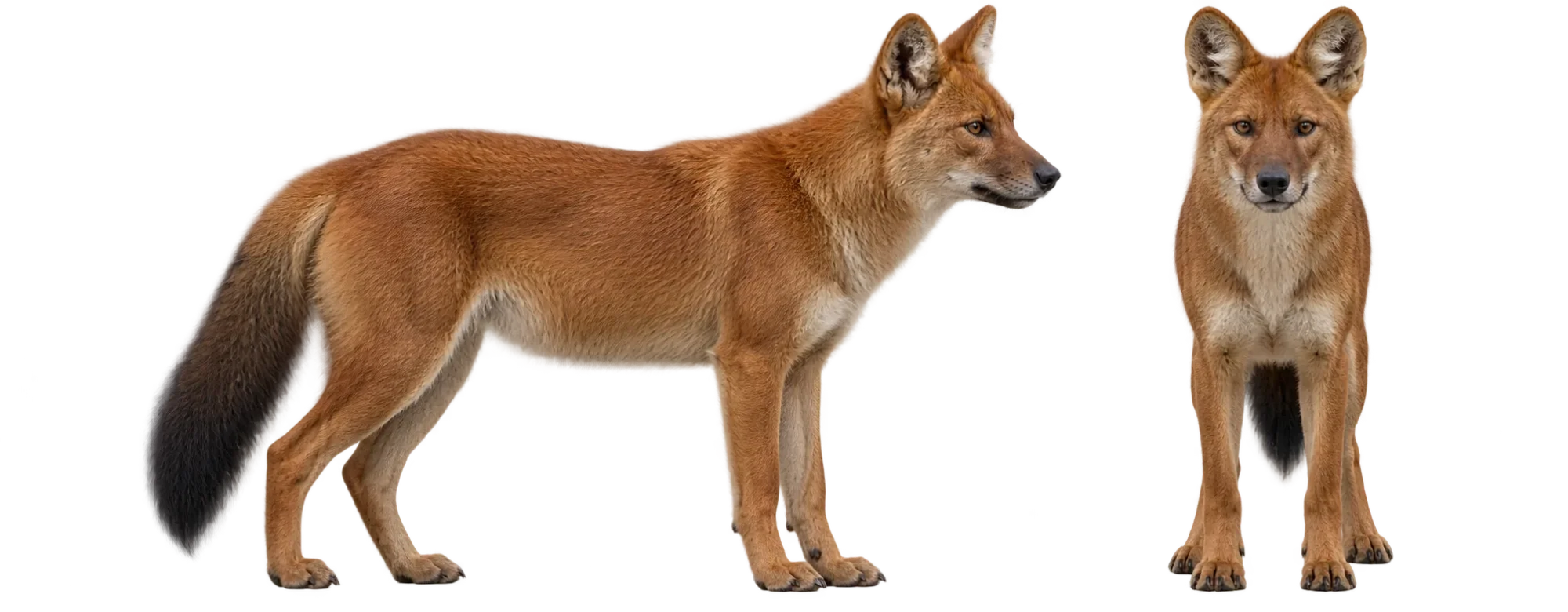
Dhole life history is closely tied to pack membership. A female may be physically capable of reproduction before she actually breeds, while pups depend on several pack members during the long transition from the den to active hunting. This social system makes breeding status, pup care and dispersal as important as gestation or litter size when describing the species.
Breeding Follows a Seasonal Cycle That Varies Across the Range
Dholes, Cuon alpinus, are seasonal breeders, but there is no single breeding month that applies everywhere they occur. Field observations from India have placed mating mainly within the cooler part of the year, while reports from other parts of Asia show different timing. Captive populations also vary.
Hormone monitoring supports this seasonal pattern. In captive dholes studied in Thailand, male reproductive hormone levels rose during the breeding period, while females showed a seasonal rise in ovarian hormones associated with estrus and ovulation.
Pregnancy lasts about nine weeks, commonly reported at roughly 60–63 days. Litters can be large for a canid of this size. Reports include four to twelve pups, although the number can differ greatly between females, packs and breeding seasons.
A female does not necessarily reproduce as soon as she becomes sexually mature. Field work on wild dholes has placed first successful breeding at around three years in some populations, while animals under captive conditions have reproduced earlier. Access to breeding appears to depend partly on social position within the pack, so physiological maturity and actual first reproduction should be treated as separate stages.
Pup Rearing Draws on the Whole Pack
The denning female carries and nurses the litter, but pup care soon becomes a group activity. Other dholes may remain near the den while packmates hunt, and returning animals provide food to both the mother and pups.
Regurgitated meat can become part of the pups’ diet when they are only a few weeks old. This allows food gathered away from the den to be transferred directly to dependent young. Pack members may also guard, groom and interact with the pups.
Many observations describe one main breeding female, but this is not absolute. More than one female has occasionally been recorded nursing young within the same group. In some older observations it was unclear whether all of those females had produced litters or whether some were nursing another female’s pups. Dhole reproduction is therefore better described as strongly socially regulated rather than restricted by an unbreakable one-female rule.
This shared care changes the cost of reproduction for the mother. She can remain with very young pups while other adults continue moving and feeding. It also links pup survival to the condition and stability of the pack rather than to the mother alone.
Pups Move From Den Dependence to Pack Hunting Within Months
The first months of a dhole’s life contain several distinct transitions. Nursing dominates the earliest period, followed by increasing use of regurgitated solid food. Weaning estimates differ among observations, but it generally occurs within the first two months rather than marking an immediate end to adult provisioning.
Adult body size is reached later than the first hunting experience, with observations placing full size at roughly 15 months. A young dhole can therefore travel and hunt with the pack well before its physical development and breeding opportunities are complete.
Reproduction Temporarily Changes How a Pack Uses Its Members
Denning affects the daily organization of the entire group. Classic field work found that one or more adults could remain with pups while other animals travelled to hunt. During this period, the number of dholes seen moving together away from the den can therefore underestimate the number belonging to the pack.
Recent research from Mudumalai Tiger Reserve provides another example. Researchers following identified packs recorded denning between December and February in the packs that reproduced. The number of adults observed away from den areas fell around the start of the reproductive period, consistent with adults remaining near young while other members continued normal movements.
Not every observed pack produced pups during the study. That variation matters because dhole life history operates at two levels: individual animals mature and disperse, while entire packs pass through years with different breeding outcomes, numbers of helpers and numbers of dependent young.
Older field studies also found male-biased adult groups and sex-related differences in dispersal. Young animals do not simply reach a fixed age and begin breeding where they were born. Movement between packs and the availability of a breeding position can shape when an individual finally enters the reproductive population.
 Red foxVulpes vulpes
 African wild dogLycaon pictus
 CoyoteCanis latrans
 Gray wolfCanis lupus