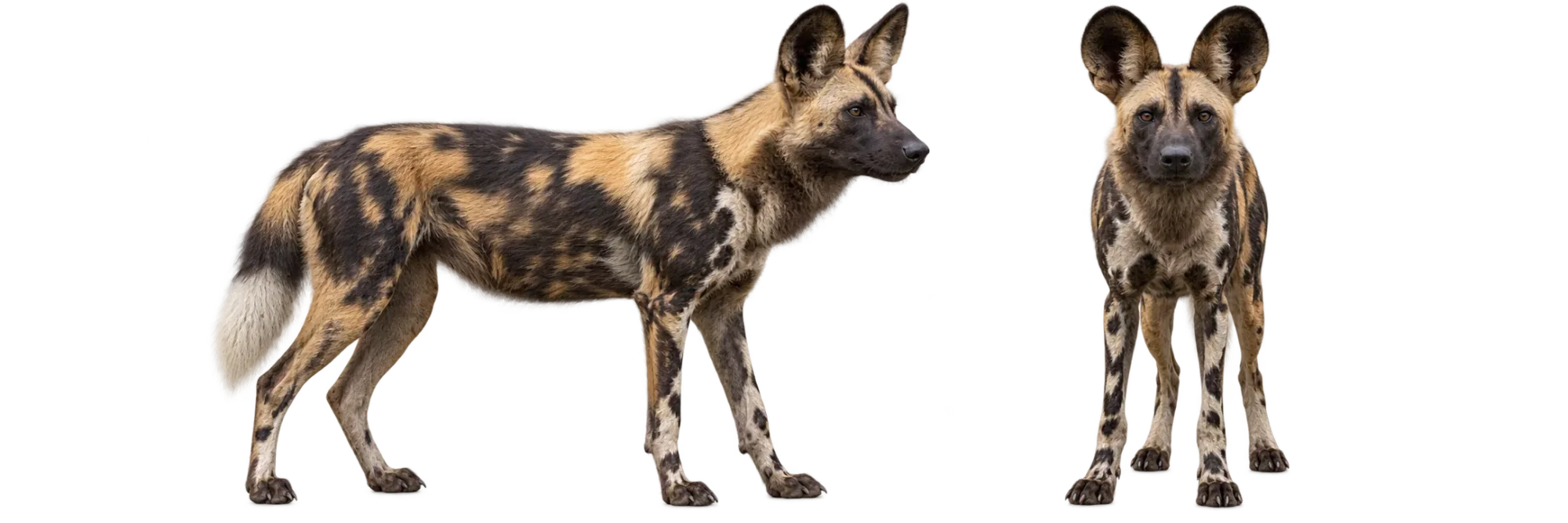
African wild dogs (Lycaon pictus) raise young through a pack-level breeding system. Most pups are produced by the dominant female and her mate, but their survival depends on adults and yearlings that hunt, guard the den, carry food back to the breeding female and feed pups that cannot yet travel with the pack.
Reproduction Is Concentrated Within the Pack
African wild dogs are cooperative breeders. A pack usually contains several animals old enough to reproduce, yet breeding is heavily skewed toward its dominant male and female. Genetic and field studies show that this pattern is strong rather than absolute: subordinate animals sometimes reproduce, and a litter can have more than one father.
This distinction matters because sexual maturity does not mean that an animal will immediately produce offspring. Wild dogs may become physiologically capable of reproduction while still living as non-breeding members of their natal pack. Many spend this period helping to raise younger pups before gaining a breeding opportunity elsewhere.
When a female becomes pregnant, gestation lasts roughly 69–72 days. Litters can be unusually large for a wild canid. Six to eight pups is common in reported datasets, while much larger litters have also been recorded. The number born is only one part of reproductive success; the number that survives through the denning period and reaches later juvenile stages can differ greatly.
The Breeding Calendar Varies Across Africa
A single continent-wide birth month would give a misleading picture of African wild dog reproduction. Populations in southern Africa often show a pronounced annual breeding season, with births concentrated during the cooler, drier part of the year. Nearer the equator, breeding can be less tightly seasonal.
Females normally have one reproductive cycle within the annual breeding period. This produces a rhythm in which the pack shifts from wide-ranging movement to a den-centered phase after the pups are born.
Reported mating and birth dates should be interpreted with location in mind. Timing observed in Botswana, Zimbabwe or South Africa should not automatically be applied to an equatorial population.
The Den Temporarily Reshapes Pack Life
Newborn pups spend their first weeks underground. Field observations commonly place first emergence at about three to four weeks of age. During this period the breeding female remains closely tied to the den, while other pack members hunt and return with food.
The helpers are not passive companions. Adults can regurgitate meat for the nursing female and, as the pups begin eating solid food, for the pups themselves. Pack members also remain near the den and take part in guarding the litter.
This cooperation links the fate of a litter to the condition of the whole pack. Studies across wild populations have found relationships between the number of adult helpers and reproductive performance. Larger packs can supply more hunters and carers, although food conditions and local ecology also affect how many pups ultimately survive.
Food Sharing Extends Development Beyond Maternal Care
Young African wild dogs receive care from more animals than their biological parents. Once pups can eat meat, hunting adults return and regurgitate food for them. Older juveniles and other non-breeding pack members can also take part in pup care.
Pups gradually move from milk to solid food rather than making an abrupt switch. By around 11–12 weeks, they are generally far more mobile and can begin following the pack. Their dependence does not end at that point. Young animals still benefit from priority access to food and the hunting ability of older pack members while they develop the stamina and coordination needed for a mobile carnivore lifestyle.
Pup survival is therefore partly a social trait. A litter may be born to one female, but raising it draws on the hunting effort, food sharing and vigilance of several pack members.
Young Adults May Help Before Starting a New Pack
Reaching adulthood does not automatically break the connection with the natal pack. Some young wild dogs remain for a period as helpers, contributing to later litters produced by the breeding animals. Others eventually disperse.
Long-term field data show that dispersal is influenced by sex, season, pack composition and the availability of unrelated animals of the opposite sex. It is therefore better understood as a flexible social transition than as a fixed event at one exact age.
Dispersal also helps produce the next generation of packs. Wild dogs commonly leave in groups rather than as isolated individuals. When compatible male and female groups meet, a new social unit can form and eventually establish its own breeding pair.
This pattern separates sexual maturity from first successful reproduction. An animal may be mature, remain in its birth pack as a helper, disperse later and breed only after joining or forming a suitable pack.
 Red foxVulpes vulpes
 DholeCuon alpinus
 Gray wolfCanis lupus
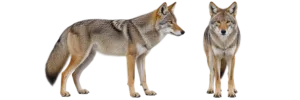 CoyoteCanis latrans