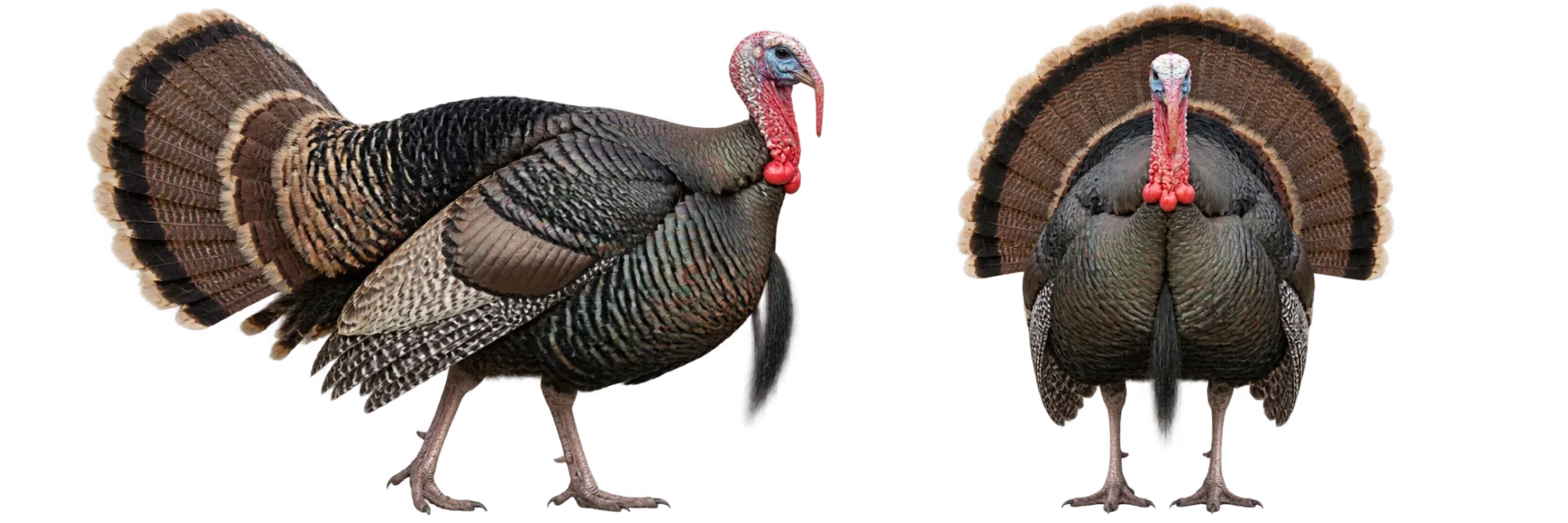
Wild turkey reproduction is split sharply between the sexes. A male may mate with several females, yet his role ends with mating. The hen alone selects the nest area, lays and incubates the eggs, and then leads a mobile brood whose young are already walking and feeding soon after they hatch.
Breeding Begins With Competition Among Males
Wild turkeys, Meleagris gallopavo, have a polygynous mating system. During the spring breeding period, males gobble and perform strutting displays to attract females while also competing with other males. Cornell describes this display as a combination of a fanned tail, lowered wings and changes in feather posture.
Sexual maturity does not guarantee equal breeding success. Turkeys can become capable of reproduction at about a year old, but young males often have difficulty competing with older males during their first breeding season. The difference between physiological maturity and actual mating success is therefore important when interpreting a simple maturity-age value.
Male wild turkeys do not incubate eggs or raise poults. Nesting, incubation and brood care are performed by the hen.
A Full Clutch Is Built One Egg at a Time
The nest is a shallow depression on the ground rather than a constructed platform or cup high in vegetation. Hens commonly choose places where surrounding vegetation, fallen material or other low cover helps conceal the nest.
Egg laying stretches the reproductive cycle well beyond the incubation period itself. A hen generally lays about one egg per day until the clutch is complete. Reported clutch sizes vary; Cornell lists 4–17 eggs, while regional descriptions often place a typical clutch near 10–12 eggs.
Continuous incubation begins after laying is largely complete. The eggs normally hatch after roughly four weeks; Cornell gives a range of 25–31 days, while many field accounts use about 28 days as a practical average. During incubation the hen spends most of the day on the nest and leaves for limited feeding and other short recesses.
Nest failure does not always end reproduction for that season. Adult hens may make another nesting attempt after an early failure, although the probability of renesting varies with age, timing, condition and population. Missouri observations, for example, report renesting in about half of adult hens after an unsuccessful first attempt, with younger hens less likely to try again.
Poults Move From the Nest Within Hours of Hatching
Wild turkey poults are precocial. They hatch covered in down, with open eyes and enough mobility to leave the nest and follow the hen very quickly. They can walk and begin feeding for themselves within about a day rather than remaining in the nest to be fed for weeks.
This fast transition from egg to mobile young does not make the early period easy. Newly hatched poults can forage, but they are still poor at regulating body temperature and cannot immediately escape danger by flying to a tree. The hen therefore remains the center of the brood even though she does not have to deliver every mouthful of food.
Young poults also have a different feeding emphasis from adults. In one study of Merriam’s wild turkeys in the Black Hills, arthropods made up more than 60% of poult diets, and younger poults consumed more arthropods than older young. This high-protein food supply fits a period of rapid feather and body growth.
The First Weeks Carry the Highest Developmental Risk
The weeks before strong flight and elevated roosting are a vulnerable stage in the wild turkey life cycle. Poults spend their earliest nights near the ground, remain dependent on the hen for brooding warmth and face weather as well as predation while their bodies are still small.
Field results illustrate how strongly survival can be concentrated in this early window. A study of 841 Merriam’s wild turkey poults in the southern Black Hills estimated 33% survival to four weeks; more than half of the recorded mortality during that period occurred within the first seven days. Cold and wet events were especially harmful to the youngest poults. Those figures describe that study population rather than a universal survival rate for all wild turkeys.
As poults grow, they improve their ability to regulate body temperature, move through vegetation and escape to raised roosts. This means a few weeks of development can change both their exposure to weather and the ways they avoid predators.
Brood Life Extends Well Beyond the Nest
Leaving the nest is only the start of parental care. The hen guides the poults through feeding areas, broods them for warmth when they are small and responds to threats while the young learn to forage independently. Male parents do not join this stage.
Family structure also changes as summer progresses. A hen and her young may join other hens and poults, producing larger brood groups rather than keeping each clutch isolated until adulthood. Cornell records family groups combining in this way, while regional accounts also describe larger brood flocks later in summer.
The young remain associated with the female far longer than their brief stay at the nest might suggest. Males and females may separate from the maternal group at different times, and social position becomes more important as juvenile birds approach their first breeding season. A turkey that can feed itself on its first day is therefore still months away from completing the social transition into an independently breeding adult.
 Indian peafowlPavo cristatus
 Red junglefowlGallus gallus