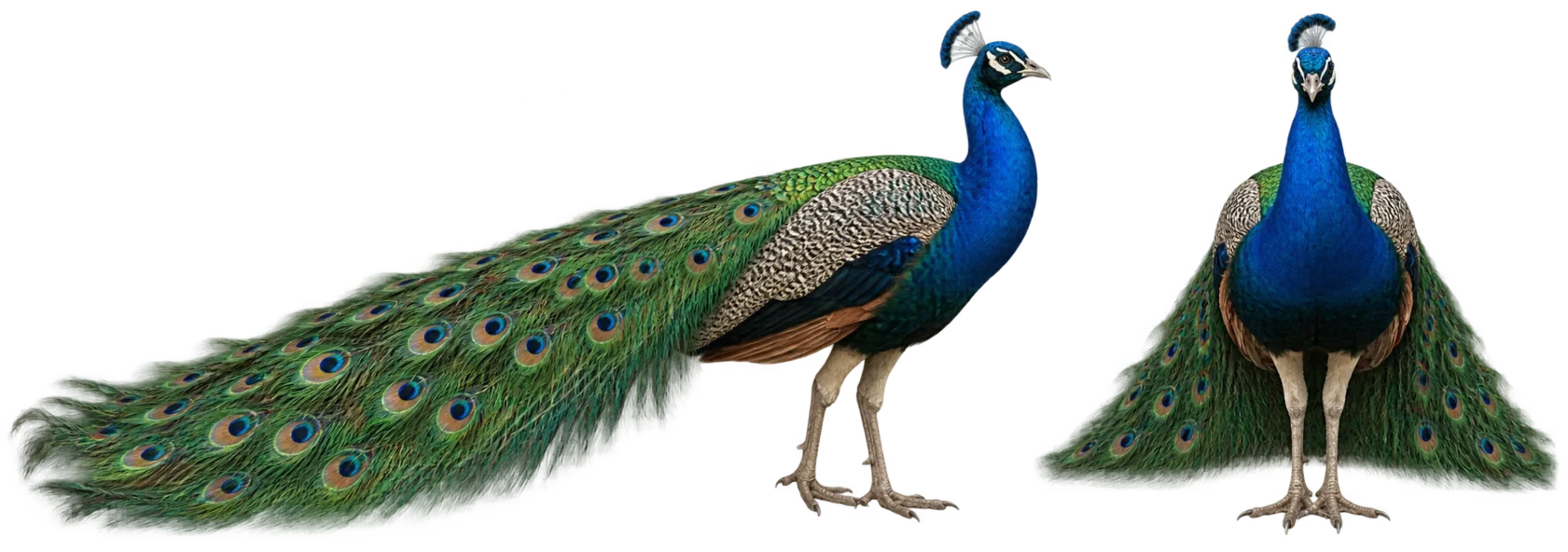
The breeding calendar of Indian peafowl shifts with local rainfall. Males spend the breeding season competing through courtship displays, while peahens take over the nest, incubation, and care of the young. Development also happens on different clocks: a chick becomes mobile within hours, while a male takes years to acquire the adult train used in courtship.
Breeding Timing Changes With Local Rainfall
Indian peafowl are seasonal breeders, but the season is not fixed to the same months everywhere. Field observations across South Asia show that display, egg laying, and the appearance of chicks shift with regional rainfall patterns. In some areas males display before the main rains; elsewhere breeding activity follows a different monsoon cycle.
This local variation explains why published breeding periods can look inconsistent. A 2026 study of captive Indian peafowl in Chattogram, Bangladesh, recorded egg laying from July through September, while field studies from parts of India and Sri Lanka have reported different seasonal peaks. A single month range should therefore be treated as a broad population-level pattern rather than a rigid reproductive calendar.
Females usually breed once during a season, although another clutch may be produced after an earlier nesting attempt is lost. The timing allows nesting and early chick growth to occur under local conditions that can differ greatly across the species’ range.
Male Courtship Develops Over Several Years
Adult peacocks use small display areas, and neighboring males may form groups of display courts known as leks. Females can visit different males before mating. The large fan used during these displays is formed mainly by elongated upper-tail coverts rather than the bird’s true tail feathers.
The adult male appearance develops gradually. Young males initially resemble peahens much more closely. Male coloration becomes clearer as they grow, elongated train feathers begin developing around the second year, and the full adult train is generally reached around three to four years of age. The train is then shed and regrown through the regular annual molt.
A male may reach reproductive maturity at roughly two to three years of age while his adult ornament is still developing. Age at sexual maturity should therefore not be treated as the age when the train has reached its fullest form.
Female choice also cannot be reduced to a simple count of eyespots. Earlier studies linked train ornamentation with mating success, but experiments found that the natural differences in visible eyespot number among normally ornamented adult males explained little of the variation in mating success. Other work has shown that the color and iridescent properties of the eyespots can also influence courtship outcomes.
Peahens Handle Nesting and Incubation Alone
After mating, the peahen prepares a shallow nest, usually on the ground in concealed vegetation. Clutch size varies among populations and studies. Three to eight eggs is a common reported range, while larger clutches have also been recorded under some conditions.
A four-year captive study published in 2026 recorded clutches of three to seven eggs, with a mean of 5.1. Such figures are useful for showing normal variation, but they should not be treated as a fixed clutch size for every population.
Incubation lasts about four weeks, commonly around 27 to 30 days. The female incubates the eggs without help from the male. Male parental care also does not continue after hatching, leaving the peahen responsible for keeping the brood together as the chicks begin feeding and moving through their surroundings.
Chicks Become Mobile Long Before Adult Development Is Complete
Peachicks are precocial. They hatch covered in down and can stand and walk within hours. They begin feeding for themselves very early and can make short flights at a young age, with flight ability appearing within roughly the first week or two.
Early mobility is different from full independence. Some life-history accounts place functional independence from the mother at roughly seven to ten weeks, while other observations report young remaining with a peahen for several months. These figures can describe different stages of development: a chick may already feed and fly while still maintaining a family association and benefiting from maternal protection.
Sex differences also emerge slowly. Juvenile males lack the long adult train and initially have much of the subdued appearance seen in young females. Male plumage changes through the first years of life before the breeding ornament reaches its adult form. Hatching, independent movement, reproductive maturity, and full male ornamentation are therefore separate points in the Indian peafowl life cycle.
 Wild turkeyMeleagris gallopavo
 Red junglefowlGallus gallus