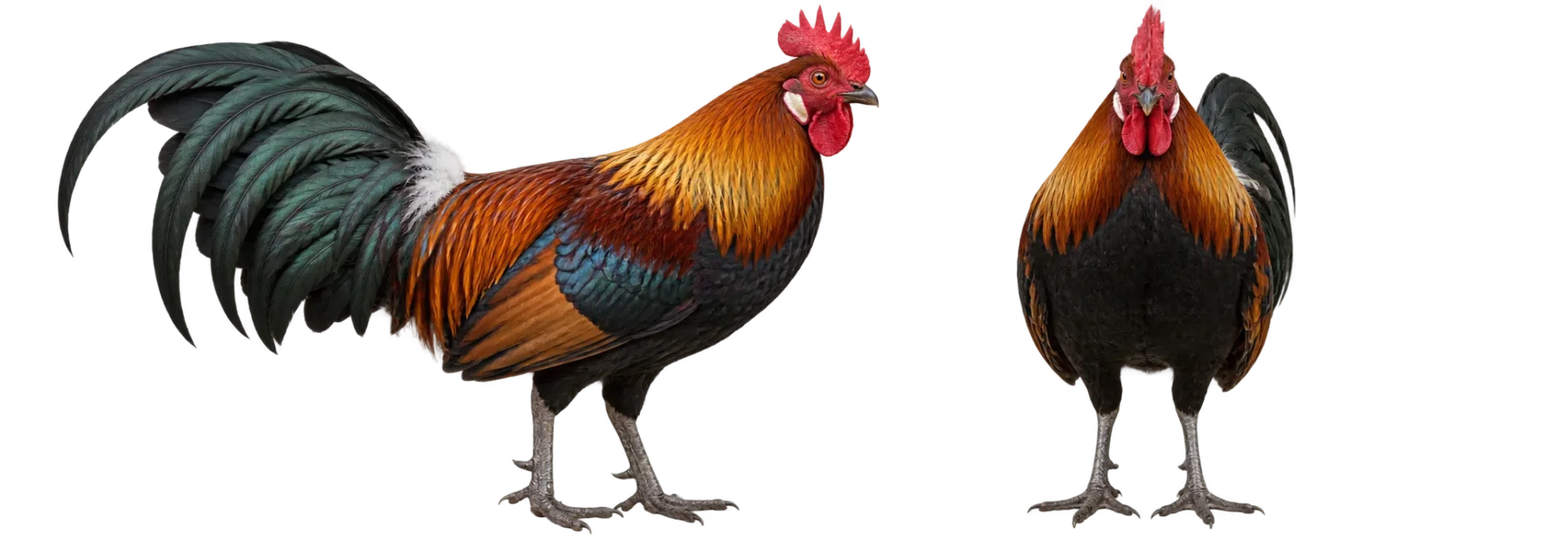
Red junglefowl (Gallus gallus) retain a reproductive pattern that differs sharply from the high-output, weakly seasonal breeding familiar from many domestic chickens. Wild birds breed on a seasonal schedule, females carry the full incubation burden, and newly hatched chicks remain closely tied to their mother despite being able to walk and forage soon after hatching.
Seasonality Sets the Reproductive Calendar
Wild red junglefowl do not maintain the near-continuous laying pattern found in many domestic lines. Breeding responds to seasonal conditions, and the timing varies among populations rather than falling on one fixed calendar across the species’ range.
Field monitoring of G. g. jabouillei on Hainan Island found breeding concentrated from March through July, with the highest activity in April. This seasonal pattern fits experimental evidence that red junglefowl retain a stronger reproductive response to changing day length than highly domesticated chickens.
The difference matters when interpreting life-history records. Egg production measured in domestic hens cannot be transferred directly to wild red junglefowl. Domestication has altered both the timing and intensity of reproduction.
Ground Nesting Makes Reproductive Success Uneven
The female makes a simple nest close to the ground, commonly using vegetation for cover. She lays a clutch and performs the incubation herself. Development inside the egg lasts about three weeks, after which the chicks hatch in a precocial state.
Producing a clutch does not guarantee the same number of surviving chicks. A two-season study of natural nests on Hainan recorded an average clutch of about five eggs among the nests examined, yet only 31.2% of monitored nests succeeded. Predation accounted for a large share of nest failure.
This creates an important distinction between potential fecundity and realized reproduction. A female may produce several eggs, but exposed ground nests can lose the entire reproductive attempt before hatching. Local predator communities and nest placement therefore influence reproductive output beyond the clutch-size value shown in a species record.
Precocial Chicks Remain Closely Tied to the Hen
Red junglefowl chicks emerge from the egg relatively well developed. They can move with the hen and begin pecking for food early in life. Precocial development, however, does not make the chicks immediately independent.
During the first days after hatching, chicks spend much of their time close to the female. Contact with the hen provides warmth when their own temperature regulation is still limited and keeps the brood together while the chicks learn where and how to forage.
Maternal behaviour continues for weeks. Observations and experimental work on red junglefowl place the end of the normal mother–offspring association at roughly 10 to 12 weeks, although the strength and duration of maternal behaviour can vary. The first weeks therefore combine rapid physical development with an extended period of social dependence.
Multiple Mating Shapes Paternity Within a Clutch
Red junglefowl live within social hierarchies in which dominant males can gain greater access to females. Rank alone does not determine all mating, however. Controlled studies have found that females commonly mate with more than one male while producing a clutch, even when direct competition between the males is removed.
This mating pattern allows sperm from different males to overlap within the female reproductive tract. As a result, eggs belonging to one reproductive sequence need not all have the same father. Reproductive success in red junglefowl therefore depends on more than which male holds the highest social position.
Wild and Domestic Reproductive Schedules Differ
The close relationship between red junglefowl and domestic chickens creates an unusual problem for life-history data. Domestic chickens descend primarily from red junglefowl ancestry, but thousands of years of domestication have changed growth, reproductive timing, egg production and responses to seasonal cues.
Experiments involving red junglefowl and domestic lines have linked domestication-related genetic variation with reduced dependence on seasonal day length and an earlier onset of laying. Those changes help explain why reproductive measurements from poultry cannot automatically stand in for measurements of wild Gallus gallus.
Population identity also deserves attention. Genomic studies have documented gene flow from domestic chickens into wild red junglefowl populations. A measurement taken from a heavily introgressed or feral population may reflect a different biological background from one collected in a less-admixed native population. For traits such as breeding season, fecundity and reproductive development, the origin of the birds can be as informative as the numerical value itself.
 Indian peafowlPavo cristatus
 Wild turkeyMeleagris gallopavo