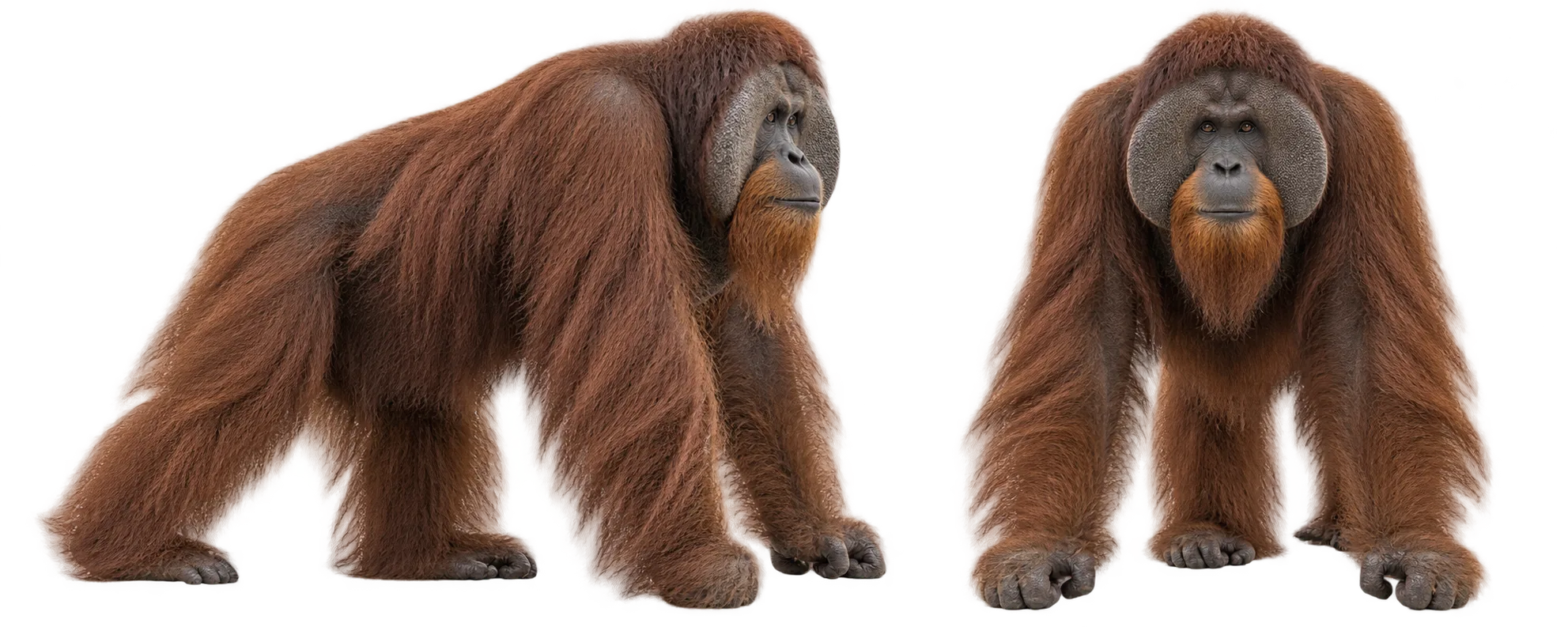
Pongo abelii spends an unusually large share of its life growing up. A young Sumatran orangutan can remain closely associated with its mother for most of a decade, while a female may devote many years to one offspring before giving birth again. During that long period, the young ape is gradually learning how to move, forage, build nests and use the local food repertoire without maternal support.
Maternal Investment Can Extend Across Most of a Decade
Long-term observations at Ketambe produced an estimated female age at first reproduction of about 15.4 years. The same population had a mean recorded interbirth interval of 9.3 years, based on complete intervals between successive births.
That 9.3-year figure is useful, but it should not be treated as a fixed value for every Sumatran orangutan population. A later analysis combining long-term data from seven wild orangutan study sites found a mean closed interbirth interval of about 7.6 years across orangutans and did not find a clear island-level difference in the basic life-history measures examined. Local ecology, individual histories and the way intervals are measured can all affect estimates from a particular field site.
A mother normally continues nursing and accompanying her dependent offspring for years. Ovulation and conception are delayed during much of this period, linking the long birth interval directly to the prolonged development of the previous young.
This reproductive pace is paired with very high survival of young in long-term wild datasets. Rather than producing offspring frequently, orangutans invest heavily in a single dependent youngster over an extended period.
Independence Develops Through Several Separate Milestones
Young Sumatran orangutans do not become independent at one sharply defined age. Different abilities appear at different points. Physical movement through the trees develops earlier than full nutritional and social independence.
The years spent beside the mother also provide access to information that cannot be reduced to simple physical growth. Young Sumatran orangutans watch what others eat, inspect food handling and sometimes solicit difficult foods from their mothers. Mothers are more likely to share foods that require more complicated processing when their offspring are still learning those skills.
Research published in 2025 used more than a decade of behavioral observations from Suaq to model how immature orangutans acquire their diet repertoires. Simulated youngsters reached adult-like diet breadth by the normal age of independence only when the model included several forms of social learning, including close association and attentive observation. This helps explain why the long period before independent ranging can carry developmental value well beyond nursing alone.
Sexual Maturity and Male Physical Development Can Follow Different Timelines
Adult male Sumatran orangutans occur in two recognizable forms. Flanged males have the large cheek pads and other pronounced secondary sexual traits associated with fully developed adult males. Unflanged males lack these features but can already be sexually mature.
An unflanged adult does not simply represent a juvenile that is incapable of reproduction. Genetic paternity work in a Sumatran population found that unflanged males fathered offspring, including six of the eleven offspring assigned in one long-running study. The development of full flanges can therefore occur well after reproductive capability has appeared.
The unflanged stage may persist for years before an irreversible transition to the flanged form. Comparative work at Suaq also found prolonged developmental arrest to be especially common among the Sumatran males observed there. More recent longitudinal research following males before and after flange development confirmed that the physical transition is accompanied by changes in social and reproductive behavior.
This two-form adult system makes male development less suited to a single maturity age. Sexual maturity, reproductive success and the appearance of full adult secondary traits describe different parts of the male life history and may occur years apart.
 GorillaGorilla gorilla
 ChimpanzeePan troglodytes
 Pygmy chimpanzee, or BonoboPan paniscus
 OrangutanPongo pygmaeus