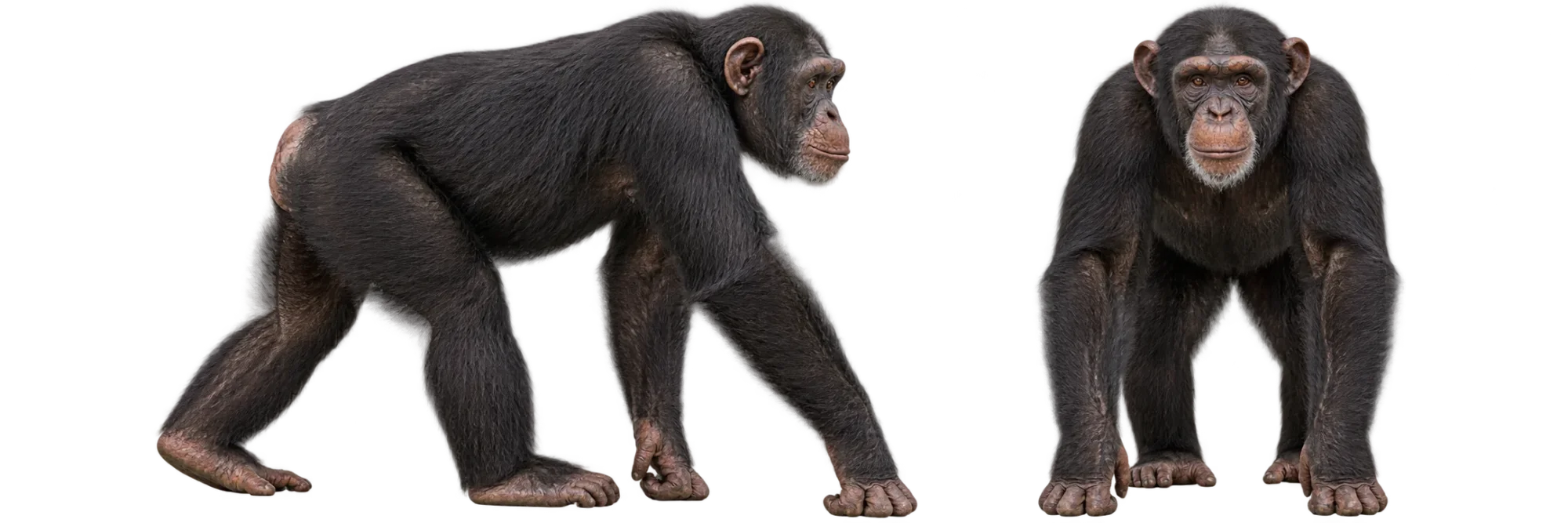
For chimpanzees, the years after a birth shape reproductive pace more than pregnancy itself. A female may spend several years nursing, carrying, traveling with, and supporting one offspring before another surviving infant is born. This long period of maternal investment is central to the life history of Pan troglodytes.
Long Nursing Keeps Chimpanzee Births Far Apart
Pregnancy lasts well under a year, but successful births are usually separated by much longer intervals. At Gombe, gestation averaged about 225 days, while the average interval between births was a little over five years. Studies across several wild populations commonly place birth spacing in the range of roughly five to six years when the previous infant survives.
The long interval is closely tied to lactation. Chimpanzee mothers usually nurse for years, and reproductive cycling can remain suppressed during much of that period. A mother therefore invests a large part of her reproductive time in one dependent offspring rather than producing infants in rapid succession.
Infant Survival Changes the Reproductive Schedule
Long-term Gombe records found that postpartum amenorrhea averaged about 3.9 years when an infant survived to weaning age. When an infant died, mothers could resume cycling far sooner. This shows why a fixed birth-interval value cannot fully describe chimpanzee reproduction: the outcome of the previous birth directly affects when the next reproductive opportunity arrives.
Female Chimpanzees Reach First Birth Years After Early Reproductive Signs
Female development includes several milestones that do not occur at the same age. Sexual swellings can begin around the early adolescent years, but this does not mean that a female has reached her normal age of first reproduction. Long-term Gombe data placed first full swelling at about 10.8 years and first birth at about 13.3 years.
A later analysis of known-age wild females found even more variation. Average age at sexual maturity was about 11.5 years, while average age at first birth was about 14.9 years. Individual first births ranged from about 11 to more than 22 years in that sample. Females that dispersed from their birth community tended to reproduce later than females that remained, and early maternal loss was also linked with delayed development.
Age at sexual maturity and age at first birth therefore describe different stages. Social transition, dispersal and individual development can add years between the first outward signs of reproductive maturity and the production of an infant.
Male reproduction follows a different pattern. Genetic paternity data from wild communities show that adolescent males can sire offspring before reaching full adult status. Later reproductive success is strongly shaped by competition and social relationships, so physical adulthood and effective breeding success do not fall on one simple age threshold.
Young Chimpanzees Stay Closely Tied to Their Mothers After Weaning
Milk dependence commonly ends around four to five years of age, although the timing varies among individuals. Some wild chimpanzees continue occasional nursing behavior beyond the point when milk is an important nutritional source. The end of suckling is therefore not always identical to the end of infant-like behavior.
Maternal dependence also continues in other forms. Young chimpanzees are carried extensively during early life and gradually increase independent travel and foraging. After nutritional weaning, juveniles may continue traveling and socializing with their mothers for several more years, often remaining closely associated through much of the juvenile period.
This extended relationship can affect development after milk dependence has ended. Research on wild chimpanzees has found maternal effects on offspring growth during the post-weaning years, and the loss of a mother can still affect survival even after an offspring is old enough to feed independently.
The result is a long developmental sequence: independent feeding arrives before full social and behavioral independence. That sequence helps explain why chimpanzee reproduction remains slow even though pregnancy itself is not unusually long for a great ape.
Ngogo Shows How Widely Chimpanzee Survival Can Vary
A maximum longevity record should not be read as the expected lifespan of a wild chimpanzee. Survival differs markedly among populations because mortality during infancy, disease exposure, food conditions and other local pressures alter how many animals reach old age.
Ngogo in Uganda provides a clear example. A long-term demographic study estimated life expectancy at birth at about 32.8 years for both sexes combined, with females averaging 35.8 years and males 29.6 years. Earlier estimates from some other wild study populations were much lower. Wild chimpanzee datasets have therefore produced life-expectancy estimates ranging from the teens to more than 30 years.
Chimpanzees that survive the vulnerable early years can still have long adult lives. At Ngogo, expected remaining lifespan rose substantially once individuals had survived infancy and reached weaning age. This is why lifespan statistics based on birth can look very different from the ages routinely reached by animals already observed as healthy juveniles or adults.
Captive survival data form another distinct context. Large zoo datasets have reported median life expectancy from birth of about 35.7 years for females and 30.1 years for males, with some individuals living far longer. Those values should not be substituted for wild-population life expectancy or for a species-wide “normal lifespan.”
Ngogo Females Show a Measurable Post-Reproductive Stage
Long life creates another unusual part of chimpanzee life history. Decades of observations at Ngogo found that female fertility declined after about age 30, while no births were recorded after age 50. Hormone measurements from females aged up to 67 showed the reproductive changes expected during a menopausal transition.
For females that reached adulthood in this community, researchers estimated that about one-fifth of adult life could be spent in a post-reproductive state. Several females survived for a decade or more after their final birth.
This finding should remain tied to its population context. Females in many other wild chimpanzee communities rarely survive long enough for an extended post-reproductive period to become common. The Ngogo evidence establishes that wild chimpanzees can experience menopause and prolonged survival after reproduction, but it does not show that the same duration is typical in every population.
The distinction matters when interpreting longevity records. A chimpanzee may remain alive well after fertility has fallen, while another population with heavier adult mortality may contain few females old enough for the same late-life pattern to be visible.
 GorillaGorilla gorilla
 Pygmy chimpanzee, or BonoboPan paniscus
 OrangutanPongo pygmaeus
 Sumatran OrangutanPongo abelii