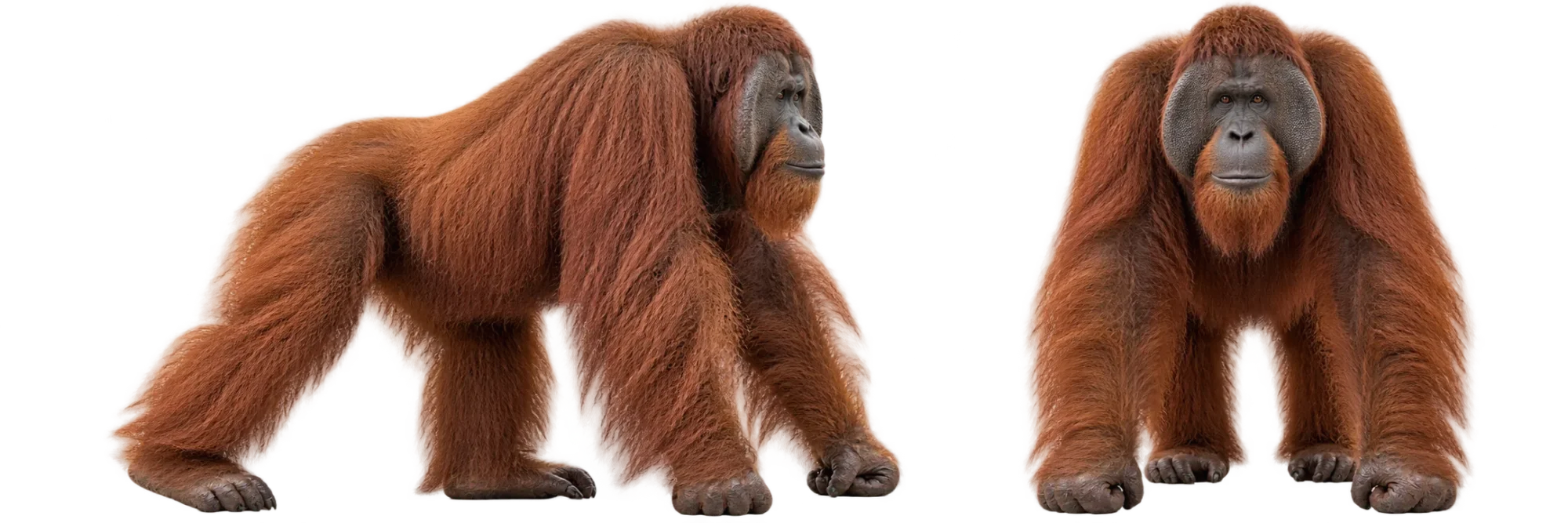
Living orangutans belong to three species—Bornean, Sumatran, and Tapanuli orangutans—but the best long-term field records reveal a shared pattern: offspring develop slowly, mothers invest in one young animal for years, and reproduction proceeds at a pace rarely seen among mammals. The exact timing varies among populations, so broad orangutan figures are most useful when treated as biological ranges rather than fixed deadlines.
Years of Maternal Investment Separate Successful Births
Orangutans usually produce a single infant. Gestation lasts roughly seven and a half to eight and a half months, but pregnancy itself is only a small part of the reproductive schedule. The much longer commitment begins after birth, when the infant remains closely dependent on its mother.
A study combining long-term observations from seven wild field sites calculated an average closed interbirth interval of about 7.6 years. Earlier work with wild Sumatran orangutans at Ketambe recorded an average interval of 9.3 years. These figures are not contradictory: reproductive timing can differ with population, ecology, observation period, and the way intervals are calculated.
Wild females also begin reproducing relatively late. Across the multi-site field dataset, first birth occurred at around 15 years of age. A separate long-term Sumatran study estimated first reproduction at 15.4 years. This late start combined with long spacing between surviving offspring limits how quickly a wild population can replace lost adults.
Rehabilitated or provisioned females have sometimes reproduced earlier and at shorter intervals than fully wild females. Studies of rehabilitant orangutans have linked some of this difference to greater food availability, while also noting that age estimates, maternal experience, and other conditions can affect the records. Values from such populations should not automatically be used as the normal schedule for wild orangutans.
Independence Develops in Several Different Stages
An orangutan can become capable of moving and feeding without constant physical help long before its relationship with its mother ends. This distinction helps explain why a simple label such as “independent” can hide much of the developmental process.
Infants initially travel while clinging to their mothers. Over the following years they become better climbers, handle more foods, build nests, and spend more time moving on their own. Nursing commonly continues until around six or seven years of age, although the timing varies.
Research on wild Sumatran orangutans found that three-year-olds already showed considerable locomotor independence and useful nest-building ability. Even so, immature orangutans continued sharing their mother’s night nest until around weaning. In that population, fully independent ranging developed later, at roughly 11 years of age. These ages describe one well-studied population rather than a universal timetable for every orangutan.
Learning Continues After Basic Physical Skills Appear
The long association with the mother also provides access to information. Young orangutans must learn how to recognize, obtain, and process many foods that vary in difficulty and seasonal availability.
Long-term observations of Sumatran mother-offspring pairs found that young orangutans requested food more often when an item was difficult to process. Mothers were more likely to share complex foods during periods when the offspring were acquiring feeding skills. Similar research on Bornean orangutans found that younger offspring especially sought foods they could not yet process easily themselves.
This creates a long developmental overlap: physical independence expands first, while ecological knowledge and independent ranging continue to mature over several more years.
High Juvenile Survival Fits the Slow Reproductive Schedule
A species that raises offspring this slowly can sustain such a reproductive pace only when many young survive. Long-term wild data show that orangutans can achieve unusually high survival during the years before reproduction.
In the seven-site field analysis, female survival to the age of first birth was estimated at 94%. The same study found very high survival before weaning in both sexes. The researchers described these survival rates as exceptionally high for mammals living under natural conditions.
That relationship matters more than treating a longevity record as a typical lifespan. An individual orangutan may live for many decades, but longevity records, estimated minimum ages, and normal survival probabilities describe different things. Earlier work on wild Sumatran orangutans estimated survival to at least 58 years for males and 53 years for females, yet those figures should not be read as fixed life expectancies for every orangutan population.
Male Reproductive Adulthood Can Precede the Flanged Form
Male orangutans add an unusual complication to the idea of maturity. Adult males occur in unflanged and flanged forms. Flanged males develop large cheek pads and other secondary sexual traits, while reproductively capable unflanged males lack the full set of these features.
Flange development is therefore not a simple marker separating immature males from adults. An unflanged male may remain in that adult form for years, and in some cases for much longer, before developing flanges. Studies have also found population differences in how often prolonged developmental arrest occurs.
Recent work continues to refine the terminology used for these males. A 2026 review notes that older age-based descriptions can be misleading because unflanged males may already be adults and reproductively active. Current evidence also shows that both forms can sire offspring, although a long-term study of a fully wild Bornean population found higher reproductive success among flanged males.
For life-history data, this means male sexual maturity, adult body form, and the appearance of full secondary sexual traits should remain separate measurements rather than being collapsed into one age.
 ChimpanzeePan troglodytes
 GorillaGorilla gorilla
 Sumatran OrangutanPongo abelii
 Pygmy chimpanzee, or BonoboPan paniscus