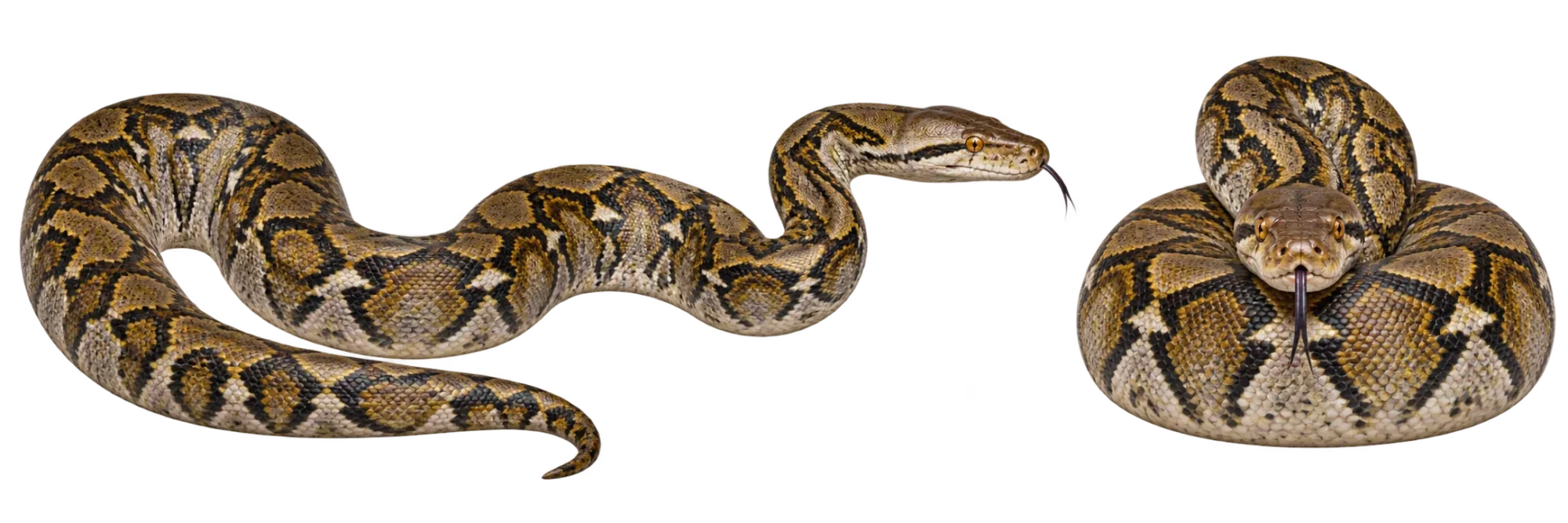
Reticulated pythons (Malayopython reticulatus) can become enormous, but their life history is not built around waiting many years to reach full size. Field studies in Sumatra show that reproduction begins while these snakes are still far below their eventual adult dimensions. Growth then continues for years, especially in females, creating unusually wide differences in body size among reproductively mature animals.
Growth Can Change Rapidly With Food Availability
Reticulated pythons have a highly flexible growth pattern. A 12-month study of farmed M. reticulatus in Thailand and Vietnam found wide differences in daily mass gain among individuals. Females grew faster than males, while food intake and growth early in life were closely associated with how much total growth occurred later in the study.
The same work showed how differently python growth responds to interruptions in feeding compared with the steady growth expected in many mammals. Some animals went without food for as long as 4.2 months while losing very little body mass each day. When feeding resumed, rapid growth resumed as well.
Body size at a given age can reflect feeding history as well as age itself. Two reticulated pythons of similar age therefore do not have to follow the same growth trajectory, particularly when their food intake has differed.
This helps explain why body length or mass is often more informative than a simple age estimate when discussing development in this species.
Reproduction Begins Well Before Maximum Body Size
Research on more than 1,000 wild-collected reticulated pythons from southern Sumatra found an unusual relationship between maturation and eventual adult size. The minimum length at maturity was only about 35% of the maximum length represented in the sample.
The difference was even more pronounced when body mass was considered. Newly mature females weighed less than 4% of the maximum female mass recorded in that study, while newly mature males were below 5% of the corresponding male maximum. Mature reticulated pythons can therefore continue through a very large amount of growth after reproduction becomes possible.
Direct ages were not known for those wild snakes. Seasonal changes in their size distribution, combined with captive growth records available to the researchers, suggested relatively early maturation, with males estimated to mature earlier than females. Those age estimates should not be treated as a fixed timetable for every population.
Later fieldwork in northern Sumatra found that pythons matured at larger body sizes than animals studied in southern Sumatra. Reproductive timing also differed between the two regions. A single maturity size or breeding calendar cannot describe the species across its entire Southeast Asian range.
Female Growth Continues to Change Reproductive Output
Because females can reproduce long before reaching their largest sizes, reproductive capacity does not remain fixed throughout adulthood. In the southern Sumatran study, clutch size rose with maternal body length. Seventeen examined clutches averaged about 24 eggs, but individual clutches ranged from 11 to 46.
A separate northern Sumatran study found a similar mean of 24.2 eggs. The important life-history pattern is not the average alone: large females can devote a substantial amount of energy to one reproductive event, yet reproduction is not necessarily annual. In that northern population, females were estimated to reproduce only once every two to four years.
This produces a distinctive combination of traits. Reticulated pythons can mature while relatively small, continue growing far beyond maturity, and increase reproductive output as female size rises, while individual females may leave long gaps between clutches.
Females also attain much larger body sizes than males. That sexual size difference develops alongside continuing adult growth and means that two reproductively mature snakes can occupy very different points on the species’ size range.
Facultative parthenogenesis has been genetically documented in a captive reticulated python. A female that had been separated from males produced viable female offspring without normal sexual fertilization. This demonstrates that the mechanism is biologically possible in the species, but it is an exceptional reproductive event rather than its usual breeding strategy.
Maternal Care Is Concentrated Around the Eggs
Reticulated pythons are oviparous. After laying, the female coils around the clutch rather than leaving the eggs exposed. Muscle contractions can generate heat within the coils, allowing the female to influence the thermal conditions around the developing embryos.
This incubation period can also carry an energetic cost. In one documented captive breeding event, the female stopped feeding while attending the clutch and regularly performed the muscular shivering associated with egg warming. The eggs hatched after 72 days under natural maternal incubation in that case.
The pattern of parental investment changes sharply at hatching. The female’s active role is centered on protecting and thermally attending the eggs; hatchlings emerge capable of functioning independently and do not enter a prolonged period of feeding or care by the mother.
 Burmese PythonPython bivittatus
 Ball pythonPython regius