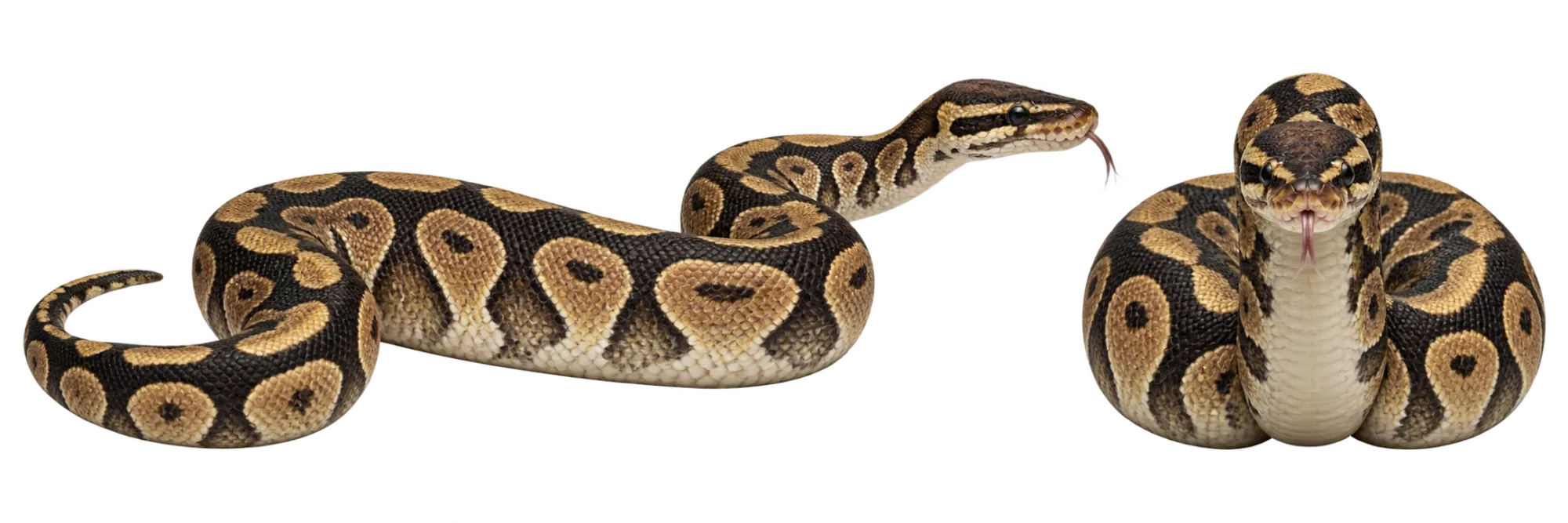
Ball python life history is closely tied to seasonal reproduction, egg laying, and an unusually long period of maternal attendance for a snake. The female does more than remain beside the clutch: her tight coils help control the conditions around developing eggs during roughly two months of incubation.
Seasonal Timing in Ball Python Reproduction
Wild ball pythons, Python regius, show a seasonal reproductive cycle. Observations from West Africa place mating mainly around the rainy season, while egg laying occurs later, often during the dry part of the year. In southern Togo, studied females commonly deposited their eggs in early February. Other field accounts place egg laying over a wider period extending into early spring.
This timing should not be treated as a fixed calendar for every population. Local rainfall, temperature, food availability, and geographic setting can shift reproductive events. Conditions in captivity can alter the schedule even more.
A 2026 study of captive females found ovulation concentrated between April and August and egg laying from June through November. The same study recorded a median clutch of six eggs and an incubation period of about 58 days. These dates differ from many West African field observations, showing why captive breeding records and wild reproductive timing should be kept separate when describing the species.
From Follicle Growth to Egg Laying
Ball pythons are oviparous, so embryos complete most of their development inside eggs after those eggs have been laid. The period before laying includes follicle growth, ovulation, movement of the ova through the reproductive tract, shell formation, and oviposition.
Follicles enlarge as yolk accumulates. Recent ultrasound work with captive females found that follicle diameter became a useful indicator of how close a female was to ovulation. Larger follicles were associated with fewer days remaining before ovulation, although individual females did not follow an identical schedule.
A skin shed often occurs between ovulation and egg laying. Captive observations commonly place oviposition several weeks after ovulation, but this interval is not identical among all females. For an egg-laying snake, it is more accurate to distinguish this pre-laying period from the later incubation period inside the egg rather than treating both as one continuous gestation measurement.
Reproductive maturity also develops differently between the sexes. Published records generally place males at reproductive maturity earlier than females. In females, age alone does not determine whether reproduction occurs; body size, energy reserves, ovarian development, and environmental conditions also affect whether a breeding cycle proceeds to ovulation and fertile egg production.
Brooding Protects the Eggs From Water Loss
After laying, a female ball python gathers the eggs into a compact group and coils tightly around them. She can remain with the clutch until hatching, a period of about two months. This maternal attendance is one of the most informative parts of the species’ reproductive biology because experiments have shown that the coils affect the physical environment of the eggs.
Research on ball pythons in southern Togo found that maternal brooding had only a modest effect on incubation temperature under the warm local conditions. Its stronger effect was on water balance. Eggs brooded by females lost less water than eggs incubated without maternal attendance. Reduced drying also limited changes to the yolk and was associated with better development of the young.
The fit between the female’s body and the clutch matters. In experiments where researchers increased clutch size, females could not completely cover all of the added eggs. Exposed portions of the enlarged clutches lost more moisture, and embryo survival fell. The normal clutch is therefore linked not only to how many eggs a female can produce, but also to how effectively she can surround them during incubation.
Brooding females generally stop feeding while attending the eggs. Even so, a study of females in the warm climate of southern Togo found relatively little body-mass loss during the two-month brooding period. The local thermal environment reduced the need for frequent energy-demanding muscular heat production, allowing prolonged attendance without the energetic cost that might be expected in a cooler setting.
Development Ends With an Independent Hatchling
Near the end of incubation, the young snake uses an egg tooth to cut through the leathery shell. Hatching does not necessarily occur at exactly the same moment for every egg in a clutch, and a hatchling may remain partly inside the egg while the last yolk reserves are absorbed.
Maternal care ends around hatching. Ball python young receive no extended feeding or protection from the female and begin life as independent predators. Their early growth then depends on their own feeding success and environmental conditions rather than continued parental investment.
Experimental work also suggests that incubation conditions can affect the condition of the hatchling at emergence. Eggs protected by maternal brooding produced young that retained more of the resources available during development and performed better in several early movement tests than young from eggs exposed to greater water loss. The incubation environment can therefore influence more than whether an embryo simply survives to hatch.
Longevity Records Represent Different Biological Contexts
Ball pythons can remain reproductively capable for many years, particularly under human care, but longevity figures need careful interpretation. Captive records extending beyond four decades are maximum longevity records, not the expected lifespan of every individual.
Wild lifespan estimates are much shorter and are based on less complete information than long-term captive records. Survival outside captivity includes predation, food shortages, disease, reproductive demands, and other environmental pressures that are reduced or managed in captivity. A captive maximum and an estimated wild lifespan therefore describe different parts of the species’ life history and should not be used interchangeably.
 Burmese PythonPython bivittatus
 Reticulated pythonPython reticulatus