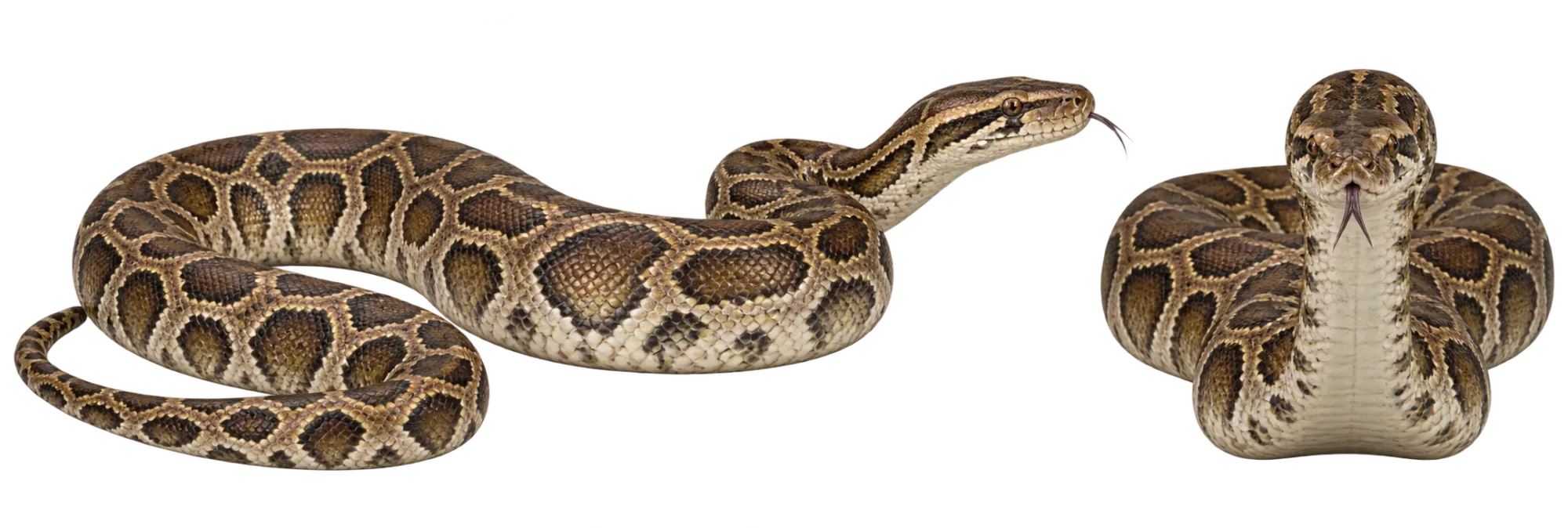
Python bivittatus has a reproductive life history shaped strongly by body size, season and maternal investment. Field studies show that males and females enter the reproductive population at different sizes, larger females can produce much larger clutches, and egg development includes weeks of active brooding in which the female can raise clutch temperature while relying on stored energy.
Male and Female Maturity Occur at Different Body Sizes
Age alone is a poor way to define reproductive maturity in Burmese pythons. Growth can differ with food supply, environment and whether an animal is wild or captive, so animals of the same age may not be at the same reproductive stage.
A large study of wild Burmese pythons collected in southern Florida used gonadal development together with snout–vent length rather than assigning maturity from age alone. The resulting size classes placed the transition to the adult class at about 182 cm SVL for males and 206 cm SVL for females. These are population-based class boundaries, not universal minimum sizes that every Burmese python must reach before reproducing.
The difference continues among reproductively active animals. In the same dataset, reproductive females averaged about 298 cm SVL, compared with about 211 cm for reproductive males. This sexual size difference matters later in the life cycle because female body size is closely tied to the number of eggs a female can develop and lay.
The South Florida Population Has a Tightly Timed Reproductive Cycle
The clearest long-term field record comes from the established population in southern Florida. There, reproductive activity follows a seasonal pattern rather than occurring evenly through the year. The main breeding period lasts roughly 100 days from December into March, followed by egg laying in late spring and hatchling emergence later in the warm season.
Male physiology follows this seasonal pattern as well. Research published in 2026 on free-ranging adult males found that testosterone rose before the breeding season and then declined as the season progressed, reaching baseline levels during the non-breeding period. Day length and ambient temperature were associated with those hormone changes.
These dates describe the South Florida population and should not be treated as a fixed calendar for every part of the species’ native Asian range. Local temperature, rainfall patterns and photoperiod can shift reproductive timing.
Female Body Size Strongly Influences Egg Production
Burmese python clutch size has a broad range, and much of that variation is linked to the size of the mother. Measurements from wild Florida females showed a clear positive relationship between maternal snout–vent length and the number of eggs eventually laid.
The 96-egg nest shows what a very large female can produce, but it is not representative of a normal clutch. The female associated with that nest was exceptionally large, and 83 of the 96 eggs hatched.
There is also an important measurement distinction. Counts of developing ovarian follicles can be higher than the number of eggs eventually deposited. Some follicles may not progress to oviposition, so a follicle count is better treated as potential reproductive output rather than an actual clutch size. Counts of laid eggs provide the more direct measure.
Brooding Is an Energetically Expensive Part of Reproduction
Egg laying does not end the female’s reproductive investment. Burmese python females coil around their eggs and can remain with the clutch through most of incubation. During this period, repeated muscular contractions known as shivering thermogenesis allow the female to generate heat and buffer the eggs against cooler surrounding temperatures.
A wild nest monitored in Florida from May through July 2022 provided an unusually detailed record of this process. While the female was brooding, temperatures within her coils reached about 33°C when the surrounding pipe environment was about 27.7°C. When she temporarily moved away from the clutch, egg temperatures fell. They rose again after she returned and resumed brooding.
The female’s coils provide physical protection, but they also form a controlled thermal environment. Heat production, coil adjustments and nest-site choice all influence the conditions experienced by the developing embryos.
This care has a large energetic cost. Burmese pythons generally do not feed while brooding. The female in the closely monitored 2022 nest lost 27.9% of her pre-nesting body mass after egg production and brooding. By the end of that year, she had regained only part of the lost mass.
That energy budget helps explain why reproduction does not necessarily occur every year for each female. Field reproductive data from Florida indicate that females may nest at intervals of roughly two to three years, allowing time to rebuild the reserves required for another reproductive cycle.
Maternal Care Stops as the Hatchlings Become Independent
The female’s extended attendance is concentrated on the egg stage. She may leave shortly before hatching begins, and there is no comparable period of feeding or guarding the young after emergence.
In the intensively monitored 96-egg nest, the female moved off the clutch 51 days after oviposition. The first eggs began to pip six days later. Most hatchlings emerged within several days, although the full hatching sequence extended longer as some eggs developed more slowly than others.
Once dispersed, young Burmese pythons face a very different life stage. A radio-telemetry study followed 28 South Florida hatchlings released at their original nest sites. Estimated known-fate survival during the first six months was 35.7%, and only two of the tracked snakes survived to three years after hatching. Predation accounted for much of the recorded mortality.
Those survival figures belong to one Florida field study rather than to the species everywhere. They do, however, show that producing dozens of eggs does not translate directly into the same number of future adults. Burmese python reproduction combines high egg output with heavy maternal investment before hatching and strong losses during early independent life.
 Ball pythonPython regius
 Reticulated pythonPython reticulatus