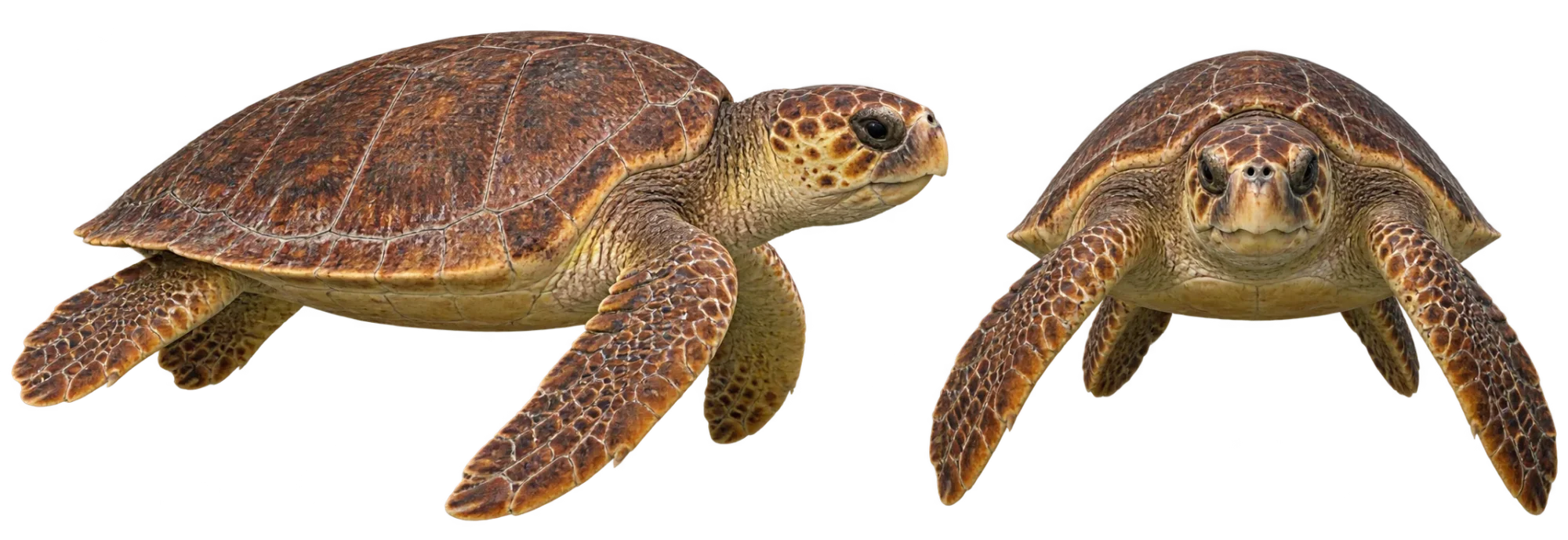
A loggerhead sea turtle, Caretta caretta, spends much of its life growing before reproduction begins. That long developmental period is not a fixed countdown: growth and maturity can differ by region, juveniles can switch between oceanic and coastal habitats, and adult females divide their reproductive effort across several nests and multiple nesting seasons.
Maturity Comes After a Long and Variable Growth Period
About 35 years is often used as a broad reference for female loggerhead maturity, but research shows why a single age should not be treated as a universal threshold. Studies based on skeletal growth marks in western North Atlantic loggerheads found wide variation in the ages associated with maturation. Estimates near the mean adult maturation size were roughly in the late 30s for females, while some individuals could mature considerably earlier.
Newer work also shows that geography matters. A 2025 study comparing loggerheads from the U.S. Gulf region with turtles from the U.S. Atlantic coast found faster juvenile growth in the Gulf sample. Their estimated maturation ages were about 7.5 to 15 years earlier than those of comparable Atlantic-coast turtles.
Age at maturity reflects growth history rather than a species-wide birthday. Food availability, environmental conditions, individual growth rates and regional life histories can alter how quickly a turtle reaches reproductive size. Size and age therefore need to be considered together.
This slow route to adulthood has an important consequence for the species’ life history: years of juvenile growth occur before an individual contributes offspring. Adult reproduction then continues across repeated breeding seasons rather than being concentrated into a short period early in life.
Juvenile Development Moves Between Different Marine Habitats
After leaving the nesting beach, young loggerheads enter an oceanic stage. NOAA describes the first 7 to 15 years as largely open-ocean development. Turtles later begin using nearshore and continental-shelf waters, where they may continue growing for another decade or longer before maturity.
The change is more flexible than a simple one-way move from open ocean to coast. Tracking and life-history research in the North Atlantic has shown that some large juveniles return to oceanic waters after entering coastal habitat. An individual can move between these environments more than once.
That flexibility helps explain why body size alone does not always identify a loggerhead’s exact developmental setting. Turtles of similar ages or sizes may have different movement histories, feeding opportunities and growth rates.
Some populations also develop across enormous distances. North Pacific loggerheads originating from nesting areas in Japan can spend years at developmental feeding grounds near Baja California before eventually crossing the Pacific again as they approach the adult phase. Much of the animal’s growth can therefore occur thousands of kilometres from its natal region.
Reproductive Effort Is Spread Across Nests and Years
An adult female does not usually return to the beach for a single nest and finish reproducing for the season. During one nesting season, loggerheads commonly deposit several clutches. A female may lay roughly three to five nests, sometimes more, with about two weeks separating successive nesting events. A nest commonly contains around 100 eggs, although clutch size varies.
The next breeding season does not normally begin the following year. Females commonly have a gap of roughly two to three years before another reproductive migration, with longer intervals also recorded. This creates two different reproductive rhythms: repeated nesting within one season and a much longer interval between breeding seasons.
Recent work has also shown why clutch frequency is harder to measure than simply counting how often a tagged female appears on one monitored beach. A study of loggerheads nesting in Bahia, Brazil, combined beach monitoring with satellite tracking and found that females could nest outside the intensively monitored area. Beach observations alone can therefore miss some clutches and underestimate a female’s seasonal reproductive output.
Females generally return to the region where they hatched, but nesting-site fidelity does not mean every clutch must be placed at exactly the same point on the same beach. Movement among nesting sites within a season is part of the variation seen in loggerhead reproduction.
Nest Temperature Shapes Development Before Hatching
Loggerhead eggs develop in the sand for roughly two months, with incubation speed affected by thermal conditions. Temperature also influences the sex of the developing turtles. Cooler incubation conditions tend to produce more males, while warmer conditions tend to produce more females.
Temperature affects more than sex determination. Experimental and field studies have linked incubation conditions with hatching or emergence success, body size and early locomotor performance. Very warm nests can produce poorer emergence results, while different incubation temperatures can alter crawling and swimming performance after hatching.
This means two nests with similar clutch sizes can produce different developmental outcomes even before the hatchlings reach the water. The thermal environment experienced inside the nest becomes part of each turtle’s life history from the embryonic stage onward.
Once emergence begins, the young turtles leave the underground nest and move toward the sea without parental care. The female’s reproductive investment has already been divided among several clutches, while the hatchlings begin the long oceanic growth period that may last well over a decade before coastal development and eventual maturity.
 Green sea turtleChelonia mydas
 HawksbillEretmochelys imbricata