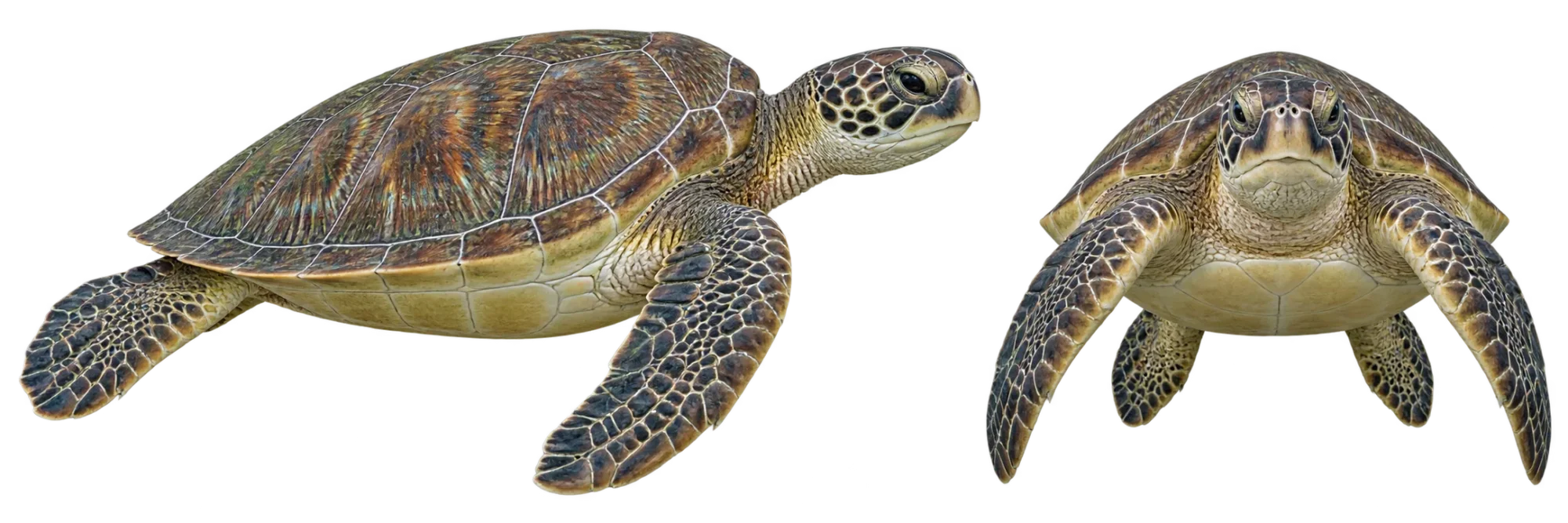
Green sea turtles change both habitat and feeding strategy as they grow. Young turtles may spend years in oceanic waters before moving into coastal feeding areas, while mature adults can travel long distances between feeding grounds and breeding sites. Because growth differs among populations, the path from hatchling to reproductive adult in Chelonia mydas has no single fixed timetable.
Green Turtles Change Habitat as They Grow
A newly emerged green turtle begins life by crossing the beach and moving offshore. The early oceanic stage can last for several years. During this period, small turtles use open-water habitats and feed on plant and animal material associated with floating ocean communities.
Many juveniles later move into shallower coastal waters. These areas can become long-term developmental and feeding grounds where turtles continue growing toward adult size. Diet often changes with this move. Coastal green turtles commonly feed heavily on seagrasses and algae, although the amount of animal material eaten varies among populations.
The timing of the coastal transition is not identical across the species. Research on juveniles from southern Brazil estimated recruitment to coastal habitat at roughly two to three years of age and around 30 cm curved carapace length. Work on eastern Pacific turtles has placed the transition closer to about four to six years in some groups.
Even the usual oceanic-to-coastal sequence has exceptions. Studies in the eastern Pacific have found post-oceanic green turtles remaining in pelagic feeding habitat for long periods rather than settling permanently into the shallow lagoon and seagrass habitats often associated with the species. Habitat use therefore depends partly on the population and the feeding opportunities available to it.
Age at Maturity Varies by Population
Green turtles spend a large part of their lives growing before they reproduce. Broad species accounts often place female maturity at around 25 to 35 years, but studies of individual populations show that one age cannot describe every green turtle.
Eastern Pacific research, for example, has found marked differences even between nesting groups within the same broad region. Some females associated with nesting areas in Michoacán, Mexico, were estimated to mature at around the late teens, while estimates for larger-bodied females associated with the Revillagigedo Islands were closer to 30 years. Male and female maturation ages can also differ.
Hawaiian green turtles show why maturity estimates need context. Long-term growth data once supported estimates of roughly 35 to 40 years before first reproduction, while other analyses have produced estimates closer to the early twenties. Part of this gap comes from how turtle growth is measured.
Researchers can reconstruct age and growth from annual layers preserved in bones, a method known as skeletochronology. These records have shown that growth does not always proceed at a steady yearly rate. Occasional growth spurts can shorten the time needed to reach reproductive size, so calculations based only on average growth rates may make the juvenile period appear longer than it really was.
Food availability, habitat quality, body size and regional growth patterns can all contribute to different maturation schedules. For green turtles, age at sexual maturity is therefore a population-level trait as well as a species-level characteristic.
Reproduction Is Clustered Into Nesting Seasons
Reproduction follows a different rhythm from the long juvenile growth period. Mature turtles may spend years at feeding grounds before beginning another breeding migration. Adults commonly reproduce on cycles of about two to five years, although the interval can vary among individuals and populations.
Once a female enters an active nesting season, egg laying becomes much more frequent. A female can return to the nesting beach at intervals of roughly two weeks and produce several clutches before leaving the breeding area. A green turtle nest often contains around a hundred eggs, but clutch size varies naturally.
This creates two very different time scales within the same reproductive strategy: several nests can be produced within one season, followed by a gap of years before the female breeds again. The interval gives the turtle time to return to its feeding area and rebuild the energy reserves needed for another migration and nesting season.
Females often return to a nesting region close to where they hatched decades earlier. Their feeding areas may be hundreds or thousands of kilometres from those beaches, so reproduction can require a long migration before any eggs are laid.
Nest Temperature Determines Hatchling Sex
Green turtle embryos develop in sand for roughly two months, and the thermal conditions inside the nest affect more than development speed. Like other sea turtles, Chelonia mydas has temperature-dependent sex determination.
Cooler incubation conditions generally produce more males, while warmer conditions produce more females. The relationship should not be reduced to one universal temperature threshold. The temperature that produces an approximately even sex ratio differs among green turtle populations, and conditions inside a natural nest change from day to day.
Studies of green turtle eggs have also found that incubation temperature can affect development rate, hatchling size and the amount of yolk remaining when a turtle hatches. Warmer eggs normally develop faster within the viable temperature range, while temperatures near the extremes can reduce normal development and hatching success.
Sex determination is especially sensitive during a limited part of embryonic development rather than equally sensitive throughout the entire incubation period. Temperature changes during that window can alter the proportion of males and females produced. Recent work with natural green turtle nests also shows that temperature variation within and between nests matters: brief cooler periods and small thermal differences can allow some males to develop even under conditions that would appear strongly female-producing when judged only by an average nest temperature.
 HawksbillEretmochelys imbricata
 Loggerhead sea turtleCaretta caretta