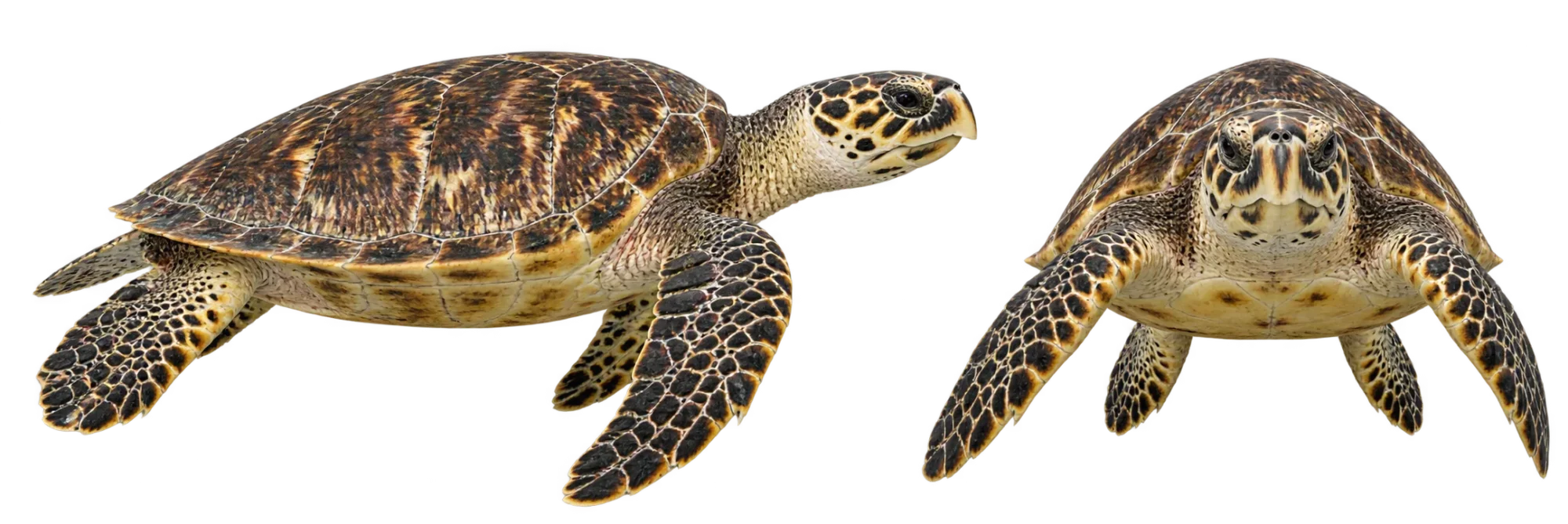
A hawksbill sea turtle, Eretmochelys imbricata, spends much of its early life growing toward a reproductive stage that may not begin for decades. Its life history also changes with age: young turtles pass through offshore waters before many settle into coastal feeding areas, while mature females periodically leave those feeding grounds for concentrated nesting seasons.
Growth Continues for Decades Before Reproduction
Hawksbills do not have one dependable worldwide age of sexual maturity. Growth differs among populations and feeding areas, so reaching adult size can take very different amounts of time. Broad estimates commonly place maturity at roughly 20 to 35 years, but studies of particular populations have produced younger or older estimates.
Research using growth layers in the bones of eastern Pacific hawksbills illustrates this variation. In a sample from El Salvador, turtles with detectable maturity transitions were estimated to have matured between about 16 and 26 years old. The sample of mature individuals was small, so that range is best treated as information about that population rather than a universal schedule for the species.
Growth also slows as adulthood approaches. Eastern Pacific skeletal records showed rapid growth during the earliest years, followed by progressively smaller annual gains. Mature turtles in that study added very little shell length each year. Adult size therefore does not represent a short growth phase reached soon after the juvenile period; it is the result of a long developmental history.
Young Hawksbills Change Habitat as They Grow
The first part of a hawksbill’s life is not simply a smaller version of adult life. After leaving the nesting beach, hatchlings enter offshore waters. Floating algae, drifting material and ocean currents can provide habitat during these early years.
NOAA describes this offshore stage as lasting roughly one to five years for many hawksbills before juveniles move into shallower coastal feeding grounds. Once established there, they may spend many years growing before reproduction begins.
The transition is not identical everywhere. Growth-layer and stable-isotope research in the eastern Pacific found evidence that young turtles initially used offshore habitat, but individuals later recruited to coastal areas at different ages and sizes. Some settled around rocky reefs, while others entered mangrove estuaries. Among turtles that moved into estuaries, estimated settlement ages ranged from about three to thirteen years.
This changing habitat use matters when interpreting growth data. A juvenile’s growth rate reflects more than age alone. Food availability, local conditions and the particular feeding ground can all influence how quickly a turtle approaches mature size.
A Nesting Season Contains Several Separate Clutches
Female hawksbills do not normally lay a single clutch and finish reproduction for the year. A nesting female typically returns to the beach repeatedly during one season, producing a series of nests separated by roughly two weeks.
Across the species, three to five nests in a season is a useful general range, although actual reproductive output varies among females and nesting populations. Average clutch counts are also high for a sea turtle. NOAA reports roughly 130 to 160 eggs per nest as a broad average, while individual populations can fall outside that range.
Detailed observations from Tortuguero, Costa Rica, found an average interval of about 16 to 17 days between nesting attempts and a mean clutch size of 158 eggs. Other nesting areas can follow somewhat different schedules, so these figures describe a studied population rather than a fixed biological rule.
After completing a nesting season, a female usually does not repeat the entire process the following year. Two- to three-year intervals are common in documented populations, while broader records show that the gap between nesting seasons can sometimes be longer. Reproduction is therefore concentrated into productive nesting seasons separated by periods spent away from the nesting beach.
Incubation Conditions Shape Development Inside the Nest
Once a clutch is buried, there is no continuing parental care. Development takes place within the beach sand, and incubation commonly lasts around two months. Local temperatures can shorten or lengthen that period, so incubation duration is not identical among beaches or seasons.
Temperature also affects the sex of developing hawksbills. Like other sea turtles with temperature-dependent sex determination, hawksbills tend to produce a greater proportion of females under warmer incubation conditions and more males under cooler conditions. The relationship operates during a sensitive part of embryonic development rather than being determined genetically at fertilization in the way it is for many mammals.
Conditions can differ even within one nesting beach. Shade, vegetation, sand properties, rainfall, nest depth and location can alter the thermal environment surrounding a clutch. Studies of hawksbill nesting beaches have consequently found differences in estimated hatchling sex ratios among sites and years.
Hatching itself is also a process rather than an instantaneous event. Embryos complete development inside the eggs, hatch beneath the sand and then work upward through the nest before emerging at the surface. Once above ground, hatchlings move toward the open horizon over the sea and begin the offshore stage that starts the next long growth cycle.
 Green sea turtleChelonia mydas
 Loggerhead sea turtleCaretta caretta