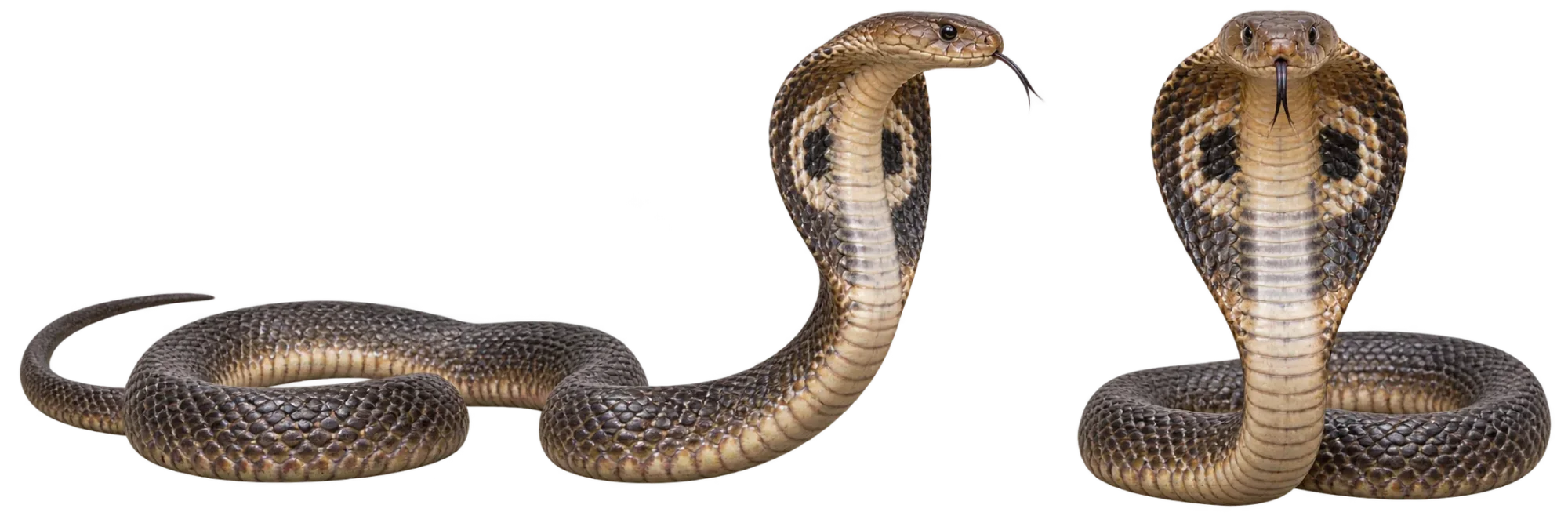
Indian cobra reproduction is strongly seasonal, but field records show more variation than a single breeding date or clutch-size figure suggests. Naja naja lays eggs in protected cavities, females may remain with a nest, and newly hatched young begin independent life at only a few tens of centimeters long.
Seasonal Timing Across the Indian Range
Breeding activity does not fall on one fixed calendar across the entire range of the Indian cobra. Field observations from Telangana recorded mating in February and March, egg laying in April and May, and hatchlings in June and July. Broader Indian records place egg laying across roughly March to July.
This regional sequence is more useful than treating one month as the species-wide breeding season. Naja naja occupies a large part of South Asia, so local conditions can shift when reproductive activity is seen.
Older scientific literature also needs careful reading. Many Asian cobra populations were once grouped under the name Naja naja. The Chinese cobra is now recognized separately as Naja atra, for example. Reproductive studies describing a “Chinese cobra, Naja naja” should therefore not automatically be used as life-history data for the modern Indian cobra.
Nest Choice and Female Attendance
Indian cobras usually place their eggs inside an existing protected space rather than constructing an exposed nest. Recorded sites include rodent burrows, underground cavities, spaces beneath bricks, and passages beneath or beside building floors. These sites provide darkness and a more sheltered environment for developing eggs.
West Bengal rescue records are especially informative. Four clutches collected from different locations were found in rodent burrows or in corridors within the walls and floors of mud houses. Another observation from Kerala involved an adult female curled directly over a large clutch beneath a pile of old bricks near a house.
Females are known to remain near or attend their eggs, but an adult is not always present when a clutch is found. None of the four West Bengal clutches documented in one 2023 reproduction report had an adult cobra with them at the time of discovery.
This means nest attendance should be described as a documented behavior, not as an uninterrupted rule for every female and every clutch.
Clutch Size From Routine Nests to Rare Extremes
A commonly cited clutch for the Indian cobra contains roughly 12–30 eggs, while published accounts give somewhat wider values. Natural-history observations show why a normal range should not be treated as a hard biological limit.
The 45-egg Kerala observation is important because an adult female was found on the clutch, supporting its interpretation as one unusually large reproductive event.
The 74 eggshells documented in West Bengal in 2024 represent something different. Researchers found three distinct clutches in the same underground area, along with two adult females and one male. The separate groups contained 20, 25, and 29 eggs.
Because the combined total was far beyond the largest recorded single clutch, the researchers interpreted the site as the first reported case of communal oviposition in spectacled cobras. The observation came from one site, however, and the researchers could not determine exactly when each clutch had been laid. It is evidence that females can share an egg-laying site, not evidence that communal nesting is routine.
Incubation Records Need the Starting Point
Indian cobra eggs are often described as hatching after about 50–60 days, with broader figures around seven to ten weeks also reported. Field rescue records reveal an important detail: the date eggs are collected is rarely the date they were laid.
In the West Bengal study, four rescued clutches spent between 5 and 45 days under monitored incubation before hatching. Those numbers are remaining incubation times after collection, not complete laying-to-hatching periods. The embryos had already been developing inside their original nests.
A full incubation period requires a known laying date and a known hatching date. Eggs found in a burrow, wall or floor cavity may already be days or weeks into development, so the time recorded after rescue cannot be used as the species’ total incubation period.
This distinction helps explain why some field reports contain apparently very short incubation values without contradicting the longer full incubation period reported for the species.
Field Measurements Show the Scale of a New Hatchling
The same West Bengal records provide unusually detailed measurements of newly emerged Indian cobras. Across four clutches, mean snout-to-vent lengths for male and female groups were approximately 24.4–26.6 cm. Mean tail lengths were about 4.9–5.3 cm, placing average total length near 30 cm for many of the hatchlings measured.
Mean body mass was only 10–12 g. Despite that small size, the young emerged as fully formed snakes rather than passing through a dependent juvenile stage with parental feeding.
All hatchlings in those monitored clutches completed their first recorded shed within about 24–30 hours after fully emerging from the egg. After hatching, the reproductive investment associated with the nest ends and the young begin independent life.
 King cobraOphiophagus hannah
 Black mambaDendroaspis polylepis