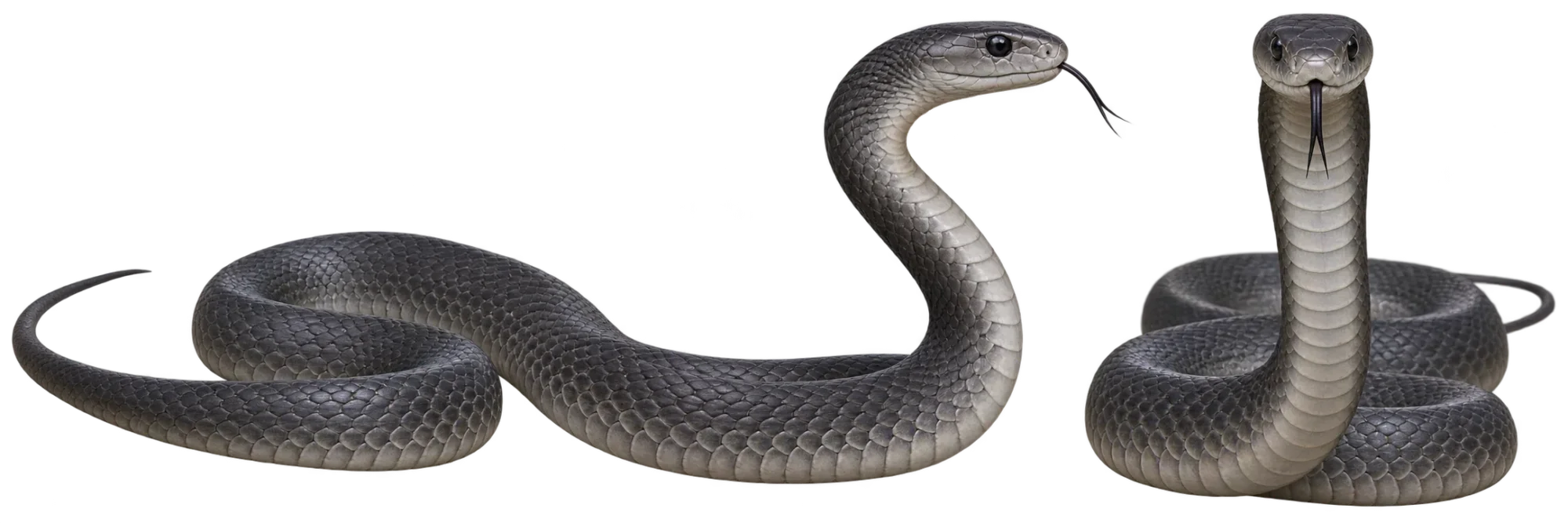
The black mamba, Dendroaspis polylepis, follows a seasonal reproductive cycle in which adults come together briefly, females develop and lay eggs, and the young begin independent life immediately after hatching. Much of this cycle takes place without prolonged pair bonding or parental care.
Breeding Timing Changes With Local Conditions
Black mambas reproduce during the warmer part of the year, but a single calendar period does not describe every population across their broad African range. Southern African accounts commonly place mating in spring and early summer, while local temperature and seasonal patterns can shift the timing elsewhere.
Adults that are usually solitary become more mobile during this period. Males locate receptive females through chemical cues, using tongue-flicking to sample scent trails and information from the female’s body.
Copulation can be prolonged. After mating, the adults separate rather than forming a continuing pair, so reproduction represents a relatively short period of social contact within an otherwise largely solitary life.
Male Combat Is a Distinct Part of the Breeding Season
Two male black mambas may compete by raising the front of their bodies and twisting around one another. Each attempts to force the other downward. Because the snakes are closely intertwined, this behavior has sometimes been mistaken for mating.
The raised, intertwined posture seen between two males is competitive wrestling. Courtship between a male and female instead involves close chemical investigation followed by mating when the female is receptive.
This competition occurs around access to females rather than as a long-term territorial partnership. Once the breeding encounter ends, males provide no known care for the eggs or hatchlings.
Development Continues in Eggs After Laying
Black mambas are oviparous. After mating, the female retains the developing eggs for a period before depositing them in a protected site. Reported clutch sizes vary among sources and individual females, with many accounts placing them roughly within the range of 6 to 17 eggs, while some institutional descriptions report larger clutches.
Suitable laying sites provide shelter and a warm, relatively stable environment. Underground chambers, decomposing vegetation and other enclosed retreats have been reported. The female does not remain to brood the clutch.
Hatchlings Begin With No Parental Care
Newly hatched black mambas are already well developed rather than passing through a dependent juvenile stage. Commonly reported hatchling lengths are around 40 to 60 cm. They emerge with functional movement, sensory systems and venom apparatus and can begin living independently soon after leaving the egg.
This creates a sharp transition between incubation and independent life. The female has already left the laying site, and neither parent feeds, protects or teaches the young.
Juvenile growth is often described as rapid, but a precise age of sexual maturity is much less securely documented in accessible scientific and institutional records. Fast growth should therefore not be treated as evidence for a specific maturity age unless a source measures reproductive maturity directly.
Longevity Records Come Mainly From Captive Animals
Wild lifespan remains poorly measured for the black mamba. Older summaries often repeat an 11-year captive record, but modern longevity databases contain a higher recorded maximum.
The AnAge animal ageing database reports a maximum of 26.2 years in captivity for Dendroaspis polylepis. The database also marks the sample size as small.
That figure is a maximum observed record, not an estimate of how long a typical black mamba lives. It also cannot be transferred directly to wild populations, where mortality from predators, injury, food availability and other environmental pressures differs from managed captivity.
 Indian cobraNaja naja
 King cobraOphiophagus hannah