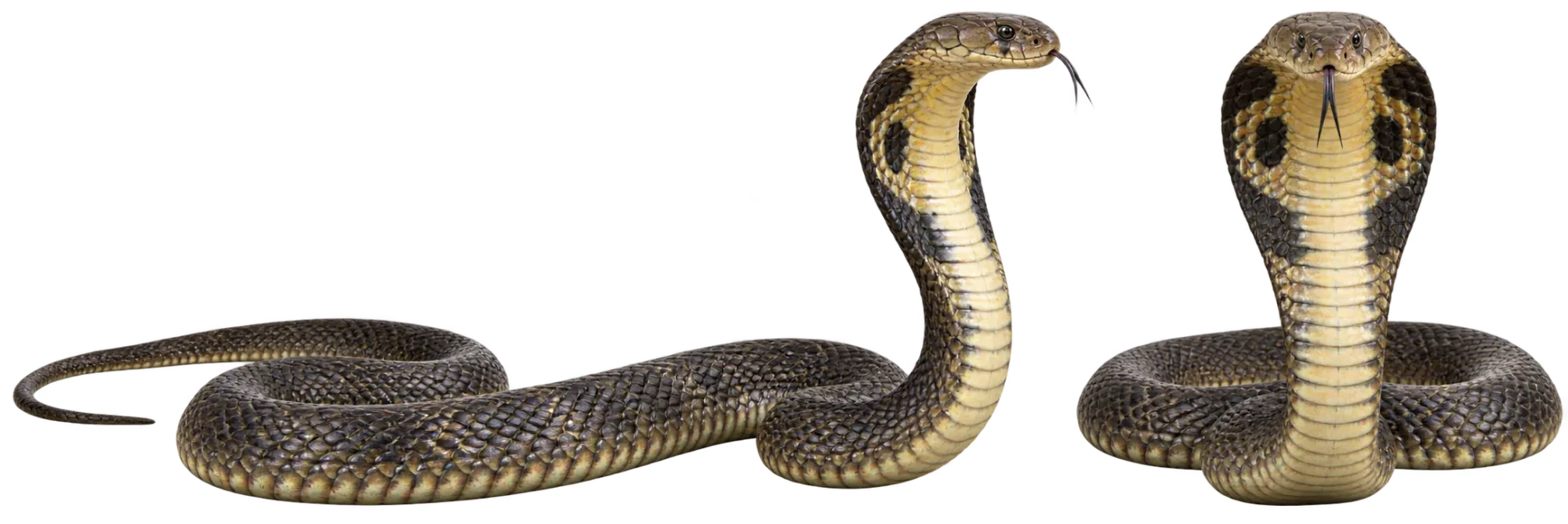
King cobra reproduction centers on an unusual investment for a snake: the female constructs a mound nest, deposits her eggs inside it, and remains nearby for part of incubation. Recent research has also changed what the name Ophiophagus hannah covers, making the location and date of older life-history records unusually important when interpreting this species.
Why Older King Cobra Records Need a Species Check
For generations, king cobras from much of South and Southeast Asia were treated as one species, Ophiophagus hannah. A 2024 taxonomic revision instead recognized four species within the former king cobra complex.
Current Use of Ophiophagus hannah
The name now applies in a narrower sense to populations extending through parts of the northern Indian subcontinent, the Andaman Islands, Indo-Burma, southern China and Indochina to central Thailand. Western Ghats king cobras are Ophiophagus kaalinga, many Sunda-region populations are Ophiophagus bungarus, and the Luzon lineage is Ophiophagus salvatana.
This matters for life-history data. An old record labeled simply “king cobra” may describe an animal that is no longer classified as O. hannah. Reproductive observations from northern India, Bhutan and parts of southern China remain especially useful for understanding O. hannah sensu stricto, while records from the Western Ghats or Sundaland should not automatically be combined with them as though they came from one biological population.
The Nest Changes the Incubation Environment
A female king cobra gathers leaf litter, twigs and other loose plant material with movements of her body and tail, producing an above-ground mound with the eggs enclosed inside. The nest is therefore more than a place to hide a clutch.
A field study of natural nests in the western Himalayan foothills found that the mound created a warmer and less variable incubation environment than the surrounding air. Warmer nests were associated with better hatching success, while aspects of the thermal regime were also associated with hatchling length.
natural nests monitored
mean temperature increase inside nests
linked with higher hatching success
The effect is especially relevant in cooler subtropical environments, where outside temperatures can shift sharply between day and night. Nest construction gives the developing embryos a buffered microclimate rather than leaving incubation entirely to the conditions available at an exposed egg-laying site.
Field Clutches and the 72-Egg Yunnan Record
Clutch size is not represented well by one universal number. Published field observations of O. hannah sensu stricto have commonly documented clutches in the teens through the thirties. One monitored nest in eastern Bhutan, for example, contained 37 eggs.
Recent observations from Yunnan, China, widened that picture. A nest documented in Xishuangbanna contained 30 eggs, while another nest found in 2025 contained 25. The latter produced hatchlings that were observed leaving the nest in August.
The most unusual record came from a Kunming nest containing 72 eggs. Multiple king cobras had been present during the guarding period, and the researchers could not determine the sex of each animal. The clutch therefore should not be treated as evidence that 72 eggs represents a normal upper range for one female. One possibility is an exceptionally large clutch from a single female; another is that eggs from more than one female were present in the same nest.
How to Read the 72-Egg Record
An exceptional nest is evidence that such a nest can occur, not that a typical female lays that many eggs. Until the parentage of unusually large clutches is better understood, ordinary field ranges and exceptional multi-individual observations should remain separate.
Maternal Attendance Covers Only Part of Development
Female king cobras can remain with the mound for weeks after laying, giving the eggs a period of active nest attendance that is uncommon among snakes. The guarding animal may occupy the mound itself or remain close enough to respond to disturbance.
Field observations also show that nest attendance and incubation are not the same period. Females can abandon their nests well before the young emerge, leaving the remaining embryonic development to the protected microclimate of the mound. The young are therefore not dependent on a mother being present at the moment of hatching.
Recent observations add another complication. In Yunnan, more than one adult was seen at some nests during the guarding period. Historical accounts had sometimes suggested participation by two adults, but many later field studies recorded only a single guarding female. The newer observations confirm that multiple individuals can be present without yet establishing how often this happens or exactly what role each snake performs.
Nest Reuse Appears to Be Uncommon
A 2026 field report added another behavior to the known reproductive biology of O. hannah: reuse of an existing nest mound. Researchers in Uttarakhand found two mounds containing separate clutches from different nesting events. Differences in the nest layers and the condition of the eggshells indicated that the structures had been used across more than one breeding season.
The observations do not prove that the same individual female returned each time. Another female could have selected an existing mound. Either way, the records show that a king cobra nest does not necessarily lose all reproductive value after one clutch has hatched.
The behavior appears rare in the available field record. Among 51 nests monitored between 2006 and 2025 in the study area, reuse was identified only twice. Suitable thermal conditions, a proven hatching site or the energy saved by modifying an existing mound are possible explanations, but current observations are too limited to separate those possibilities.
Eggshell remains from one reused mound were accompanied by pieces of shed skin from young king cobras. This raises the possibility that some hatchlings remained within the nest briefly through their first shed, although the same evidence was not present in every nest examined.
 Black mambaDendroaspis polylepis
 Indian cobraNaja naja