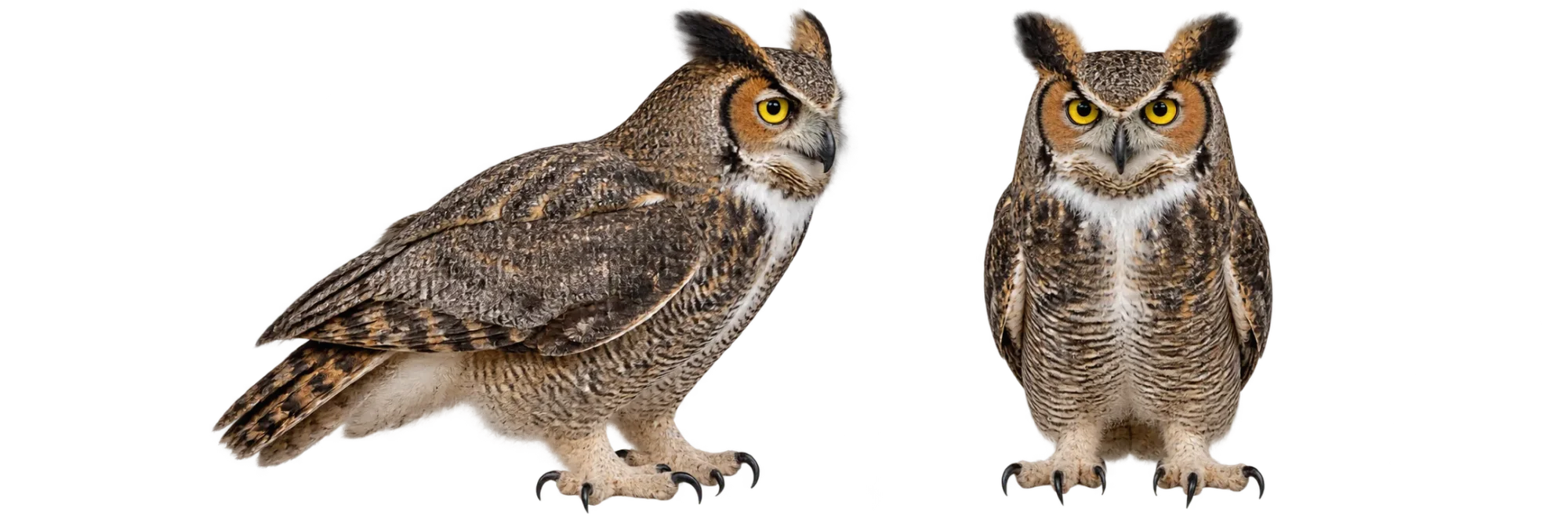
A young Great Horned Owl can climb out of its nest weeks before it becomes a capable flyer. That early departure is part of a long developmental period in which climbing, short flights, stronger flight and continued parental care occur as separate stages rather than one sudden transition to independence.
Breeding Begins While Winter Still Shapes the Landscape
Great Horned Owls (Bubo virginianus) are notably early breeders across much of their range. Courtship and territorial calling can intensify during winter, and some pairs lay eggs long before many other North American birds have begun nesting. Timing varies geographically. Birds at higher latitudes generally breed later than those farther south.
The pair usually does not construct a new nest from scratch. Great Horned Owls commonly occupy an existing stick nest made by a hawk, crow, raven or another large bird. They can also use tree cavities, cliff ledges, buildings and artificial platforms. The availability of a suitable site can therefore shape where breeding takes place even though the species itself occupies many different habitats.
A typical clutch contains 1–4 eggs, and one brood is usual during a breeding season. The female performs the incubation. The male supplies much of the food while she remains with the eggs and, later, the small owlets.
Nesting dates should not be treated as one fixed calendar period for the entire species. Latitude, local climate, prey conditions and the timing of individual pairs can shift egg laying by weeks or months.
Hatching Starts a Period of Very Rapid Growth
Incubation generally lasts about 30–37 days. Newly hatched owlets are altricial: their eyes are initially closed, their movement is limited, and they depend completely on parental warmth and food.
The female broods the young closely during their earliest days while the male continues bringing prey. As the owlets grow and become better able to regulate their body temperature, the female can spend more time away from the nest and can also take part in obtaining food.
Growth during the first month is fast. Cornell observations and published measurements show young Great Horned Owls gaining much of their eventual body mass while they are still unable to fly. An owlet can therefore look surprisingly large while remaining developmentally dependent.
Size is also influenced by sex. Adult females are normally heavier than males, and that difference begins to appear during nestling growth. A young owl approaching adult-like mass should not be assumed to have reached adult flight ability, hunting skill or independence.
Leaving the Nest and Flying Are Separate Milestones
Great Horned Owl development is especially easy to misinterpret around five to nine weeks after hatching. Young birds may leave the nest, climb through nearby limbs and remain around the nesting tree before sustained flight is possible.
This progression explains why published accounts can give different ages for “fledging.” One source may record the first departure from the nest, another the first short flight, and another the point at which an owlet flies more competently. These observations describe different milestones rather than necessarily conflicting biology.
Even after an owlet has left its original nest, it may remain in the same group of trees and continue calling for food. A bird perched outside the nest is therefore not automatically abandoned or independent.
Parental Care Continues Long After the First Flight
Flight does not immediately turn a juvenile Great Horned Owl into a self-sufficient predator. The parents continue delivering food while the young develop stronger flight, learn to move around their surroundings and gain experience handling prey.
Juveniles may remain associated with their parents for several months after fledging. Cornell observations describe young remaining with the adults for roughly three to four months before dispersing from the natal territory in some populations.
This extended period helps separate three events that are sometimes compressed into a single “fledging age”: leaving the nest, becoming capable of flight and becoming independent. For Great Horned Owls, those events can be spread across a substantial part of the juvenile period.
Young birds can be physiologically capable of breeding relatively early. Females may breed at about one year of age, while broader accounts give a range of roughly one to three years for reproductive maturity. Actual breeding also depends on whether a young adult can obtain a territory and mate. Some adults remain nonbreeding “floaters” rather than immediately establishing their own nesting territory.
Established Pairs Return to a Seasonal Territorial Cycle
Great Horned Owls are generally monogamous, and members of an established pair may remain within the same territory outside the nesting period even when they roost separately. Territorial hooting becomes especially conspicuous around the months leading into breeding.
The nest itself is less permanent than the pair’s use of a territory. Because many Great Horned Owls occupy nests originally built by other species, a stick nest can deteriorate during a single season and may not be suitable the following year. A pair can remain in the same general area while shifting to another nest structure.
Survival can extend far beyond the age of first breeding. Long-term banding records include a Great Horned Owl known to have reached at least 28 years of age. Such a record represents exceptional documented longevity, not the expected lifespan of every wild individual.
Adults that survive from year to year can repeat the winter breeding cycle many times: territory defense and pair calling, selection of a usable nest, incubation, rapid nestling growth, branching, progressive flight development and months of continued care before the young disperse.
 Eurasian eagle-owlBubo bubo
 Burrowing owlAthene cunicularia