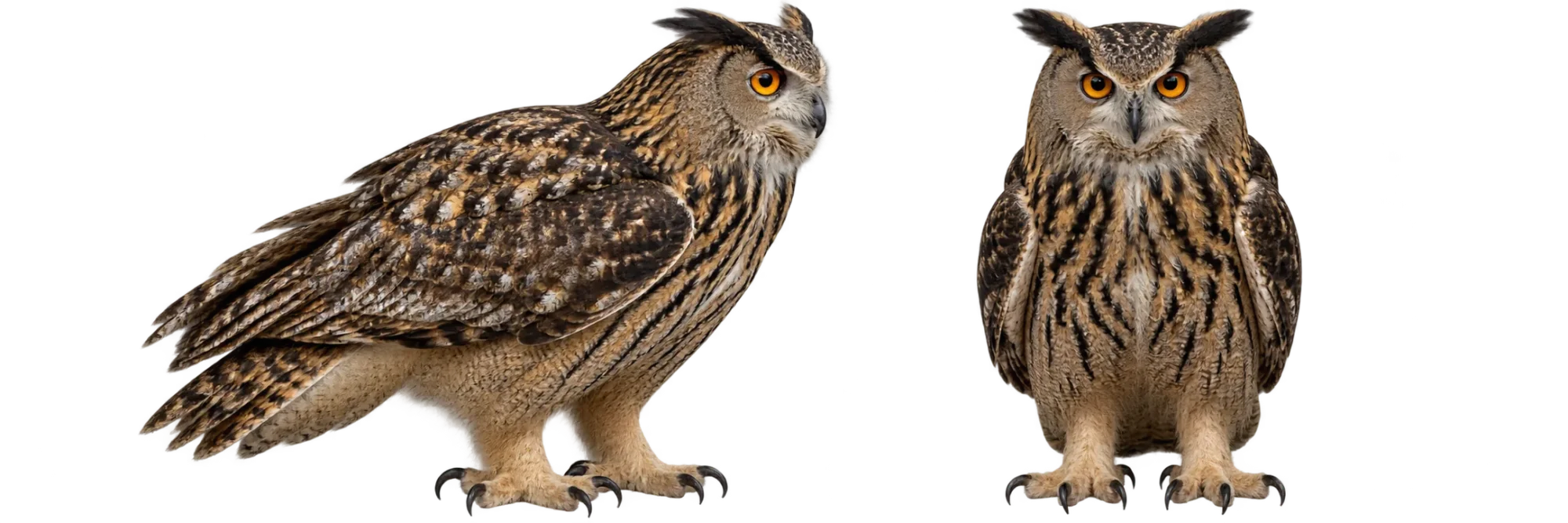
The Eurasian eagle-owl, Bubo bubo, grows rapidly during its first weeks, yet reaching near-adult size is only one part of becoming independent. Young birds remain tied to their parents for months after leaving the nest, and many do not enter the breeding population until well after their first year.
Winter Breeding Begins a Long Period of Parental Care
Across much of Europe, Eurasian eagle-owls begin breeding early in the year. Exact timing varies with latitude, local conditions and food supply. In some well-studied populations, laying starts during winter, so a pair may already be committed to reproduction long before spring conditions arrive.
Eggs are normally laid several days apart. The female performs the incubation, while the male supplies much of her food. Direct nest observations have recorded incubation periods of roughly 32–35 days for individual eggs. Because incubation starts before the whole clutch is complete, chicks from the same nest may hatch on different days.
This age difference matters most during early development. An older chick can already be larger and more mobile while a later-hatched sibling is still at an earlier growth stage. The reproductive cycle therefore develops as a sequence rather than as a group of young progressing at exactly the same rate.
Food conditions can also alter breeding performance. Long-term field research has linked prey availability and diet composition with laying date and reproductive output. This helps explain why a single fixed breeding date or brood outcome cannot represent every Eurasian eagle-owl population.
Rapid Early Growth Comes Before Months of Dependence
Growth is especially fast during the first part of nestling life. Measurements from young Eurasian eagle-owls found the strongest increase in body mass during approximately the first 30 days, while major gains in body dimensions continued for about 40–45 days. Growth then slowed enough that body measurements became less useful for judging a young bird’s exact age.
Leaving the nest does not mark independence. Young from accessible ground or low cliff nests may move away from the nest when about 40–45 days old even before they can fly properly. Birds raised on high cliffs generally remain at the nest longer because leaving such a site requires much better flight ability.
After this stage, the family can become surprisingly spread out. Radio-tracked juveniles have been recorded as far as about 1.5 km from the nest at 80–90 days of age. Siblings also tend to move farther apart as they get older. These birds may look physically advanced while they are still living within the parental territory and depending on adults for food.
Fledging and independence are different stages
A young eagle-owl may leave its original nest area weeks or months before it finally separates from its parents. Flight ability therefore should not be treated as the end of parental dependence.
Parental roles change during this period. Females spend much of the earliest nestling stage close to the young, while males carry much of the hunting load. As the chicks become older, females spend less time at the nest and take a broader role away from it.
Natal Dispersal Often Starts at About Five to Six Months
The transition from dependent juvenile to independent disperser is prolonged. A detailed study of young eagle-owls found definitive dispersal beginning at roughly 150–160 days of age. Research in the European Alps produced a similar pattern: surviving tracked juveniles left their parents at a median age of about 23 weeks, although individuals varied widely.
Dispersal is not simply a short flight away from the natal nest. Young birds can spend weeks moving through unfamiliar areas before settling temporarily. Alpine tracking recorded nightly movements that accumulated into much larger total journeys, showing that this stage involves extended exploration rather than one direct transfer from the parental territory to a future breeding site.
Other tracking work has found that departure often occurs when juveniles are around six months old. Moonlight may influence the exact night on which a bird begins this movement, with brighter conditions associated with dispersal departures in several European study populations.
Leaving the parents still does not mean immediate breeding. Field studies generally place normal first reproduction later, often around three years of age or beyond, although exceptions occur. A tracked female has been documented breeding successfully during her first year, while other monitored young birds showed no breeding attempt at two or three years of age.
This variation separates reproductive capability from the age at which reproduction actually begins. A young Eurasian eagle-owl can be physically mature enough to survive independently well before it acquires a breeding territory, forms a pair and produces its own young.
 Great horned owlBubo virginianus
 Burrowing owlAthene cunicularia