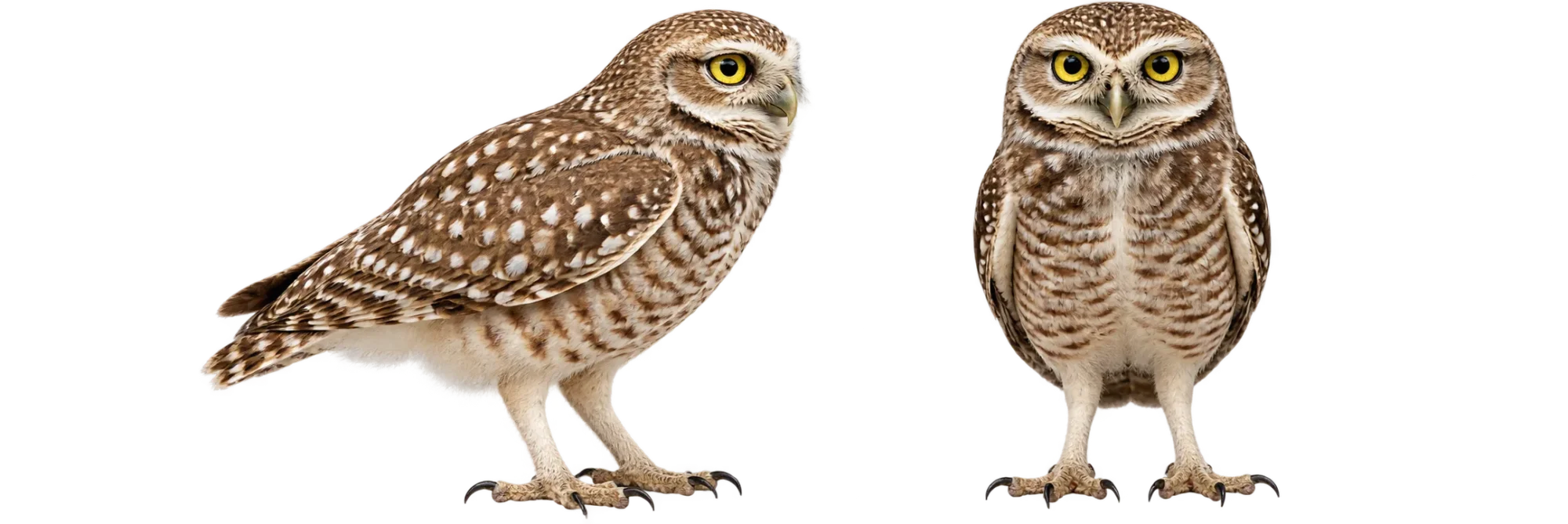
For a burrowing owl, Athene cunicularia, the breeding season is organized around an underground nest chamber and a long period of parental care. Eggs may be laid in a fairly large clutch, yet the young do not all reach the same stage at the same time. Hatching can be spread across several days, chicks begin appearing above ground well before they can fly well, and family groups may keep using a network of nearby burrows as the young develop.
The Nest Burrow Shapes the Breeding Cycle
Most burrowing owls use tunnels originally dug by mammals such as prairie dogs and ground squirrels. Some populations, especially in Florida and parts of the Caribbean, can excavate their own burrows. The underground chamber is more than a place to lay eggs. It is the center of courtship, incubation, chick shelter, food delivery, and early juvenile activity.
Pairs may return to the same breeding area in later years, and nonmigratory birds can use burrows throughout the year. During courtship, the male displays near the nesting area and brings food to the female. Once incubation is underway, the female spends most of her time with the eggs while the male supplies food and watches the area around the burrow.
Egg Laying, Incubation, and Staggered Hatching
A female usually lays several white eggs over a series of days. Reported clutches commonly fall between 2 and 12 eggs, although clutch size varies among regions and breeding conditions. Incubation is mainly performed by the female and is often reported at about 28 to 30 days.
The chicks do not necessarily hatch together. A four-year study of 112 nests in southern Saskatchewan recorded hatching spans from 1 to 7 days, with four days the most common span. This creates a real age and size difference within a single brood. The youngest chick may therefore face a different feeding situation from an older sibling even though both came from the same clutch.
Hatching timing also varies within the species. Research in California has found different laying intervals and different points at which females begin steady incubation. That variation helps explain why a single fixed schedule cannot describe every burrowing owl nest.
Chicks Move Outward Before They Become Independent
Newly hatched burrowing owls are helpless, down-covered, and dependent on their parents. For roughly the first two weeks, the female remains closely tied to the nest while food brought by the male supports both her and the brood. She later begins hunting again as the chicks become less dependent on constant brooding.
Food Supply Strongly Affects How Many Young Survive
Burrowing owls can lay many eggs, but fledgling production depends heavily on whether parents can keep the brood fed. This matters most after hatching, when several growing chicks may be competing for prey at the same time.
A five-year food-supplementation experiment with breeding burrowing owls in Canada found that supplemented pairs fledged, on average, 47% more young than unfed pairs except during a year when natural prey was unusually abundant. In the unfed broods, nearly all recorded nestling deaths in that study were attributed to food shortage. The result helps explain why clutch size alone is a poor measure of reproductive output.
Staggered hatching can make this pressure uneven within a brood. Later-hatched chicks start smaller and younger than their older siblings, so low food availability can affect them sooner. In years with abundant prey, more of that initial brood may survive through the nestling period.
Dispersal Begins Before the Next Breeding Season
After the dependent period, young burrowing owls leave the natal area on very different schedules. A controlled field study at 135 nests found that dispersal timing responded to food conditions, ectoparasite levels, local conditions, and the timing of parental departure. Juvenile dispersal is therefore flexible rather than a single age-triggered event.
Most young eventually establish themselves away from the natal nest, but delayed dispersal also occurs. Studies of urban and rural burrowing owls have found a small number of first-year birds, mainly males, remaining with their parents instead of leaving immediately. The behavior was uncommon, yet it shows that independence and family separation are not always the same event.
Burrowing owls are capable of breeding at about one year of age. For a bird that may spend its first months moving among burrows, learning to hunt, and deciding when to leave its natal area, the transition from dependent chick to breeding adult is spread across much of its first year rather than ending at fledging.
 Great horned owlBubo virginianus
 Eurasian eagle-owlBubo bubo