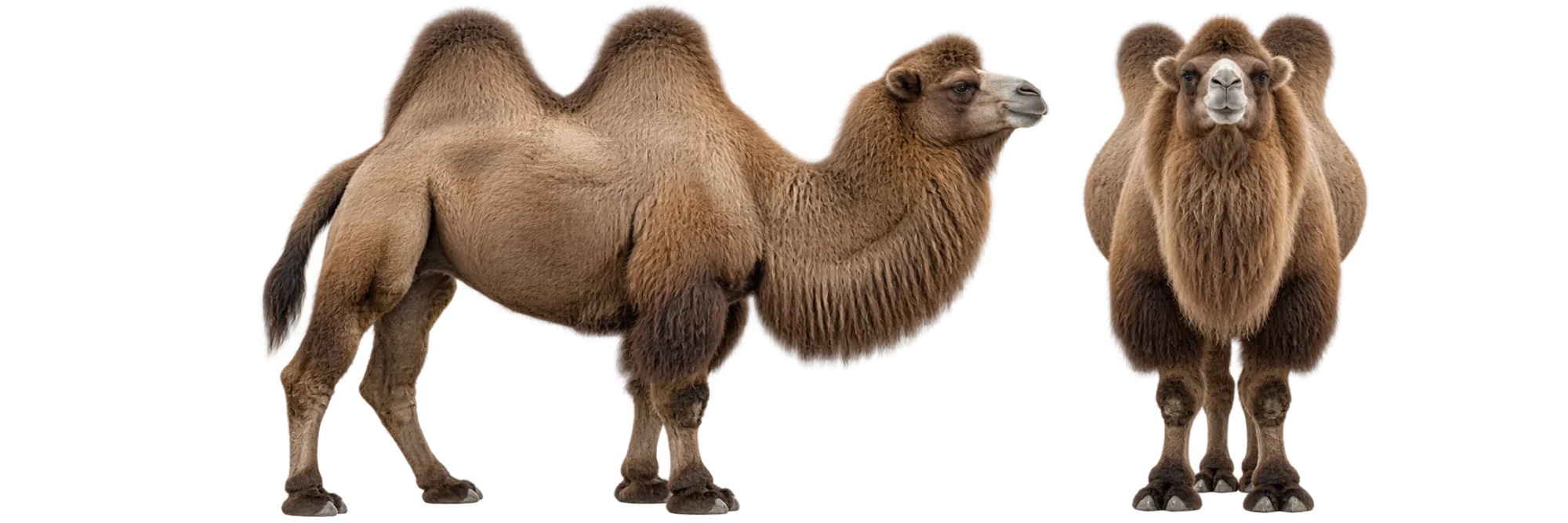
The domestic Bactrian camel, Camelus bactrianus, invests heavily in each calf. Pregnancy lasts for about 13 months, births are usually single, young remain closely tied to their mothers long after they can walk, and another successful pregnancy commonly comes only after a long reproductive interval.
Which Bactrian Camel the Life-History Data Describe
The name “Bactrian camel” is sometimes applied loosely to both domestic and wild two-humped camels. That creates a real problem for life-history data. The domestic Bactrian camel is Camelus bactrianus, while the surviving wild camel is generally recognized as Camelus ferus.
The distinction is deeper than domestication status. Genetic work indicates that the living wild camel lineage separated from the ancestors of domestic Bactrian camels long before domestication. Modern wild camels are therefore not simply feral versions of the domestic animal, nor are they the surviving population from which today’s domestic Bactrian camels were directly domesticated.
Reproductive ages, longevity records and observations of calf development should not automatically be transferred between C. bactrianus and C. ferus. Older references sometimes combine them or use older taxonomic names, so apparently conflicting values may describe different populations rather than the same biological sample.
Breeding Is Concentrated in the Cooler Part of the Year
Bactrian camels are seasonal breeders. The exact months vary with latitude, temperature, food availability and management, but reproductive activity is generally concentrated in the cooler season. Studies and managed-herd records from Asia often place the main breeding period from winter into early spring.
Females do not follow a simple spontaneous ovulation cycle like many familiar domestic mammals. Camels are induced ovulators: mating provides the stimulus that normally leads to ovulation. Follicles can develop in repeated waves during the breeding season when pregnancy has not occurred.
Male reproductive activity also changes with season. Hormone monitoring of zoo-housed Bactrian camels found higher androgen concentrations during part of the year, supporting the strong seasonal pattern already observed in camel breeding behavior. The calendar is not identical in every herd, so one fixed breeding month should not be treated as a species-wide rule.
Pregnancy Lasts for Roughly Thirteen Months
A Bactrian camel pregnancy occupies more than a full year. Reproductive literature commonly places gestation around 375–415 days, although individual pregnancies can fall outside that range. A study of zoo-housed Bactrian camels, for example, recorded pregnancies lasting 404 and 442 days.
Such variation is useful context for a species trait database. Gestation is a biological range rather than a countdown that ends on the same day in every female. Parity, nutrition, management and characteristics of the pregnancy can all contribute to differences between recorded values.
A single calf is the normal outcome. Twins can occur but are unusual. The long gestation, combined with nursing and a seasonal opportunity to breed again, helps explain why females generally do not produce one calf every year.
Under ordinary reproductive patterns, a female may produce a calf about every second year. Postpartum females can remain reproductively inactive while raising a calf, especially when nutritional conditions are limiting. Better body condition can shorten that delay, so the interval between births is partly biological and partly influenced by husbandry.
Calves Become Mobile Long Before They Become Independent
Bactrian camel calves are well developed at birth. A healthy calf can stand soon after delivery and begin moving with its mother within hours. That early mobility is important for a large grazing animal, but it should not be confused with early independence.
Nursing commonly continues for about one to two years. The mother remains the main source of milk and protection during the early part of this period, while the calf gradually shifts toward the feeding behavior of older animals. Young camels may continue associating closely with their mothers beyond weaning.
This produces two very different developmental milestones. Locomotor ability appears almost immediately, while nutritional and social independence develop over years. A calf that can walk during its first day is still at the beginning of a long juvenile period.
Females Usually Mature Earlier Than Males
Published ages for sexual maturity vary because puberty, first successful breeding and full adult development are not identical milestones. Females are often reported as sexually mature at roughly three to five years. Males commonly reach effective breeding maturity later, often around five to seven years, although earlier physiological maturity can occur.
Managed herds make this distinction especially clear. A young camel may show signs of puberty before it has the body size or condition considered suitable for breeding. Husbandry records can therefore give a later “breeding age” than a physiological study gives for the onset of sexual maturity.
Male age is also tied to competition and breeding condition. Reaching puberty does not immediately make a young male equivalent to an established adult breeding male. Physical growth and reproductive development continue after the first signs of sexual maturity.
 LlamaLama glama
 DromedaryCamelus dromedarius