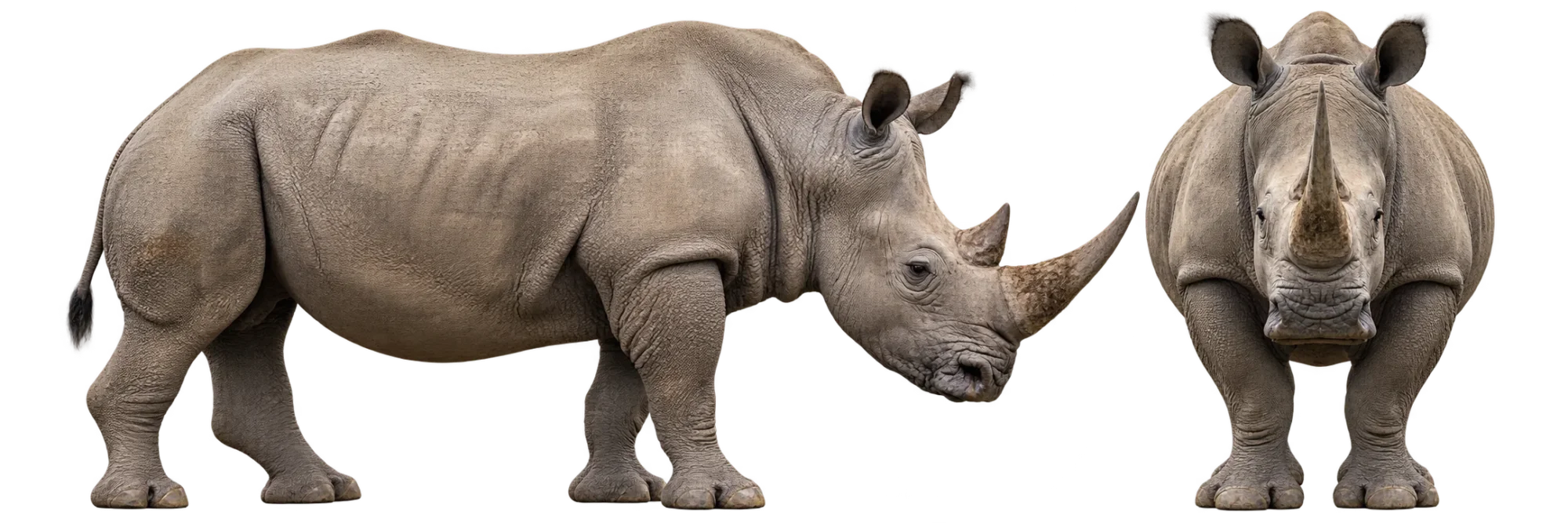
A female white rhinoceros spends much of her reproductive life either pregnant or caring for a dependent calf. Pregnancy lasts about 16–17 months, and the interval between calves commonly extends beyond two years. That long cycle links gestation, maternal care and the timing of the next conception more closely than a single reproduction statistic suggests.
Most detailed reproductive measurements for Ceratotherium simum come from southern white rhinoceroses, including animals living in large managed reserves and zoological populations.
Pregnancy and the Calving Interval
White rhinoceroses produce one calf per pregnancy. A large analysis of rhinoceros gestation records found an average white rhino pregnancy of about 504 days, with observed pregnancies ranging from roughly 480 to 525 days. This places gestation close to 16.5 months, although individual pregnancies do not all last exactly the same length.
The period between births is much longer than pregnancy alone. In a study of more than 1,300 southern white rhinos living in a large game-ranch setting, females had a median interval of about 29 months between calves. Pregnancy therefore occupies well over half of a typical birth-to-birth cycle.
The rest of that interval includes recovery after birth, nursing, continued calf care and the return to successful breeding. For a large mammal that normally raises one calf at a time, reproductive output depends heavily on maintaining this long sequence without interruption.
From Sexual Maturity to First Calving
Sexual maturity and the production of a first calf are different life-history milestones. Female white rhinos may become reproductively mature while still relatively young, but observed first births generally occur later.
In the large game-ranch population, the median age at first calving was 83.2 months, or just under seven years. Individual females varied widely around that point. This field-based measure is more informative about the start of actual reproduction than treating the earliest possible maturity age as the beginning of regular breeding.
Male development follows a different path. Becoming physiologically capable of reproduction does not give a young male the same breeding opportunities as an established adult. Access to females is strongly affected by territorial status and competition among males.
Maternal Care Extends the Calf Period
The mother provides essentially all parental care. A newborn can stand and begin nursing soon after birth, but independence develops slowly. Calves begin sampling grass while still dependent on milk and remain closely associated with their mothers long after they become mobile and capable grazers.
Published estimates of weaning age differ because researchers do not always measure the same endpoint. Some species summaries place weaning near the end of the first year, while detailed field observations have recorded nursing continuing well into the second year. Male calves may nurse longer than females in some observed populations.
A calf can obtain much of its food by grazing before nursing has completely stopped. It may then remain with its mother after nutritional dependence has declined. Mother-calf associations commonly continue into the second or third year.
In open habitat, a young white rhino often moves ahead of its mother. This arrangement leaves the larger female behind the calf if the pair has to move away from a threat. As the mother approaches another reproductive cycle or produces a new calf, the older offspring becomes progressively more independent.
Territorial Males Have Unequal Breeding Success
White rhino mating is not based on permanent pairs. Genetic paternity work has shown that both males and females can reproduce with multiple partners, although individual mating histories vary.
Adult males commonly establish territories, and those territories matter biologically because they affect access to receptive females. Long-term paternity data show that reproductive success is uneven among territorial males. Some sire more calves than others even when several adult males are present in the same broader population.
A male may remain close to a receptive female for several days before mating. Female movement between male territories and interactions with resident bulls help determine which males actually reproduce. As a result, male sexual maturity alone gives an incomplete picture of male reproductive life history.
Estrous Cycle Length Varies Between Females
Female reproductive cycles are unusually variable in white rhinoceroses. Hormone studies of managed animals have recorded both shorter cycles of roughly 30–35 days and much longer cycles near 70 days. Some females show one pattern consistently, while others can change between patterns.
The longer cycles result from an extended luteal phase. They were once often associated with poor fertility because full-term pregnancies had rarely been documented after them. Later reproductive work showed that pregnancies can be established following long luteal phases when ovulation and insemination are carefully managed.
This variation helps explain why a single estrous-cycle value does not describe every white rhinoceros female. Reproductive timing can differ between individuals even within the same subspecies and managed population.
 Black rhinocerosDiceros bicornis