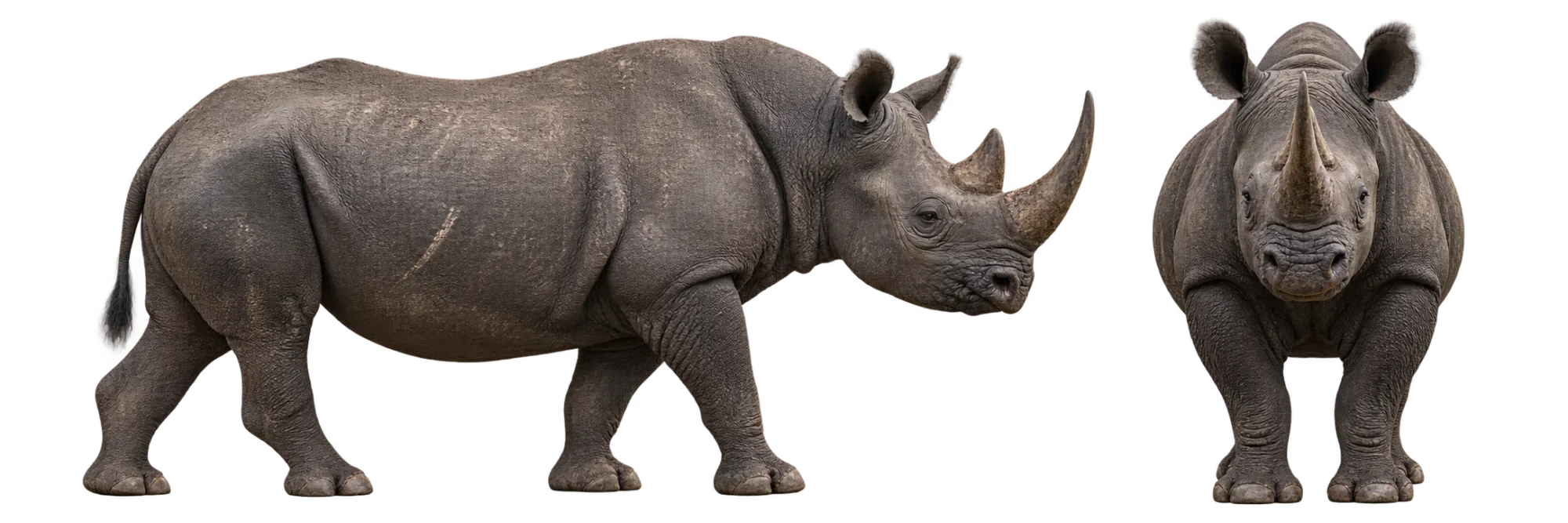
For Diceros bicornis, reproductive pace is shaped by a long pregnancy and an even longer period of maternal care. A female normally produces one calf, then remains closely associated with that offspring for years. Small changes in the age of first birth or the interval between calves can therefore make a large difference across a female’s reproductive life.
Pregnancy Lasts About Fifteen Months, With Real Variation
Black rhinoceros gestation is often rounded to 15 months, but pregnancy length is not identical from one female to another. A large comparison of rhinoceros pregnancies published in 2023 calculated a mean of 460.6 days for black rhinoceroses, based on roughly 70 gestation records. Recorded pregnancies in that dataset ranged from 436 to 486 days.
Earlier reproductive monitoring produced a similar spread. Hormone measurements from eastern black rhinoceroses recorded pregnancies lasting 440 to 470 days, supporting the use of about 15 months as a practical central estimate rather than a fixed biological deadline.
The 2023 analysis also found that gestation length shifted slightly with the time of year. Pregnancies ending in spring and summer averaged about a week shorter than those ending in autumn and winter. Calf sex did not show the same effect. Black rhinoceroses can reproduce throughout the year, so these seasonal differences describe variation in timing rather than a strict breeding season.
An unusually long pregnancy has also been documented
A veterinary case published in 2025 reported a healthy calf after a 490-day pregnancy in a zoo-managed female undergoing fertility treatment. It extends the documented upper end of gestation but represents an individual clinical case, not the normal pregnancy length for the species.
Calving Intervals Change Across Populations
The time between calves is one of the most variable parts of black rhinoceros reproduction. Long-term records from Namibia found a mean inter-birth interval of 38 months among breeding females. The individual records ranged much more widely, showing that a three-year interval is useful as a population-scale reference but cannot describe every female.
Differences can appear even between populations living within the same protected landscape. Research in South Africa recorded a mean interval of about 39 months among females in one section of Addo Elephant National Park and about 27 months in another section. Other monitored populations have also produced intervals both shorter and longer than these values.
Post-birth reproductive timing shows the same variability. A hormone study of wild females in Zimbabwe detected no new conception during the first eight months after birth among the females studied. Long-term demographic records from Addo, however, included a rare 16-month interval between two calves, short enough to indicate conception very soon after the previous birth. These observations come from different animals and populations, so they should not be turned into a single fixed postpartum waiting period.
Local conditions can affect the pace as well. A 2024 study across three Kenyan black rhinoceros populations found that females associated with greater seasonal shifts in diet tended to reproduce more slowly. The relationship was observational, but it adds to evidence that birth spacing reflects the circumstances experienced by a population as well as the basic reproductive biology of the species.
First Calving Usually Occurs Around Seven Years of Age
Sexual maturity and actual reproduction are separate life-history measurements. General species datasets commonly place female sexual maturity at roughly 5 to 7 years, while male maturity is often placed somewhat later. Those ages describe reproductive development; they do not establish when an individual will actually produce its first offspring.
Field records provide a clearer measure for females. In a 20-year study of Namibian black rhinoceroses, 32 females with known birth histories produced their first calves at a mean age of 7.4 years. The youngest recorded first-time mother in that dataset was 5.2 years old, while some females reproduced much later.
South African populations produced closely comparable averages. Females monitored in two sections of Addo Elephant National Park had their first calves at about 7.4 and 7.5 years on average.
This distinction matters when life-history datasets are compared. An age listed as sexual maturity should not automatically be treated as age at first birth. For a species carrying a calf for about 15 months, the conception leading to a first calf also occurred well before the recorded age at first parturition.
The Calf Remains With Its Mother for Several Years
A black rhinoceros normally gives birth to a single calf. Development begins quickly after birth, even though independence comes much later. A study of two captive-born eastern black rhinoceros calves recorded both standing within 76 minutes of birth and first nursing at about 130 minutes. During their first six months, the calves gained about 1.2 kilograms per day and continued to spend much of their time close to their mothers.
Milk remains part of the relationship far beyond the neonatal stage. Species accounts often place weaning around 18 months to two years, but observations show that nursing can continue beyond a single standard age. A detailed zoo study followed one calf through a 25-month lactation period.
Weaning also should not be confused with independence. Young black rhinoceroses may remain associated with their mothers for roughly two to four years. Field demographic studies sometimes classify an animal as a calf until it separates from its mother or reaches its fourth birthday, whichever occurs first.
Solid food and greater physical independence develop during this period, but the mother-calf association continues much longer than the earliest developmental milestones. That extended relationship occupies a large part of the interval before another calf arrives and makes prolonged maternal care a major part of the black rhinoceros life history.
 White rhinocerosCeratotherium simum