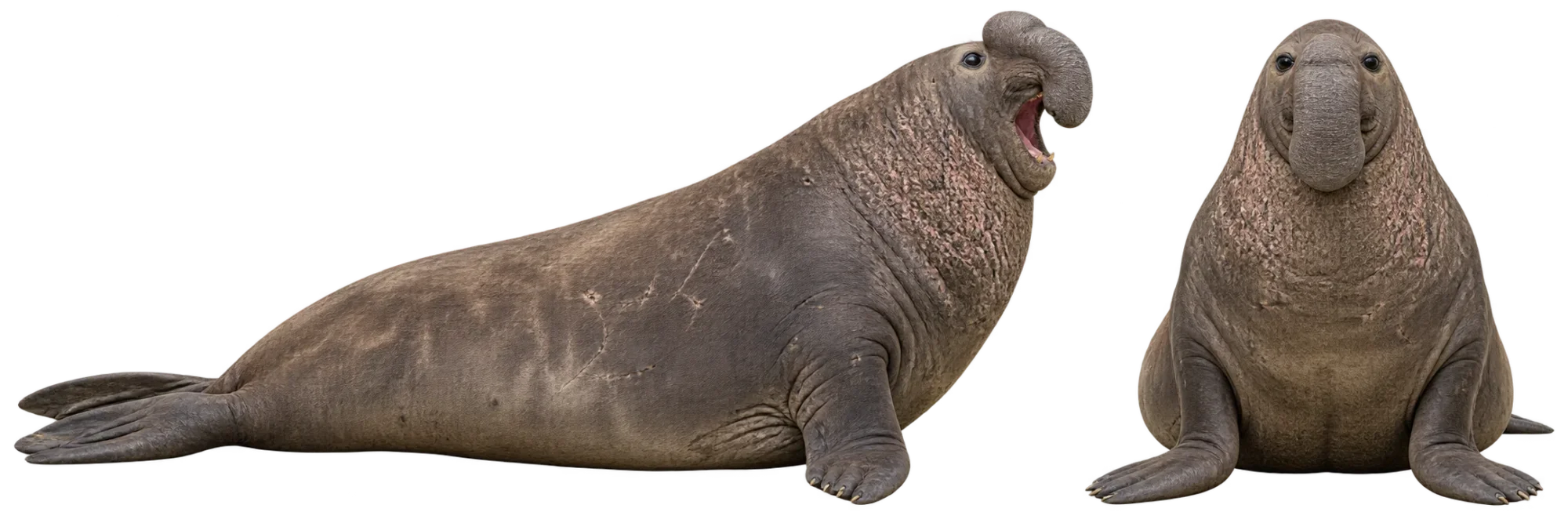
The southern elephant seal (Mirounga leonina) concentrates much of its reproductive effort into brief periods ashore. A female gives birth, nurses one pup while fasting, mates near the end of lactation, and then leaves the colony to rebuild the reserves needed for the next stages of her annual cycle. Males follow a very different path: physiological maturity comes years before most have the size needed to compete successfully for mates.
A Short Lactation Transfers a Large Share of Maternal Reserves
Southern elephant seals are capital breeders. A female arrives at the breeding colony carrying the energy that will support both her own metabolism and milk production. She does not normally leave to feed during lactation.
The nursing period is unusually compressed. Studies of southern elephant seals commonly place lactation at about 23 to 24 days. During those few weeks, the pup grows rapidly while the mother becomes progressively lighter. Work at Macquarie Island found that females can lose roughly a third of their body mass during lactation.
The speed of pup growth helps explain why maternal condition matters beyond the nursing period. Australian Antarctic observations report pups of roughly 40 kg at birth and an average near 120 kg by weaning, although individual masses vary widely. The stored energy transferred by the mother becomes the young seal’s reserve after milk suddenly disappears from its diet.
Weaning is followed by a period ashore during which the pup lives on those reserves before beginning independent life at sea. Long-term work at Macquarie Island has linked higher weaning mass with better first-year survival. Maternal foraging success before breeding can therefore affect a pup months later, after direct maternal care has ended.
Delayed Implantation Sets the Timing of the Female Annual Cycle
Mating usually occurs when the current pup is close to weaning. Fertilization can follow, but development does not proceed immediately into an implanted pregnancy. Southern elephant seals undergo embryonic diapause, or delayed implantation.
The blastocyst remains unattached for about four and a half months. Implantation occurs toward the end of the female’s summer moult. This delay separates mating from active pregnancy and fits reproduction around two demanding periods when females must remain ashore and fast.
This schedule makes successful reproduction dependent on more than conception. A female must repeatedly restore the reserves consumed by lactation, fasting and moulting while also supporting pregnancy. Poor recovery at sea can reduce the chance that she completes another reproductive attempt.
Female Reproduction Commonly Begins Around Four Years of Age
Female southern elephant seals can reproduce while they are still growing. Long-term records from Macquarie Island show that some first breed at three years old, but four years was the mean age of first reproduction in the studied population.
In an 18-year dataset of more than 6,600 marked females, about 10% first entered the breeding population at age three and about 34% did so at age four. More than 60% of females that eventually bred had begun by age four. These figures describe that monitored population rather than a fixed timetable followed by every southern elephant seal.
Starting reproduction carries a measurable cost. First-time breeders in the Macquarie study had lower survival than females of the same age that had not yet bred. The penalty was especially clear among females breeding at only three years old.
Body growth helps explain the pressure on young mothers. Female growth can continue to about six years of age, so an early breeder may be allocating stored energy to her own development while also funding pregnancy and an intense fasting lactation. Age at sexual maturity therefore does not mark the end of physical development.
Male Breeding Access Comes Years After Biological Maturity
The male life history separates the ability to reproduce from the ability to secure mating opportunities. Males become physiologically mature at roughly six to seven years, yet many are still too small to challenge established adult bulls successfully.
Growth after maturity has a direct reproductive payoff. Large males are better able to win contests, hold positions around groups of females and prevent rivals from gaining access. Successful breeding therefore becomes much more likely only after several additional years of growth, with breeding performance often concentrated around the later single-digit and early teenage years.
The difference between the sexes develops gradually. Juvenile males and females are much closer in size than fully grown adults. As males mature, selection for body size produces the extreme adult dimorphism associated with the species.
Long-term demographic work at Macquarie Island also found different survival patterns once males reached older age classes. Juvenile survival was fairly similar between the sexes, but male survival became lower through later development and dropped sharply after about eight years in the studied cohorts. Few males reach the age and size at which control of a large breeding group becomes possible.
Adult Females May Skip a Breeding Season
A mature female should not be assumed to produce a pup every year. Long-running studies at Marion Island and Macquarie Island have documented females that skip breeding opportunities, particularly when their condition is less favorable.
That pattern fits the energetic limits of capital breeding. Producing and nursing a pup draws heavily on reserves, while the female must also survive the following foraging trip, moult and pregnancy. Attempting another reproductive cycle without enough stored energy can carry a greater cost than delaying reproduction.
Modelling based on southern elephant seal life histories has found that selective breeding gaps can support greater longevity and lifetime reproductive output than uninterrupted annual reproduction. In the wild, the decision is expressed through the animal’s condition and previous foraging success rather than a fixed interval between pups.
 Harbor sealPhoca vitulina