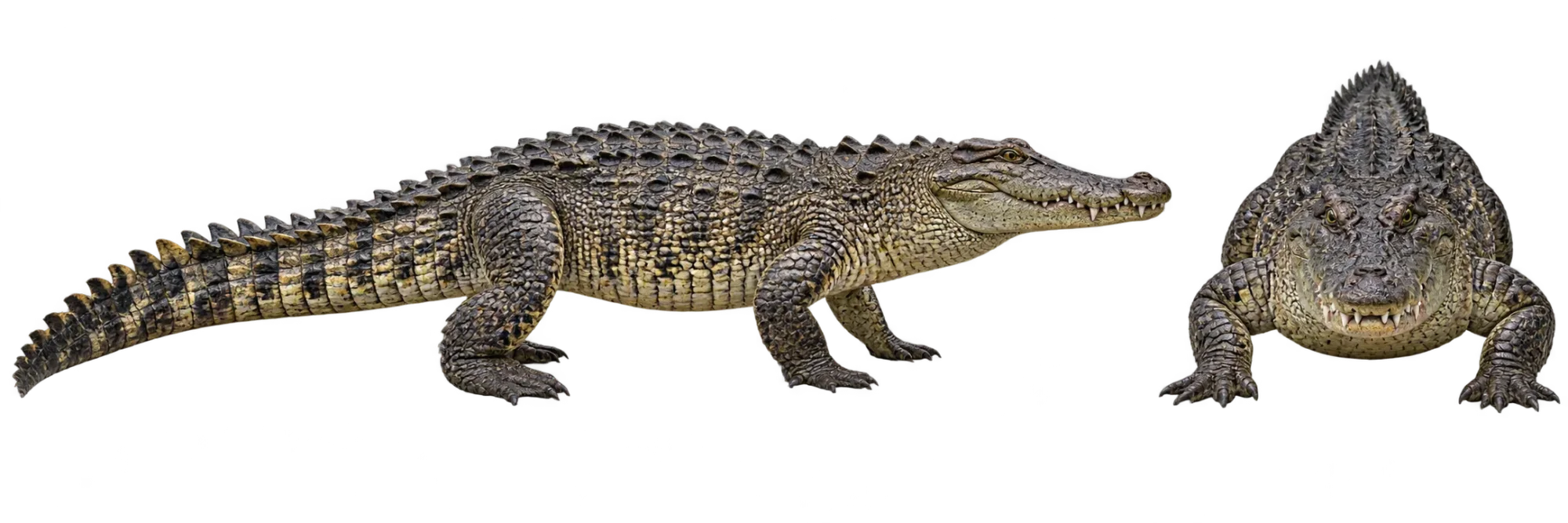
A saltwater crocodile begins life at only about 70 g, yet the path to breeding size takes well over a decade in the wild. That gap between a small hatchling and a long-lived, multi-metre adult shapes the life history of Crocodylus porosus: heavy losses occur early, reproduction is tied to wet-season nesting conditions, and the animals that survive the juvenile years may remain in the population for decades.
Breeding Begins After Years of Growth
Sexual maturity in saltwater crocodiles is closely linked with body size as well as age. In wild populations of northern Australia, females normally mature at about 2.3 m and roughly 12 years old. Males mature later, at around 3.3 m and about 16 years. Farmed crocodiles can grow faster and mature earlier, which shows why age alone is not a fixed biological threshold.
The difference between the sexes continues through adult life. Males have a much longer growth trajectory and can reach far greater body sizes than females. Reaching sexual maturity also does not mean that every adult female breeds every year. Suitable nesting locations are limited in some areas, and competition among females can prevent sexually mature animals from nesting during a given season.
This produces a long reproductive delay compared with the rapid early growth seen under controlled farming conditions. In the wild, an individual must survive many seasonal changes and social pressures before it can contribute offspring to the next generation.
Wet-Season Nesting Creates an Early-Life Bottleneck
Despite the common name “saltwater crocodile,” breeding is strongly associated with freshwater or low-salinity environments. Females usually construct mound nests during the tropical wet season, using grasses, leaf litter and soil close to freshwater swamps, billabongs or other suitable wetlands.
Northern Territory records place the main nesting period between about November and May. A clutch commonly contains around 50 eggs, although clutch size varies among females and populations.
The wet season provides the conditions needed for nesting, but it also creates one of the greatest risks to the embryos. Rising water can flood nests before development is complete. Northern Territory research has estimated average egg mortality around 75% in the wild, with large differences from one year to another.
Nest Location Matters
A nest that remains above floodwater can produce many hatchlings, while a similar clutch in a lower site may be lost almost completely. Reproductive success can therefore vary sharply even before the young leave the nest.
Females commonly remain near the nest and may defend it. This parental investment protects the clutch from some threats, but it cannot prevent losses caused by unsuitable nest conditions or severe flooding.
Nest Temperature Shapes Development Before Hatching
Saltwater crocodile eggs usually require several months of incubation. Northern Australian records show that incubation length can range from roughly 71 to 114 days, with warmer viable temperatures generally producing faster development than cooler ones.
Temperature also influences the sex of the developing young. Saltwater crocodiles have temperature-dependent sex determination rather than a simple chromosome system that fixes sex at fertilization. Research indicates that temperature has its strongest effect during a sensitive part of embryonic development several weeks after the eggs are laid.
The pattern is not simply “warmer means male” or “warmer means female.” Temperatures near the middle of the viable range can favor males, while cooler conditions and the warmer end of the viable range favor females. Natural nests also fluctuate through the day and across the incubation period, so real nest conditions are more complex than a constant laboratory temperature.
This makes the nest itself part of the reproductive process. Vegetation, moisture, shade, rainfall and nest position can influence the thermal environment experienced by the developing clutch.
Only a Small Fraction of Each Clutch Reaches Adulthood
Producing dozens of eggs does not translate into dozens of future adults. Current Northern Territory management material still draws on long-term wild-population studies showing how sharply numbers can fall during the first stages of life.
Those estimates suggest that roughly 30% of eggs may hatch under wild conditions and that only a fraction of hatchlings survive their first year. When survival through the following juvenile years is included, an illustrative estimate gives only about six five-year-old crocodiles for every 1,000 eggs originally laid.
These figures are population estimates rather than fixed survival rates for every nest or river system. Flooding, seasonal conditions, local crocodile density, predation and access to suitable juvenile habitat can all change the outcome.
The life-history pattern changes for individuals that pass through these vulnerable early stages. Saltwater crocodiles can live for more than 70 years, although a maximum longevity record should not be treated as the normal lifespan of every wild animal. Mature-adult survival is harder to measure directly, but long-term population studies show that older crocodiles can persist for many years once they have reached the larger size classes.
The result is a population built from many eggs, few eventual breeders and adults capable of reproducing across a long portion of their lives.
 Nile crocodileCrocodylus niloticus