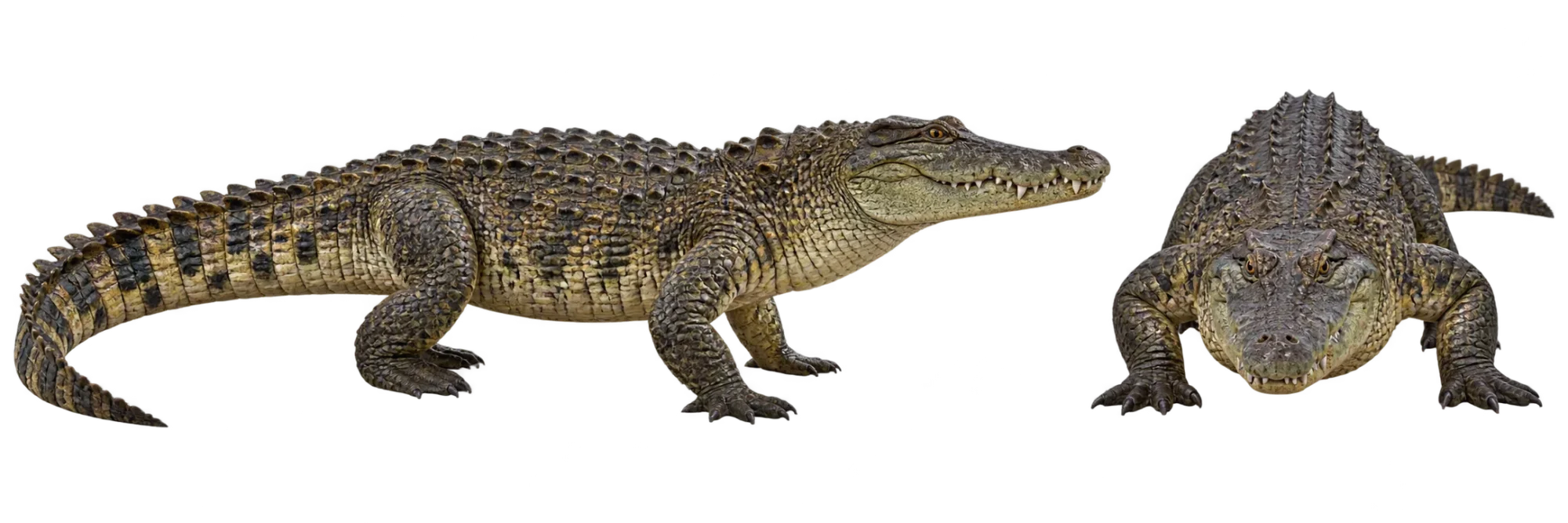
Nile crocodile reproduction is a months-long process shaped by growth, seasonal conditions, nest temperature and unusually active maternal care. The timing is not identical across Africa, and even sexually mature females do not necessarily produce a clutch every year.
Maturity Depends Strongly on Growth
For Crocodylus niloticus, body size can be more informative than a single age for describing reproductive maturity. A Zimbabwe study found females becoming sexually mature at about 262–287 cm total length, while males matured at roughly 270–295 cm. Research from other populations has recorded reproductive females at smaller sizes, including about 230 cm in the Okavango Delta.
This variation matters because wild crocodiles do not all grow at the same rate. Water temperature, food availability, body condition and local environmental conditions can alter how quickly an individual reaches reproductive size. Studies of slow-growing populations have therefore produced much later age estimates than figures reported from faster-growing crocodiles.
Male biological maturity also does not guarantee immediate breeding success. In the Okavango Delta, sperm production was detected in a male below two metres in total length, but smaller mature males may still have difficulty competing with larger males during the breeding season.
Female reproduction carries another layer of variation: mature females may skip breeding seasons. Work in Zimbabwe documented adult females that did not reproduce every year, while an Okavango study found only about 60% of adult females reproductively active in a given year. Annual egg production should therefore not be assumed for every mature female.
Breeding Timing Changes Across Populations
Nile crocodiles have a seasonal reproductive cycle, but there is no single breeding calendar that fits the species across its entire range.
In Zimbabwe, one detailed study recorded courtship and mating from late June into mid-August, followed by ovulation in the latter half of August. Females nested from early September into early October, and the eggs hatched during December.
Farther south at Lake St Lucia in South Africa, egg laying has been recorded mainly during November and December, with hatchlings emerging from January through March. These regional schedules show why month-based breeding data need geographic context.
Local conditions can also influence which females reproduce. Along the Olifants River in Kruger National Park, rainfall was associated with changes in the size of nesting females; during a dry year, only larger females were recorded nesting. Reproduction is therefore connected not only to adulthood, but also to the conditions experienced during a particular season.
Nesting Reshapes a Female’s Activity for Months
After laying a buried clutch, a female may remain closely associated with the nesting area through most of incubation. Telemetry at Lake St Lucia showed how strongly this period can restrict normal movement.
Nesting females in that study used an average home range of about 0.85 hectares, compared with more than 100 hectares recorded for non-nesting females during the nesting season. Their average daily movement was about 213 metres while nesting and rose to more than two kilometres after the nesting period.
The same research recorded high nest fidelity, including one female that remained almost continuously associated with her nesting area over a 96-day period. Guarding does not mean remaining directly on top of the eggs. During warm daylight hours, females may watch from nearby shade or water and approach when a threat appears.
Egg loss can still be substantial. In a four-year camera-trap study at Lake St Lucia, predators raided 37% of 19 monitored nests. Water monitors and marsh mongooses were the main egg predators observed. Females repeatedly returned after raids and defended nests against non-human intruders, showing that guarding is an active part of reproductive investment rather than simple nest attendance.
Nest Temperature Shapes Development and Sex
Nile crocodile embryos develop inside eggs buried in soil or sand, and their thermal environment affects both the length of incubation and the sex of the hatchlings.
Controlled experiments in Zimbabwe found incubation lasting about 110 days at 28°C but about 85 days at 34°C. Warmer conditions within the tested range accelerated development. Wild nests are more complicated because temperatures rise and fall through the day and can differ between eggs at different depths.
The species has temperature-dependent sex determination. Early experiments produced only females at 31°C and below, with males appearing at intermediate warmer temperatures. Later work has shown that the pattern is better described as female–male–female: lower and higher incubation temperatures tend to produce females, while an intermediate thermal range produces more males.
For example, laboratory work on Okavango Nile crocodiles produced females at 30.0°C, 30.5°C and 34.0°C, while temperatures from about 31.5°C to 33.0°C produced mostly males. Exact transition temperatures can differ among clutches and populations.
Wild Nests Are Thermally Uneven
Temperature measurements from natural nests have shown that shallow eggs can become warmer than deeper eggs and may experience large daily fluctuations. A constant incubator temperature is therefore useful for experiments, but it does not reproduce the full thermal pattern experienced by embryos in the ground.
Hatching Calls Coordinate the Mother’s Response
Near the end of incubation, Nile crocodile embryos begin calling from inside their eggs. These vocalizations help coordinate a stage of maternal care that continues beyond guarding the buried clutch.
A study published in 2025 tested how mothers respond to recorded hatching calls. Females excavated nests when the calls were played at a nearly continuous rate, supporting the idea that call intensity helps indicate that many embryos are ready to emerge rather than only one or two eggs approaching hatching.
Calls Increase
Mature embryos vocalize from inside the eggs as hatching approaches.
The Nest Opens
The attending female digs into the nest and exposes the eggs and emerging young.
Young Reach Water
Hatchlings can be collected gently in the mother’s mouth and transported to a nearby aquatic nursery area.
Field observations show that this transport can involve repeated trips rather than one movement. In one documented Lake St Lucia sequence, a female made 13 excursions between the nest and water over about 32.5 hours while releasing and moving hatchlings.
Maternal protection can continue after the young enter the water, but the hatchlings are not fed by the mother. They begin capturing small prey themselves while remaining vulnerable to many predators.
Early Survival Contrasts With a Long Adult Life
The large clutch and extensive nest care do not translate into high survival for every offspring. Eggs can be lost before hatching, and mortality remains high among small crocodiles after they enter the water. This concentration of mortality in the earliest life stages helps explain why producing many eggs and guarding them can coexist with a slow, long-lived adult life history.
Growth after hatching is highly dependent on environmental conditions. Research on young Nile crocodiles in the Okavango Delta found that growth rate was closely related to the amount of time animals experienced warmer-than-average water. As crocodiles become older and larger, growth generally slows, and differences between individuals accumulate.
Once a Nile crocodile survives the vulnerable juvenile period, its potential life is measured in decades. The AnAge longevity database records a wild-born female that lived for more than 56 years in captivity, along with several other individuals exceeding 50 years. That figure is a documented longevity record, not an estimate of the normal lifespan of every wild Nile crocodile.
 Saltwater crocodileCrocodylus porosus