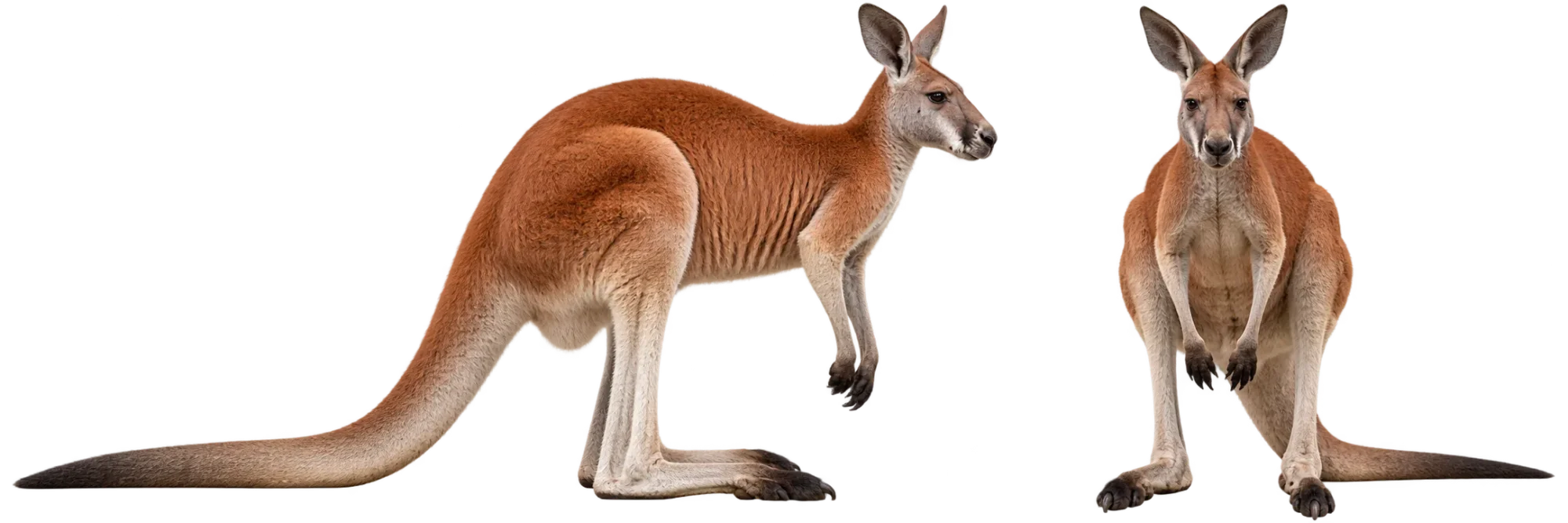
A female red kangaroo can support three offspring stages at the same time: an older young-at-foot, a pouch young, and a dormant blastocyst waiting to resume development. This overlap shapes the life history of Osphranter rufus, called Macropus rufus in much of the older research. A very short pregnancy is followed by months of pouch development, prolonged lactation, and a vulnerable transition to independent feeding.
How Red Kangaroos Keep the Next Birth in Reserve
Red kangaroos can reproduce throughout the year when food conditions allow. Pregnancy lasts only about 33 days, but the timing of the next offspring is controlled by what is happening with the young already dependent on the mother.
A female may mate again only a day or two after giving birth. The resulting embryo develops to the blastocyst stage and can then stop developing while the existing pouch young continues to suckle. This suspended stage is known as embryonic diapause.
The pause can end as the older pouch young becomes less dependent on continuous suckling, usually around the period when it begins making short trips outside the pouch. Development can also resume if the pouch young is lost. The reproductive cycle is therefore able to retain a ready next pregnancy without requiring the mother to raise two tiny pouch young at the same stage.
This arrangement can produce a striking overlap: one young may already be following the mother and still drinking milk, another may be developing inside the pouch, and a third may exist as a dormant blastocyst.
The Joey’s Main Growth Phase Runs Through the Pouch
Birth occurs very early in development. A newborn red kangaroo weighs roughly 0.75 grams and is only a few centimetres long. Its hindquarters and many external structures are still poorly developed, while the forelimbs, mouth, tongue, and nostrils are developed enough for the newborn to make the journey to the pouch and attach to a teat.
The pouch therefore covers much more than simple transport or protection. It contains a large part of the developmental period that placental mammals would complete before or soon after birth. By the time the young becomes permanently terrestrial, its movement, temperature regulation, grazing behaviour, and digestive demands have changed greatly.
Different Mammary Glands Can Serve Different-Aged Young
The mother’s investment does not end when a joey leaves the pouch. A young-at-foot may continue putting its head into the pouch to drink from the same teat it used earlier, even while a younger sibling is developing on another teat.
Red kangaroo mammary glands can function independently enough for the mother to produce different milk for young at different developmental stages at the same time. One gland may serve a small pouch young while another supplies an older young-at-foot.
Milk also changes as an individual joey develops. Studies following red kangaroo lactation through roughly the first year have found changes in milk solids, fat, carbohydrate, and individual proteins. A marked transition occurs near the time the joey starts leaving the pouch and eating vegetation, at around 200 days of age.
Why the long lactation matters
The short gestation should not be read as a short period of maternal investment. Red kangaroo development shifts much of that investment into the pouch and mammary system, with milk support continuing for about a year.
Juvenile Survival Rises and Falls With Rainfall
Red kangaroo females may continue breeding across much of the year, yet the number of young that actually survive into the adult population can change sharply between seasons. In Australia’s arid interior, successful juvenile recruitment is closely tied to periods when rainfall produces enough young, nutritious vegetation.
The difficult stage comes around and after weaning. Juveniles are still growing rapidly and need a large amount of energy for their size. Their digestive system is also less able than that of an adult to compensate when available plants become coarse and fibrous.
Field and feeding studies show that young red kangaroos depend heavily on easily digested forage such as fresh grasses and other green growth. When food quality falls, juveniles have less room to increase gut capacity or slow digestion enough to extract the energy they need. Growth can stop and body mass can fall even while adults remain able to maintain themselves on the same poorer-quality food.
This helps explain why rainfall affects red kangaroo populations through more than the number of pregnancies. Good seasons create the green forage that recently weaned animals need to complete their fastest growth. During drought, mortality can concentrate around the young-at-foot and juvenile stages, so females may reproduce without producing a matching rise in the number of animals that reach adulthood.
 Eastern gray kangarooMacropus giganteus