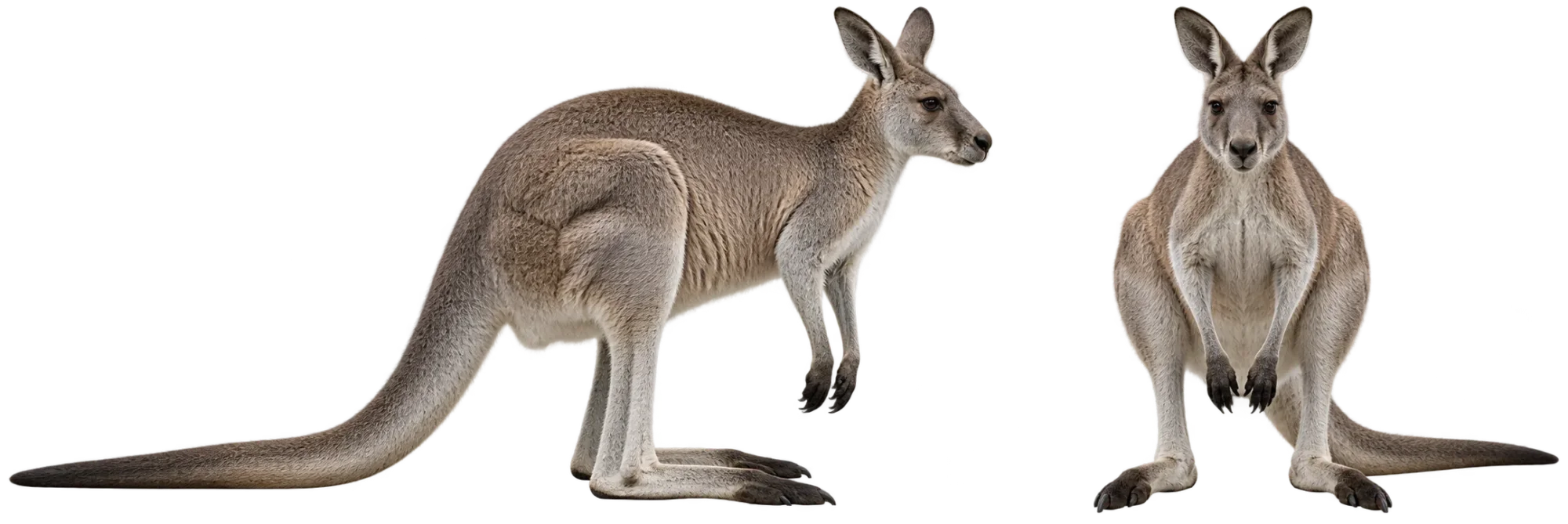
The eastern grey kangaroo, Macropus giganteus, has a short pregnancy followed by an unusually long period of postnatal development. A newborn reaches the pouch after only about five weeks of gestation, yet maternal care continues well beyond the point when the young kangaroo first begins moving outside. This long dependence shapes how often females can raise young, when young females begin reproducing, and which stages of life are most sensitive to changing conditions.
Most Development Happens After the 36-Day Pregnancy
Pregnancy lasts about 36 days. The newborn is extremely undeveloped and weighs less than one gram. Its forelimbs are developed enough for it to climb from the birth canal to the pouch without being carried there by its mother. Once attached to a teat, much of the growth that would occur before birth in a placental mammal instead takes place during lactation.
The distinction between pouch exit and weaning matters when interpreting life-history data. A joey seen feeding independently beside its mother may still be receiving milk and may remain closely associated with her for months.
A Long Nursing Period Usually Fits Into an Annual Reproductive Rhythm
Eastern grey kangaroos can give birth during different parts of the year, although births commonly concentrate around the warmer months. Long-term observations in southeastern Australia have found most births between roughly November and May. Across the species’ wider range, older field studies also recorded births in every month with a clear summer peak.
Adult females commonly make about one reproductive attempt per year. That pace makes more biological sense when the whole maternal schedule is considered rather than gestation alone. A pregnancy lasting little more than a month is followed by many months with a pouch young and then an extended young-at-foot stage.
Quiescent blastocysts have been recorded in eastern grey kangaroos, especially in females already nursing advanced pouch young. However, field work indicates that this paused embryonic stage is not present in every reproductive cycle. Describing the species as if every female routinely maintains a dormant embryo would overstate its role.
Environmental conditions can also alter the timing and outcome of reproduction. The species therefore has a recognizable seasonal concentration of births without being restricted to a narrow breeding season across its entire range.
Physiological Maturity Can Precede the First Successful Reproduction
Classic field studies have placed sexual maturity for eastern grey kangaroos broadly within the second and third years of life. Long-term monitoring of known-age females adds an important distinction: being physiologically capable of reproduction does not mean that a female immediately raises her first young.
In a closely monitored wild population at Wilsons Promontory, females typically first reproduced at three or four years of age. Thirteen years of data showed that females entering adulthood at larger size and in better body condition tended to reproduce earlier and had greater reproductive output during ages three to five.
Females that grew poorly early in life could continue catching up in body size later. Research from the same population found that this growth catch-up was associated with reduced reproduction during early adulthood and could remain linked with lower reproductive output later. Growth and reproduction are therefore competing demands across more than just the juvenile stage.
Survival Becomes Much More Stable After the Juvenile Stage
Long-term capture and resighting data show that eastern grey kangaroo survival changes strongly with age. Juvenile survival can differ sharply between years, while animals that make it through the early stages generally enter a period of much steadier adult survival.
A study following 920 eastern grey kangaroos found high survival through the prime adult years despite large changes in forage availability and population density. Survival became more variable again among older animals. This pattern helps explain why a recorded maximum age cannot be treated as the normal lifespan of every individual: the probability of reaching old age depends on surviving several life stages with very different mortality patterns.
Adult males and females also follow somewhat different trajectories. Prime-aged and older pre-senescent males had lower survival than females in the same age classes. At the same time, continued male growth has reproductive value. Studies of wild and semi-free-ranging eastern grey kangaroos have found that larger males tend to hold higher dominance positions and often achieve greater mating success.
High rank does not give a male exclusive access to reproduction. Genetic parentage work in a wild population found that dominant, large-bodied males obtained more reproductive opportunities, while lower-ranking males still sired some young. The adult male life history therefore combines continued growth, competition for rank and unequal—but not completely monopolized—reproductive success.
 Red kangarooMacropus rufus